@article{six2015multimodal,
      author      = {Joren Six and Marc Leman},
      title       = {{Synchronizing Multimodal Recordings Using Audio-To-Audio Alignment}},
      issn        = {1783-7677},
      volume      = {9},
      number      = {3},
      pages       = {223-229},
      doi         = {10.1007/s12193-015-0196-1},
      journal     = {{Journal of Multimodal User Interfaces}},
      publisher   = {Springer Berlin Heidelberg},
      year        = 2015
 }
- [2015.synchronized-recording.pdf](https://0110.be/files/attachments/434/2015.synchronized-recording.pdf)
- [SyncDataset.zip](https://0110.be/files/attachments/434/SyncDataset.zip)
- [SyncSink-1.4.jar](https://0110.be/files/attachments/434/SyncSink-1.4.jar)
---
## [SINGmaster Android App uses TarsosDSP](https://0110.be/posts/SINGmaster_Android_App_uses_TarsosDSP.md)
- Published: 2015-04-24T00:00:00Z
- Updated: 2015-07-10T12:09:11Z
- Author: Joren
- ID: 431
- Canonical: https://0110.be/posts/SINGmaster_Android_App_uses_TarsosDSP
- Tags: [Code](https://0110.be/tags/Code.md), [Java](https://0110.be/tags/Java.md), [Muziek](https://0110.be/tags/Muziek.md), [TarsosDSP](https://0110.be/tags/TarsosDSP.md), [UGent](https://0110.be/tags/UGent.md)
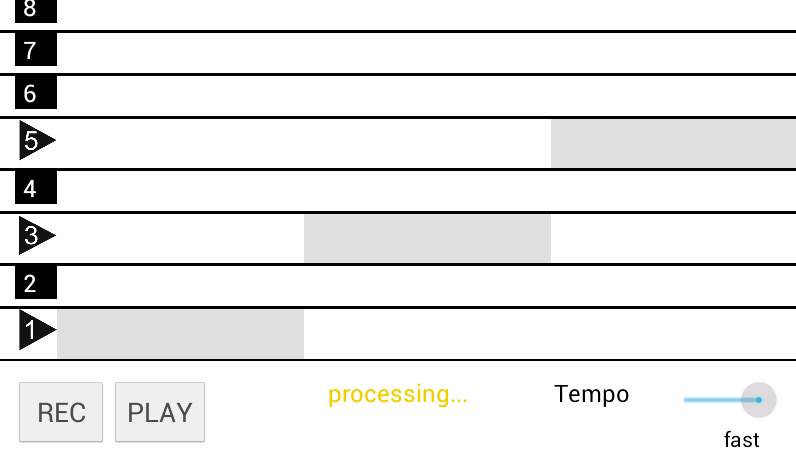
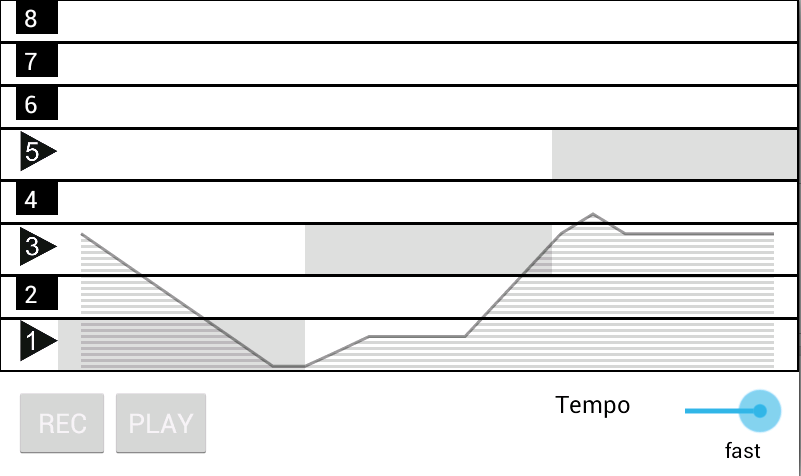
 TarsosDSP is a real-time audio processing library written in Java. Since version 2.0 it is compatible with Android. Judging by the number of forks of the [TarsosDSP GitHub repository](https://github.com/JorenSix/TarsosDSP) Android compatibility increased the popularity of the library. Now the first Android application which uses TarsosDSP has found its way to the Google Play store. Download and play with [SINGmaster](https://play.google.com/store/apps/details?id=bg.singmaster.gui) to see an application of the pitch tracking capabilities within TarsosDSP. The SINGmaster description:
> *"SING master is a smart phone app that helps you to learn how to sing. SING master presents a collection of practical exercises (on the most important building blocks of melodies). Colours and sounds guide you in the exercise. After recording, SING master gives visual feedback : you can see and hear your voice. This is important so that you can identify where your mistakes are."*
Another application in the Play Store that uses TarsosDSP is [CuePitcher](https://play.google.com/store/apps/details?id=io.github.mindosoft.cuepitcher).
- [singmaster\_logo.png](https://0110.be/files/attachments/431/singmaster_logo.png)
---
## [TarsosLSH in a Photomosaic Web App](https://0110.be/posts/TarsosLSH_in_a_Photomosaic_Web_App.md)
- Published: 2015-01-07T00:00:00Z
- Updated: 2015-01-07T08:52:18Z
- Author: Joren
- ID: 428
- Canonical: https://0110.be/posts/TarsosLSH_in_a_Photomosaic_Web_App
- Tags: [0110.be](https://0110.be/tags/0110.be.md), [Code](https://0110.be/tags/Code.md), [HoGent](https://0110.be/tags/HoGent.md), [Java](https://0110.be/tags/Java.md), [UGent](https://0110.be/tags/UGent.md)
TarsosLSH is a Java library implementing Locality-sensitive Hashing (LSH), a practical nearest neighbor search algorithm for high dimensional vectors that operates in sublinear time. The open source software package is authored by me and is available on GitHub: [TarsosLSH on GitHub](https://github.com/JorenSix/TarsosLSH).
With TarsosLSH, Joseph Hwang and Nicholas Kwon from Rice University created an [Image Mosaic web application](http://image-mosaic.appspot.com/). The application chops an uploaded photo into small blocks. For each block, a color histogram is created and compared with an index of color histograms of reference images. Subsequently each block is replaced with one of the top three nearest neighbors, creating a mosaic. Since high dimensional nearest neighbor search is needed, this is an ideal application for TarsosLSH. The application somewhat proves that TarsosLSH can be used in practical applications, which is comforting.


---
## [Constant-Q Transform in Java with TarsosDSP](https://0110.be/posts/Constant-Q_Transform_in_Java_with_TarsosDSP.md)
- Published: 2013-10-09T00:00:00Z
- Updated: 2020-11-17T09:01:43Z
- Author: Joren
- ID: 363
- Canonical: https://0110.be/posts/Constant-Q_Transform_in_Java_with_TarsosDSP
- Tags: [Code](https://0110.be/tags/Code.md), [Computational musicology](https://0110.be/tags/Computational%20musicology.md), [HoGent](https://0110.be/tags/HoGent.md), [Java](https://0110.be/tags/Java.md), [Music Information Retrieval](https://0110.be/tags/Music%20Information%20Retrieval.md), [TarsosDSP](https://0110.be/tags/TarsosDSP.md)
The DSP library for Taros, aptly named TarsosDSP, now includes an implementation of a *Constant-Q Transform* (as of version 1.6). The Constant-Q transform does essentially the same thing as an FFT, but has the advantage that each octave has the same amount of bins. This makes the Constant-Q transform practical for applications processing music. If, for example, 12 bins per octave are chosen, these can correspond with the western musical scale.
Also included in the newest release (version 1.7) is a way to visualize the transform, or other musical features. The visualization implementation is done together with Thomas Stubbe.
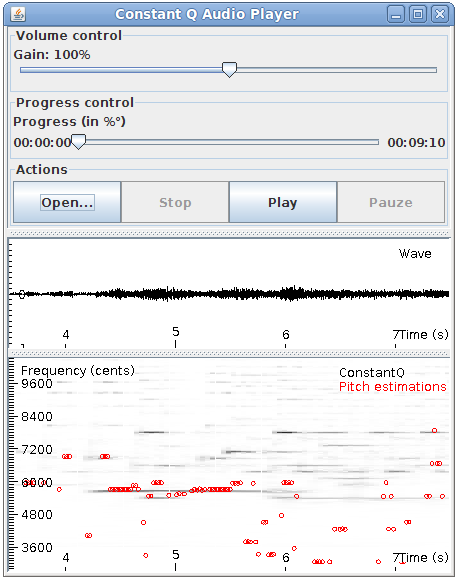
The example application below shows the Constant-Q transform with an overlay of pitch estimations. The corresponding waveform is also shown.
TarsosDSP is a real-time audio processing library written in Java. Since version 2.0 it is compatible with Android. Judging by the number of forks of the [TarsosDSP GitHub repository](https://github.com/JorenSix/TarsosDSP) Android compatibility increased the popularity of the library. Now the first Android application which uses TarsosDSP has found its way to the Google Play store. Download and play with [SINGmaster](https://play.google.com/store/apps/details?id=bg.singmaster.gui) to see an application of the pitch tracking capabilities within TarsosDSP. The SINGmaster description:
> *"SING master is a smart phone app that helps you to learn how to sing. SING master presents a collection of practical exercises (on the most important building blocks of melodies). Colours and sounds guide you in the exercise. After recording, SING master gives visual feedback : you can see and hear your voice. This is important so that you can identify where your mistakes are."*
Another application in the Play Store that uses TarsosDSP is [CuePitcher](https://play.google.com/store/apps/details?id=io.github.mindosoft.cuepitcher).


- [singmaster\_logo.png](https://0110.be/files/attachments/431/singmaster_logo.png)
---
## [TarsosLSH in a Photomosaic Web App](https://0110.be/posts/TarsosLSH_in_a_Photomosaic_Web_App.md)
- Published: 2015-01-07T00:00:00Z
- Updated: 2015-01-07T08:52:18Z
- Author: Joren
- ID: 428
- Canonical: https://0110.be/posts/TarsosLSH_in_a_Photomosaic_Web_App
- Tags: [0110.be](https://0110.be/tags/0110.be.md), [Code](https://0110.be/tags/Code.md), [HoGent](https://0110.be/tags/HoGent.md), [Java](https://0110.be/tags/Java.md), [UGent](https://0110.be/tags/UGent.md)
TarsosLSH is a Java library implementing Locality-sensitive Hashing (LSH), a practical nearest neighbor search algorithm for high dimensional vectors that operates in sublinear time. The open source software package is authored by me and is available on GitHub: [TarsosLSH on GitHub](https://github.com/JorenSix/TarsosLSH).
With TarsosLSH, Joseph Hwang and Nicholas Kwon from Rice University created an [Image Mosaic web application](http://image-mosaic.appspot.com/). The application chops an uploaded photo into small blocks. For each block, a color histogram is created and compared with an index of color histograms of reference images. Subsequently each block is replaced with one of the top three nearest neighbors, creating a mosaic. Since high dimensional nearest neighbor search is needed, this is an ideal application for TarsosLSH. The application somewhat proves that TarsosLSH can be used in practical applications, which is comforting.


---
## [Constant-Q Transform in Java with TarsosDSP](https://0110.be/posts/Constant-Q_Transform_in_Java_with_TarsosDSP.md)
- Published: 2013-10-09T00:00:00Z
- Updated: 2020-11-17T09:01:43Z
- Author: Joren
- ID: 363
- Canonical: https://0110.be/posts/Constant-Q_Transform_in_Java_with_TarsosDSP
- Tags: [Code](https://0110.be/tags/Code.md), [Computational musicology](https://0110.be/tags/Computational%20musicology.md), [HoGent](https://0110.be/tags/HoGent.md), [Java](https://0110.be/tags/Java.md), [Music Information Retrieval](https://0110.be/tags/Music%20Information%20Retrieval.md), [TarsosDSP](https://0110.be/tags/TarsosDSP.md)
The DSP library for Taros, aptly named TarsosDSP, now includes an implementation of a *Constant-Q Transform* (as of version 1.6). The Constant-Q transform does essentially the same thing as an FFT, but has the advantage that each octave has the same amount of bins. This makes the Constant-Q transform practical for applications processing music. If, for example, 12 bins per octave are chosen, these can correspond with the western musical scale.
Also included in the newest release (version 1.7) is a way to visualize the transform, or other musical features. The visualization implementation is done together with Thomas Stubbe.
The example application below shows the Constant-Q transform with an overlay of pitch estimations. The corresponding waveform is also shown.
 The journal paper *Tarsos, a Modular Platform for Precise Pitch Analysis of Western and Non-Western Music* by Six, Cornelis, and Leman was published in a special issue about Computational Ethnomusicology of [the Journal of New Music Research (JNMR)](http://www.tandfonline.com/toc/nnmr20/current) on the 20th of august 2013. Below you can find the abstract for the article, and pointers to audio examples, the Tarsos software, and the author version of the article itself.
> **Abstract:** This paper presents Tarsos, a modular software platform used to extract and analyze pitch organization in music. With Tarsos pitch estimations are generated from an audio signal and those estimations are processed in order to form musicologically meaningful representations. Tarsos aims to offer a flexible system for pitch analysis through the combination of an interactive user interface, several pitch estimation algorithms, filtering options, immediate auditory feedback and data output modalities for every step. To study the most frequently used pitches, a fine-grained histogram that allows up to 1200 values per octave is constructed. This allows Tarsos to analyze deviations in Western music, or to analyze specific tone scales that differ from the 12 tone equal temperament, common in many non-Western musics. Tarsos has a graphical user interface or can be launched using an API - as a batch script. Therefore, it is fit for both the analysis of individual songs and the analysis of large music corpora. The interface allows several visual representations, and can indicate the scale of the piece under analysis. The extracted scale can be used immediately to tune a MIDI keyboard that can be played in the discovered scale. These features make Tarsos an interesting tool that can be used for musicological analysis, teaching and even artistic productions.
To read the full text you can either download "Tarsos, a Modular Platform for Precise Pitch Analysis of Western and Non-Western Music, Author version":\[2013.08.20.tarsos_jnmr_author_version.pdf\]. Or obtain the published version of [Tarsos, a Modular Platform for Precise Pitch Analysis of Western and Non-Western Music, published version](http://www.tandfonline.com/doi/full/10.1080/09298215.2013.797999)
Ladrang Kandamanyura (slendro pathet manyura), is the name of the piece used in the article throughout section 2. The album on which the piece can be found is available at [wergo](http://www.wergo.de/shop/en_UK/Audio_CDs/1000088/show,223736,n.html). Below a thirty second fragment is embedded. You can also "download":\[08.\_Ladrang_Kandamanyura_10s-20s_up.wav\] the thirty second fragment to analyse it yourself.
Below the BibTex entry for the article is embedded.
\`\`\`ruby\
\@article{six2013tarsos_jnmr,\
author = {Six, Joren and Cornelis, Olmo and Leman, Marc},\
title = {Tarsos, a Modular Platform for Precise Pitch Analysis\
of Western and Non-Western Music},\
journal = {Journal of New Music Research},\
volume = {42},\
number = {2},\
pages = {113-129},\
year = {2013},\
doi = {10.1080/09298215.2013.797999},\
URL = {http://www.tandfonline.com/doi/abs/10.1080/09298215.2013.797999}\
}\
\`\`\`
- [jnmr.cover.jpg](https://0110.be/files/attachments/331/jnmr.cover.jpg)
- [08.\_Ladrang\_Kandamanyura\_10s-20s\_up.wav](https://0110.be/files/attachments/331/08._Ladrang_Kandamanyura_10s-20s_up.wav)
- [2013.08.20.tarsos\_jnmr\_author\_version.pdf](https://0110.be/files/attachments/331/2013.08.20.tarsos_jnmr_author_version.pdf)
---
## [FMA 2013 - Computer Assisted Transcripton of Ethnic Music](https://0110.be/posts/FMA_2013_-_Computer_Assisted_Transcripton_of_Ethnic_Music.md)
- Published: 2013-06-14T00:00:00Z
- Updated: 2014-02-25T09:22:13Z
- Author: Joren
- ID: 377
- Canonical: https://0110.be/posts/FMA_2013_-_Computer_Assisted_Transcripton_of_Ethnic_Music
- Tags: [Computational ethnomusicology](https://0110.be/tags/Computational%20ethnomusicology.md), [Computational musicology](https://0110.be/tags/Computational%20musicology.md), [Folk Music Analysis (FMA) conference](https://0110.be/tags/Folk%20Music%20Analysis%20%28FMA%29%20conference.md), [HoGent](https://0110.be/tags/HoGent.md), [Java](https://0110.be/tags/Java.md), [Research papers](https://0110.be/tags/Research%20papers.md), [Tarsos](https://0110.be/tags/Tarsos.md), [featured](https://0110.be/tags/featured.md)
At [the third international workshop on Folk Music Analysis (FMA2013)](http://www.elab-oralculture.nl/fma2013) we presented a poster titled "Computer Assisted Transcription of Ethnic Music":\[A0-Poster.png\]. The workshop took place in Amsterdam, Netherlands, June 6 and 7, 2013.
In the extended abstract, also titled "Computer Assisted Transcription of Ethnic Music":\[FMA_2013.computer_assisted_transcription.pdf\], it is described how the Tarsos software program now has features aiding transcription. Tarsos is especially practical for ethnic music of which the tone scale is not known beforehand. [The proceedings of FMA 2013](http://igitur-archive.library.uu.nl/math/2013-0604-200726/UUindex.html) are available as well.
The journal paper *Tarsos, a Modular Platform for Precise Pitch Analysis of Western and Non-Western Music* by Six, Cornelis, and Leman was published in a special issue about Computational Ethnomusicology of [the Journal of New Music Research (JNMR)](http://www.tandfonline.com/toc/nnmr20/current) on the 20th of august 2013. Below you can find the abstract for the article, and pointers to audio examples, the Tarsos software, and the author version of the article itself.
> **Abstract:** This paper presents Tarsos, a modular software platform used to extract and analyze pitch organization in music. With Tarsos pitch estimations are generated from an audio signal and those estimations are processed in order to form musicologically meaningful representations. Tarsos aims to offer a flexible system for pitch analysis through the combination of an interactive user interface, several pitch estimation algorithms, filtering options, immediate auditory feedback and data output modalities for every step. To study the most frequently used pitches, a fine-grained histogram that allows up to 1200 values per octave is constructed. This allows Tarsos to analyze deviations in Western music, or to analyze specific tone scales that differ from the 12 tone equal temperament, common in many non-Western musics. Tarsos has a graphical user interface or can be launched using an API - as a batch script. Therefore, it is fit for both the analysis of individual songs and the analysis of large music corpora. The interface allows several visual representations, and can indicate the scale of the piece under analysis. The extracted scale can be used immediately to tune a MIDI keyboard that can be played in the discovered scale. These features make Tarsos an interesting tool that can be used for musicological analysis, teaching and even artistic productions.
To read the full text you can either download "Tarsos, a Modular Platform for Precise Pitch Analysis of Western and Non-Western Music, Author version":\[2013.08.20.tarsos_jnmr_author_version.pdf\]. Or obtain the published version of [Tarsos, a Modular Platform for Precise Pitch Analysis of Western and Non-Western Music, published version](http://www.tandfonline.com/doi/full/10.1080/09298215.2013.797999)
Ladrang Kandamanyura (slendro pathet manyura), is the name of the piece used in the article throughout section 2. The album on which the piece can be found is available at [wergo](http://www.wergo.de/shop/en_UK/Audio_CDs/1000088/show,223736,n.html). Below a thirty second fragment is embedded. You can also "download":\[08.\_Ladrang_Kandamanyura_10s-20s_up.wav\] the thirty second fragment to analyse it yourself.
Below the BibTex entry for the article is embedded.
\`\`\`ruby\
\@article{six2013tarsos_jnmr,\
author = {Six, Joren and Cornelis, Olmo and Leman, Marc},\
title = {Tarsos, a Modular Platform for Precise Pitch Analysis\
of Western and Non-Western Music},\
journal = {Journal of New Music Research},\
volume = {42},\
number = {2},\
pages = {113-129},\
year = {2013},\
doi = {10.1080/09298215.2013.797999},\
URL = {http://www.tandfonline.com/doi/abs/10.1080/09298215.2013.797999}\
}\
\`\`\`
- [jnmr.cover.jpg](https://0110.be/files/attachments/331/jnmr.cover.jpg)
- [08.\_Ladrang\_Kandamanyura\_10s-20s\_up.wav](https://0110.be/files/attachments/331/08._Ladrang_Kandamanyura_10s-20s_up.wav)
- [2013.08.20.tarsos\_jnmr\_author\_version.pdf](https://0110.be/files/attachments/331/2013.08.20.tarsos_jnmr_author_version.pdf)
---
## [FMA 2013 - Computer Assisted Transcripton of Ethnic Music](https://0110.be/posts/FMA_2013_-_Computer_Assisted_Transcripton_of_Ethnic_Music.md)
- Published: 2013-06-14T00:00:00Z
- Updated: 2014-02-25T09:22:13Z
- Author: Joren
- ID: 377
- Canonical: https://0110.be/posts/FMA_2013_-_Computer_Assisted_Transcripton_of_Ethnic_Music
- Tags: [Computational ethnomusicology](https://0110.be/tags/Computational%20ethnomusicology.md), [Computational musicology](https://0110.be/tags/Computational%20musicology.md), [Folk Music Analysis (FMA) conference](https://0110.be/tags/Folk%20Music%20Analysis%20%28FMA%29%20conference.md), [HoGent](https://0110.be/tags/HoGent.md), [Java](https://0110.be/tags/Java.md), [Research papers](https://0110.be/tags/Research%20papers.md), [Tarsos](https://0110.be/tags/Tarsos.md), [featured](https://0110.be/tags/featured.md)
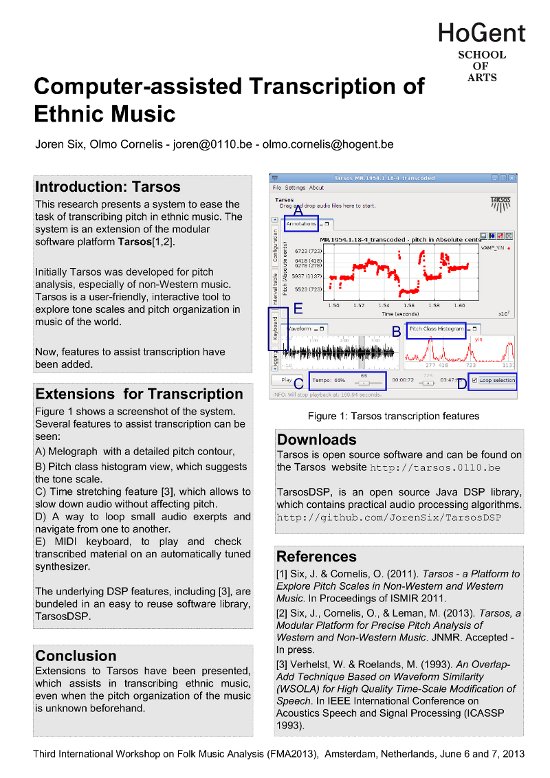
At [the third international workshop on Folk Music Analysis (FMA2013)](http://www.elab-oralculture.nl/fma2013) we presented a poster titled "Computer Assisted Transcription of Ethnic Music":\[A0-Poster.png\]. The workshop took place in Amsterdam, Netherlands, June 6 and 7, 2013.
In the extended abstract, also titled "Computer Assisted Transcription of Ethnic Music":\[FMA_2013.computer_assisted_transcription.pdf\], it is described how the Tarsos software program now has features aiding transcription. Tarsos is especially practical for ethnic music of which the tone scale is not known beforehand. [The proceedings of FMA 2013](http://igitur-archive.library.uu.nl/math/2013-0604-200726/UUindex.html) are available as well.
 ":\[A0-Poster.jpg\]
git clone https://JorenSix@github.com/JorenSix/TarsosLSH.git
    cd TarsosLSH/build
    ant  #Builds the core TarsosLSH library
    ant javadoc #build the API documentation
\
When everything runs correctly you should be able to run the command line application, and have the latest version of the TarsosLSH library for inclusion in your projects. Also, the Javadoc documentation for the API should be available in TarsosLSH/doc. Drop me a line if you use TarsosLSH in your project. Always nice to hear how this software is used.
The fastest way to get something on your screen is executing this on your command line: `java - jar TarsosLSH.jar` this lets LSH run on a random data set. The full reference of the command line application is included below:
Name
TarsosLSH: finds the nearest neighbours in a data set quickly, using LSH.
Synopsis
java - jar TarsosLSH.jar [options] dataset.txt queries.txt
Description
Tries to find nearest neighbours for each vector in the
query file, using Euclidean (L2) distance by default.
Both dataset.txt and queries.txt have a similar format:
an optional identifier for the vector and a list of N
coordinates (which should be doubles).
[Identifier] coord1 coord2 ... coordN
[Identifier] coord1 coord2 ... coordN
For an example data set with two elements and 4 dimensions:
Hans 12 24 18.5 -45.6
Jane 13 19 -12.0 49.8
Options are:
-f cos|l1|l2
Defines the hash family to use:
l1 City block hash family (L1)
l2 Euclidean hash family(L2)
cos Cosine distance hash family
-r radius
Defines the radius in which near neighbours should
be found. Should be a double. By default a reasonable
radius is determined automatically.
-h n_hashes
An integer that determines the number of hashes to
use. By default 4, 32 for the cosine hash family.
-t n_tables
An integer that determines the number of hash tables,
each with n_hashes, to use. By default 4.
-n n_neighbours
Number of neighbours in the neighbourhood, defaults to 3.
-b
Benchmark the settings.
--help
Prints this helpful message.
Examples
Search for nearest neighbours using the l2 hash family with a radius of 500
and utilizing 5 hash tables, each with 3 hashes.
java - jar TarsosLSH.jar -f l2 -r 500 -h 3 -t 5 dataset.txt queries.txt
### Source Code Organization
The source tree is divided in three directories:
- `src` contains the source files of the core DSP libraries.
- `test` contains unit tests for some of the DSP functionality.
- `build` contains ANT build files. Either to build Java documentation or runnable JAR-files for the example applications.
### Further Reading
This section includes a links to resources used to implement this library.
- The [LSH-page](http://www.mit.edu/~andoni/LSH/) maintained by Alexandr Andoni contains pointers to good resources:
- [Locality-Sensitive Hashing Scheme Based on p-Stable Distributions](http://theory.lcs.mit.edu/~indyk/nips-nn.ps) a chapter by Alexandr Andoni, Mayur Datar, Nicole Immorlica, Piotr Indyk, and Vahab Mirrokni which appeared in the book Nearest Neighbor Methods in Learning and Vision: Theory and Practice, by T. Darrell and P. Indyk and G. Shakhnarovich (eds.), MIT Press, 2006.
- [Similarity Search in High Dimensions via Hashing](http://theory.csail.mit.edu/~indyk/vldb99.ps) The original LSH Paper for hamming distance by Gionis, Aristides and Indyk, Piotr and Motwani, Rajeev.
- [Locality-Sensitive Hashing for Finding Nearest Neighbors](http://www.slaney.org/malcolm/yahoo/Slaney2008-LSHTutorial.pdf) a good introduction of LSH by Malcom Slaney & Michael Casey
- [Finding Similar Items](http://i.stanford.edu/~ullman/mmds/ch3.pdf), Chapter Three of "Mining of Massive Datasets" by Anand Rajaraman and Jeff Ullman is a textbook introducing the LSH concept.
- [Szudzik pairing functions](http://szudzik.com/ElegantPairing.pdf) by Matthew Szudzik. Explains how integer hashes can be combined deterministically to form a reversible, unique new hash.
---
## [Flanger Audio Effect in Java](https://0110.be/posts/Flanger_Audio_Effect_in_Java.md)
- Published: 2013-02-04T14:41:06Z
- Updated: 2013-12-05T18:19:15Z
- Author: Joren
- ID: 338
- Canonical: https://0110.be/posts/Flanger_Audio_Effect_in_Java
- Tags: [HoGent](https://0110.be/tags/HoGent.md), [Java](https://0110.be/tags/Java.md), [TarsosDSP](https://0110.be/tags/TarsosDSP.md)
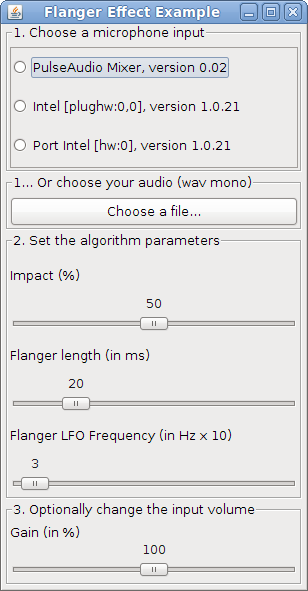
The DSP library for Taros, aptly named TarsosDSP, now includes an example demonstrating the [flanging audio effect](http://en.wikipedia.org/wiki/Flanging). Flanging, essentialy mixing the signal with a varying delay of itself, produces an interesting interference pattern.
\
java -jar Catify-latest.jar in.mid\
_______ _____ _____ _____
|__ __| | __ \ / ____| __ \
| | __ _ _ __ ___ ___ ___| | | | (___ | |__) |
| |/ _` | '__/ __|/ _ \/ __| | | |\___ \| ___/
| | (_| | | \__ \ (_) \__ \ |__| |____) | |
|_|\__,_|_| |___/\___/|___/_____/|_____/|_|
----------------------------------------------------
Name:
TarsosDSP catify'er
----------------------------------------------------
Synopsis:
java -jar Catify-latest.jar input.mid
----------------------------------------------------
Description:
The source code of the Java implementation of the catify'er can be found on the [TarsosDSP github page](https://github.com/JorenSix/TarsosDSP).
---
## [TarsosDSP Pitch Estimation Synthesizer](https://0110.be/posts/TarsosDSP_Pitch_Estimation_Synthesizer.md)
- Published: 2012-12-19T15:07:10Z
- Updated: 2013-12-05T18:19:15Z
- Author: Joren
- ID: 359
- Canonical: https://0110.be/posts/TarsosDSP_Pitch_Estimation_Synthesizer
- Tags: [HoGent](https://0110.be/tags/HoGent.md), [Java](https://0110.be/tags/Java.md), [TarsosDSP](https://0110.be/tags/TarsosDSP.md)
The DSP library for Taros, aptly named TarsosDSP, now includes an example showing how to synthesize pitch estimations. The goal of the example is to show which errors are made by different pitch detectors.

\
java -jar Resynthesizer-latest.jar in.wav\
_______ _____ _____ _____
|__ __| | __ \ / ____| __ \
| | __ _ _ __ ___ ___ ___| | | | (___ | |__) |
| |/ _` | '__/ __|/ _ \/ __| | | |\___ \| ___/
| | (_| | | \__ \ (_) \__ \ |__| |____) | |
|_|\__,_|_| |___/\___/|___/_____/|_____/|_|
----------------------------------------------------
Name:
TarsosDSP resynthesizer
----------------------------------------------------
Synopsis:
java -jar CommandLineResynthesizer.jar [--detector DETECTOR] [--output out.wav] [--combined combined.wav] input.wav
----------------------------------------------------
Description:
Extracts pitch and loudnes from audio and resynthesises the audio with that information.
The result is either played back our written in an output file.
There is als an option to combine source and synthezized material
in the left and right channels of a stereo audio file.
input.wav a readable wav file.
--output out.wav a writable file.
--combined combined.wav a writable output file. One channel original, other synthesized.
--detector DETECTOR defaults to FFT_YIN or one of these:
YIN
MPM
FFT_YIN
DYNAMIC_WAVELET
AMDF
The source code of the Java implementation of the synthesizer can be found on the [TarsosDSP github page](https://github.com/JorenSix/TarsosDSP).
- [Pitch\_Estimation\_Synthesizer.png](https://0110.be/files/attachments/359/Pitch_Estimation_Synthesizer.png)
- [flute.wav](https://0110.be/files/attachments/359/flute.wav)
---
## [Tarsos 1.0: Transcription Features](https://0110.be/posts/Tarsos_1.0%3A_Transcription_Features.md)
- Published: 2012-12-05T00:00:00Z
- Updated: 2020-11-17T09:00:24Z
- Author: Joren
- ID: 335
- Canonical: https://0110.be/posts/Tarsos_1.0%3A_Transcription_Features
- Tags: [Computational ethnomusicology](https://0110.be/tags/Computational%20ethnomusicology.md), [Computational musicology](https://0110.be/tags/Computational%20musicology.md), [HoGent](https://0110.be/tags/HoGent.md), [Java](https://0110.be/tags/Java.md), [Music Information Retrieval](https://0110.be/tags/Music%20Information%20Retrieval.md), [Tarsos](https://0110.be/tags/Tarsos.md), [WSOLA](https://0110.be/tags/WSOLA.md), [featured](https://0110.be/tags/featured.md)
Today marks the reslease of Tarsos 1.0 . The new Tarsos release contains practical transcription features. As can be seen in the screenshot below, a time stretching feature makes it easy to loop a certain audio fragment while it is playing in a slow tempo. The next loop can be played with by pressing the `n` key, the one before by pressing `b`.
Since the pitch classes can be found in a song, and there is a feature that lets you play a `MIDI` keyboard in the tone scale of the song under analysis, transcription of ethnic music is made a lot easier.
The new release of Tarsos can be found in the [Tarsos release repository](http://0110.be/releases/Tarsos/). From now on, nightly releases are uploaded there automatically.
---
## [Pitch Shifting - Implementation in Pure Java with Resampling and Time Stretching](https://0110.be/posts/Pitch_Shifting_-_Implementation_in_Pure_Java_with_Resampling_and_Time_Stretching.md)
- Published: 2012-11-05T00:00:00Z
- Updated: 2020-11-17T09:07:53Z
- Author: Joren
- ID: 370
- Canonical: https://0110.be/posts/Pitch_Shifting_-_Implementation_in_Pure_Java_with_Resampling_and_Time_Stretching
- Tags: [Code](https://0110.be/tags/Code.md), [Command Line Application](https://0110.be/tags/Command%20Line%20Application.md), [HoGent](https://0110.be/tags/HoGent.md), [Java](https://0110.be/tags/Java.md), [TarsosDSP](https://0110.be/tags/TarsosDSP.md), [WSOLA](https://0110.be/tags/WSOLA.md), [featured](https://0110.be/tags/featured.md)
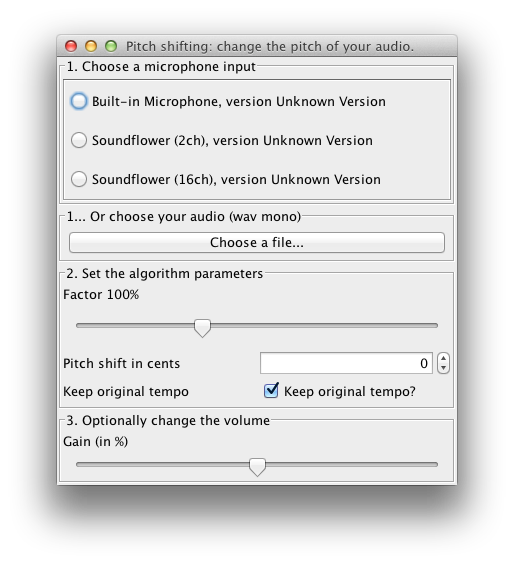
The DSP library for Taros, aptly named TarsosDSP, now includes an implementation of a *pitch shifting algorithm* (as of version 1.4). The goal of pitch shifting is to change the pitch of a piece of audio without affecting the duration. The algorithm implemented is a combination of resampling and time stretching. Resampling changes the pitch of the audio, but affects the total duration. Consecutively, the duration of the audio is stretched to the original (without affecting pitch) with time stretching. The result is very similar to [phase vocoding](http://en.wikipedia.org/wiki/Phase_vocoder).
The example application below shows how to pitch shift input from the microphone in real-time, or pitch shift a recorded track with the TarsosDSP library.
 At this years ICMC Conference, [ICMC 2012](http://www.icmc2012.si/) we presented a paper describing a way to experiment with tone scales and how to use Tarsos as a compositional tool. What follows are some pointers to the presentation, paper and to other interesting talks that were presented there.
ICMC 2012 was organized in Ljubljana from the 9 to 14 septembre and had a very dense program of talks, posters, presentations, demos and concerts.
At this years ICMC Conference, [ICMC 2012](http://www.icmc2012.si/) we presented a paper describing a way to experiment with tone scales and how to use Tarsos as a compositional tool. What follows are some pointers to the presentation, paper and to other interesting talks that were presented there.
ICMC 2012 was organized in Ljubljana from the 9 to 14 septembre and had a very dense program of talks, posters, presentations, demos and concerts.
Since 1974 the International Computer Music Conference has been the major international forum for the presentation of the full range of outcomes from technical and musical research, both musical and theoretical, related to the use of computers in music. This annual conference regularly travels the globe, with recent conferences in the Americas, Europe and Asia. This year we welcome the conference to Slovenia for the first time.### Sound to Scale to Sound, a Setup for Microtonal Exploration and Composition Our contribution to the conference was a paper titled "Sound to Scale to Sound, a Setup for Microtonal Exploration and Composition":\[icmc2012_submission_45.pdf\]. If you want to cite our work, this BibTeX entry is included for your convenience: \`\`\`ruby\ \@inproceedings{cornelis2012sound_to_scale,\ author = {Olmo Cornelis and Joren Six},\ title = {{Sound to Scale to Sound, a Setup for Microtonal Exploration and Composition}},\ booktitle = {{Proceedings of the 2012 International Computer Music Conference,\ (ICMC 2012)}},\ year = {2012},\ publisher = {The International Computer Music Association}\ }\ \`\`\` ### Program highlights What follows are a number of pointers to my personal program highlights. Verena Thomas presented two very well polished software tools. One to detect patterns in scores, called motifviewer and a tool to search in score databases in a multi-modal way. The [Probado tool](http://probado.iai.uni-bonn.de:8080/) does score-to-audio alignment and much more. [Gibber](http://www.charlie-roberts.com/gibber/) is an impressive live-coding environment with an easy syntax. Since it is all done with javascript you can start playing with it immediately. [Overtone](http://overtone.github.com/) Another live-coding environment, presented at the conference by Sam Aaron, was equally impressive. It is programmed using the Closure language. At ICMC there were a number of tools to assist in composition. One of those is [The Bach Project](http://www.bachproject.net/bach/home_page.html), by Andrea Agostini. Togheter with CatART by Diemo Swartz it forms a very expressive platform to work with sound, which was demonstrated by Aaron Einbond and Christopher Trapani in their paper titled *Precise Pitch Control In Real Time Corpus-Based Concatenative Synthesis*. Diemo Swartz presented work on Audio Mosaicing, it can be seen as a follow-up to [AuidioGuild](http://crca.ucsd.edu/~ben/audioGuide/) by Ben Hackbarth. I also got to know the work by [Thomas Grill](http://grrrr.org), on his website a nice piece of software can be found a Python implementation of the [Non Stationary Gabor Transform (NSGT)](http://grrrr.org/research/software/nsgt/). Another software system I got to know is the functional signal processing programming language [FAUST](http://en.wikipedia.org/wiki/FAUST_(programming_language)) My personal highlights of the concert programme include the works by Johannes Kreidler, Aura Pon, Daniel Mayer, Alexander Schubert and the remarkable performance by Dexter Ford. The concept behind Soundlog by Johannes Kretz was also interesting. - [ICMC\_Logo.png](https://0110.be/files/attachments/369/ICMC_Logo.png) - [2012.09.08-Sound\_to\_Scale\_to\_Sound\_\_a\_Setup\_for\_Microtonal\_Exploration\_and\_Composition.odp](https://0110.be/files/attachments/369/2012.09.08-Sound_to_Scale_to_Sound__a_Setup_for_Microtonal_Exploration_and_Composition.odp) - [icmc2012\_submission\_45.pdf](https://0110.be/files/attachments/369/icmc2012_submission_45.pdf) --- ## [TarsosDSP Release 1.0](https://0110.be/posts/TarsosDSP_Release_1.0.md) - Published: 2012-04-24T14:25:32Z - Updated: 2013-12-05T18:19:15Z - Author: Joren - ID: 352 - Canonical: https://0110.be/posts/TarsosDSP_Release_1.0 - Tags: [Code](https://0110.be/tags/Code.md), [Command Line Application](https://0110.be/tags/Command%20Line%20Application.md), [HoGent](https://0110.be/tags/HoGent.md), [Java](https://0110.be/tags/Java.md), [Music Information Retrieval](https://0110.be/tags/Music%20Information%20Retrieval.md), [TarsosDSP](https://0110.be/tags/TarsosDSP.md), [WSOLA](https://0110.be/tags/WSOLA.md), [featured](https://0110.be/tags/featured.md) After about a year of development and several revisions TarsosDSP has enough features and is stable enough to slap the 1.0 tag onto it. A 'read me', manual, API documentation, source and binaries can be found on the [TarsosDSP release directory](http://tarsos.0110.be/releases/TarsosDSP/). The source is present in the\ What follows below is the information that can be found in the read me file:
TarsosDSP is a collection of classes to do simple audio processing. It features an implementation of a percussion onset detector and two pitch detection algorithms: Yin and the Mcleod Pitch method. Also included is a Goertzel DTMF decoding algorithm and a time stretch algorithm (WSOLA).
Its aim is to provide a simple interface to some audio (signal) processing algorithms implemented in pure JAVA. Some TarsosDSP example applications are available.
The following example filters a band of frequencies of an input file testFile. It keeps the frequencies form startFrequency to stopFrequency.
AudioInputStream inputStream = AudioSystem.getAudioInputStream(testFile);
    AudioDispatcher dispatcher = new AudioDispatcher(inputStream,stepSize,overlap);
    dispatcher.addAudioProcessor(new HighPass(startFrequency, sampleRate, overlap));
    dispatcher.addAudioProcessor(new LowPassFS(stopFrequency, sampleRate, overlap));
    dispatcher.addAudioProcessor(new FloatConverter(format));
    dispatcher.addAudioProcessor(new WaveformWriter(format,stepSize, overlap, "filtered.wav"));
    dispatcher.run();
Head over to the TarsosDSP release repository and download the latest TarsosDSP library. To get up to speed quickly, check the TarsosDSP Example applications for inspiration and consult the API documentation. If you, for some reason, want to build from source, you need Apache Ant and git installed on your system. The following commands fetch the source and build the library and example jars:
git clone https://JorenSix@github.com/JorenSix/TarsosDSP.git
    cd TarsosDSP/build
    ant tarsos_dsp_library #Builds the core TarsosDSP library
    ant build_examples #Builds all the TarsosDSP examples
    ant javadoc #Creates the documentation in TarsosDSP/doc
\
When everything runs correctly you should be able to run all example applications and have the latest version of the TarsosDSP library for inclusion in your projects. Also the Javadoc documentation for the API should be available in TarsosDSP/doc. Drop me a line if you use TarsosDSP in your project. Always nice to hear how this software is used.
The source tree is divided in three directories:
src contains the source files of the core DSP libraries.
test contains unit tests for some of the DSP functionality.
build contains ANT build files. Either to build Java documentation or runnable JAR-files for the example applications.
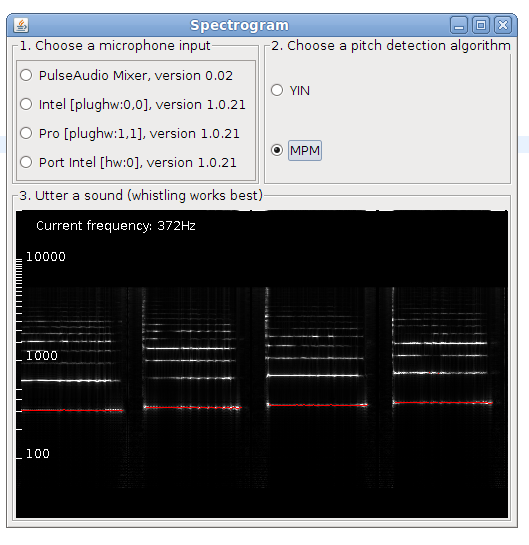
examples contains a couple of example applications with a Java Swing user interface:
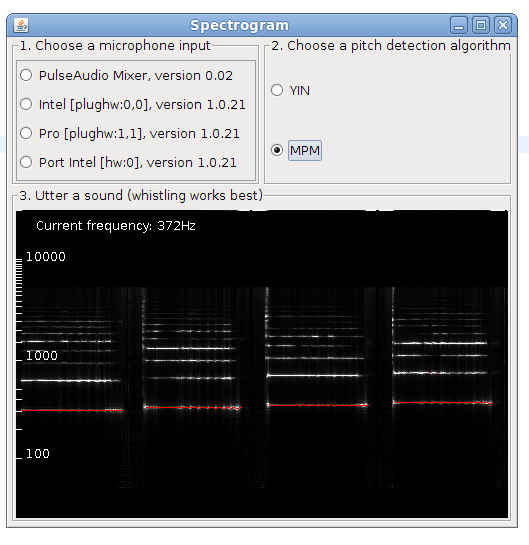
\
java -jar Spectrogram.jar in.wav\
The source code of the Java implementation can be found on the [TarsosDSP github page](https://github.com/JorenSix/TarsosDSP/).
- [Spectrogram.jar](https://0110.be/files/attachments/384/Spectrogram.jar)
- [spectrogram.png](https://0110.be/files/attachments/384/spectrogram.png)
---
## [Audio Time Stretching - Implementation in Pure Java Using WSOLA](https://0110.be/posts/Audio_Time_Stretching_-_Implementation_in_Pure_Java_Using_WSOLA.md)
- Published: 2012-02-06T14:52:34Z
- Updated: 2013-12-05T18:19:15Z
- Author: Joren
- ID: 372
- Canonical: https://0110.be/posts/Audio_Time_Stretching_-_Implementation_in_Pure_Java_Using_WSOLA
- Tags: [HoGent](https://0110.be/tags/HoGent.md), [Java](https://0110.be/tags/Java.md), [Tarsos](https://0110.be/tags/Tarsos.md), [TarsosDSP](https://0110.be/tags/TarsosDSP.md), [WSOLA](https://0110.be/tags/WSOLA.md)
The DSP library for Taros, aptly named TarsosDSP, now includes an implementation of a time stretching algorithm. The goal of time stretching is to change the duration of a piece of audio without affecting the pitch. The algorithm implemented is described in [An Overlap-add Technique Based On Waveform Similarity (WSOLA) for High Quality Time-Scale Modification of Speech](http://citeseerx.ist.psu.edu/viewdoc/download?doi=10.1.1.202.5460&rep=rep1&type=pdf).

\
java -jar TimeStretch.jar in.wav out.wav 2.0\
_______ _____ _____ _____
|__ __| | __ \ / ____| __ \
| | __ _ _ __ ___ ___ ___| | | | (___ | |__) |
| |/ _` | '__/ __|/ _ \/ __| | | |\___ \| ___/
| | (_| | | \__ \ (_) \__ \ |__| |____) | |
|_|\__,_|_| |___/\___/|___/_____/|_____/|_|
----------------------------------------------------
Name:
TarsosDSP Time stretch utility.
----------------------------------------------------
Synopsis:
java -jar TimeStretch.jar source.wav target.wav factor
----------------------------------------------------
Description:
Change the play back speed of audio without changing the pitch.
source.wav A readable, mono wav file.
target.wav Target location for the time stretched file.
factor Time stretching factor: 2.0 means double the length, 0.5 half. 1.0 is no change.
The source code of the Java implementation of WSOLA can be found on the [TarsosDSP github page](https://github.com/JorenSix/TarsosDSP/blob/master/src/be/hogent/tarsos/dsp/filters/WaveformSimilarityBasedOverlapAdd.java).
- [time\_stretching\_in\_java.png](https://0110.be/files/attachments/372/time_stretching_in_java.png)
- [08.\_Ladrang\_Kandamanyura\_10s-20s.wav](https://0110.be/files/attachments/372/08._Ladrang_Kandamanyura_10s-20s.wav)
- [TimeStretch.jar](https://0110.be/files/attachments/372/TimeStretch.jar)
---
## [Tarsos CLI: Detect Pitch](https://0110.be/posts/Tarsos_CLI%3A__Detect_Pitch.md)
- Published: 2012-02-03T15:00:06Z
- Updated: 2013-12-05T18:19:15Z
- Author: Joren
- ID: 390
- Canonical: https://0110.be/posts/Tarsos_CLI%3A__Detect_Pitch
- Tags: [Code](https://0110.be/tags/Code.md), [Command Line Application](https://0110.be/tags/Command%20Line%20Application.md), [HoGent](https://0110.be/tags/HoGent.md), [Java](https://0110.be/tags/Java.md), [Music Information Retrieval](https://0110.be/tags/Music%20Information%20Retrieval.md), [Tarsos](https://0110.be/tags/Tarsos.md)
 Tarsos contains a couple of useful command line applications. They can be used to execute common tasks on lots of files. [Dowload Tarsos](http://tarsos.0110.be/attachment/tarsos.jar) and call the applications using the following format:
`java -jar tarsos.jar command [argument...] [--option [value]...]`
The first part `java -jar tarsos.jar` tells the Java Runtime to start the correct application. The first argument for Tarsos defines the command line application to execute. Depending on the command, required arguments and options can follow.
`java -jar tarsos.jar detect_pitch in.wav --detector TARSOS_YIN`
To get a list of available commands, type `java -jar tarsos.jar -h`. If you want more information about a command type `java -jar tarsos.jar command -h`
## Detect Pitch
Detects pitch for one or more input audio files using a pitch detector. If a directory is given it traverses the directory *recursively*. It writes CSV data to standard out with five columns. The first is the start of the analyzed window (seconds), the second the estimated pitch, the third the saillence of the pitch. The name of the algorithm follows and the last column shows the original filename.
Synopsis
--------
java -jar tarsos.jar detect_pitch [option] input_file...
Option Description
------ -----------
-?, -h, --help Show help
--detector
Tarsos contains a couple of useful command line applications. They can be used to execute common tasks on lots of files. [Dowload Tarsos](http://tarsos.0110.be/attachment/tarsos.jar) and call the applications using the following format:
`java -jar tarsos.jar command [argument...] [--option [value]...]`
The first part `java -jar tarsos.jar` tells the Java Runtime to start the correct application. The first argument for Tarsos defines the command line application to execute. Depending on the command, required arguments and options can follow.
`java -jar tarsos.jar detect_pitch in.wav --detector TARSOS_YIN`
To get a list of available commands, type `java -jar tarsos.jar -h`. If you want more information about a command type `java -jar tarsos.jar command -h`
## Detect Pitch
Detects pitch for one or more input audio files using a pitch detector. If a directory is given it traverses the directory *recursively*. It writes CSV data to standard out with five columns. The first is the start of the analyzed window (seconds), the second the estimated pitch, the third the saillence of the pitch. The name of the algorithm follows and the last column shows the original filename.
Synopsis
--------
java -jar tarsos.jar detect_pitch [option] input_file...
Option Description
------ -----------
-?, -h, --help Show help
--detector  TarsosDSP, a small Java DSP library, has been used in a bachelor thesis: [Entwicklung eines Systems zur automatischen Notentranskription von monophonischem Audiomaterial](http://saeft.com/jAM/assets/Bachelorarbeit.pdf) by Michael Wager.
The goal of the thesis was to develop an automatic transcription system for monophonic music. You can download the latest version of [jAM - Java Automatic Music Transcription](http://saeft.com/jAM/index.php/index/download).
If you want to use TarsosDSP, please consult the [TarsosDSP page on github](https://github.com/JorenSix/TarsosDSP) or read [more about TarsosDSP](https://0110.be/tag/TarsosDSP) here.
---
## [Kinderuniversiteit - Muziek onder de microscoop!](https://0110.be/posts/Kinderuniversiteit_-_Muziek_onder_de_microscoop%21.md)
- Published: 2011-12-12T08:41:21Z
- Updated: 2013-12-05T18:19:15Z
- Author: Joren
- ID: 326
- Canonical: https://0110.be/posts/Kinderuniversiteit_-_Muziek_onder_de_microscoop%21
- Tags: [Dutch](https://0110.be/tags/Dutch.md), [HoGent](https://0110.be/tags/HoGent.md), [Java](https://0110.be/tags/Java.md), [Presentation](https://0110.be/tags/Presentation.md)
Zondag 18 december 2011 gaf ik een workshop voor de [Gentse kinderuniversiteit](http://kinderuniversiteit.be). Het thema van de kinderuniversiteit was [Muziek onder de microscoop](http://www.kinderuniversiteit.be/event/muziek-onder-de-microscoop). De teaser voor de workshop is hier te vinden:
TarsosDSP, a small Java DSP library, has been used in a bachelor thesis: [Entwicklung eines Systems zur automatischen Notentranskription von monophonischem Audiomaterial](http://saeft.com/jAM/assets/Bachelorarbeit.pdf) by Michael Wager.
The goal of the thesis was to develop an automatic transcription system for monophonic music. You can download the latest version of [jAM - Java Automatic Music Transcription](http://saeft.com/jAM/index.php/index/download).
If you want to use TarsosDSP, please consult the [TarsosDSP page on github](https://github.com/JorenSix/TarsosDSP) or read [more about TarsosDSP](https://0110.be/tag/TarsosDSP) here.
---
## [Kinderuniversiteit - Muziek onder de microscoop!](https://0110.be/posts/Kinderuniversiteit_-_Muziek_onder_de_microscoop%21.md)
- Published: 2011-12-12T08:41:21Z
- Updated: 2013-12-05T18:19:15Z
- Author: Joren
- ID: 326
- Canonical: https://0110.be/posts/Kinderuniversiteit_-_Muziek_onder_de_microscoop%21
- Tags: [Dutch](https://0110.be/tags/Dutch.md), [HoGent](https://0110.be/tags/HoGent.md), [Java](https://0110.be/tags/Java.md), [Presentation](https://0110.be/tags/Presentation.md)
Zondag 18 december 2011 gaf ik een workshop voor de [Gentse kinderuniversiteit](http://kinderuniversiteit.be). Het thema van de kinderuniversiteit was [Muziek onder de microscoop](http://www.kinderuniversiteit.be/event/muziek-onder-de-microscoop). De teaser voor de workshop is hier te vinden:
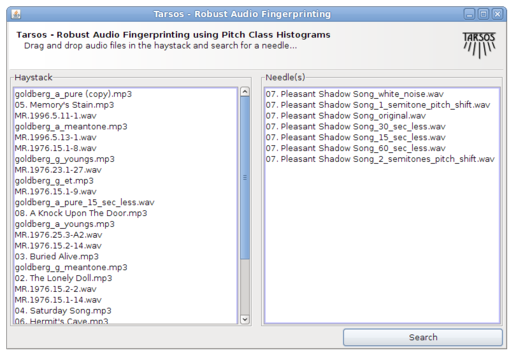
Concreet worden enkele componenten van geluid (en bij uitbreiding, muziek) gedemonstreerd met computerprogrammaatjes gemaakt in het conservatorium: - "Geluidssterkte":\[SoundDetector.jar\]: een decibel-meter met een bepaalde drempelwaarde. Probeer zo luid mogelijk te doen en zie hoe moeilijk het is om, eens een bepaald niveau bereikt is, in decibel te stijgen. - "Toonhoogte":\[UtterAsterisk.jar\]: een klein spelletje om toonhoogte aan te tonen. Probeer zo juist mogelijk te zingen of te fluiten en vergelijk je score. - "Percussie":\[PercussionDetector.jar\]: dit programma reageert op handgeklap. Hoe kan je het onderscheid maken tussen bijvoorbeeld een fluittoon en handgeklap? De foto's hieronder geven een sfeerbeeld. 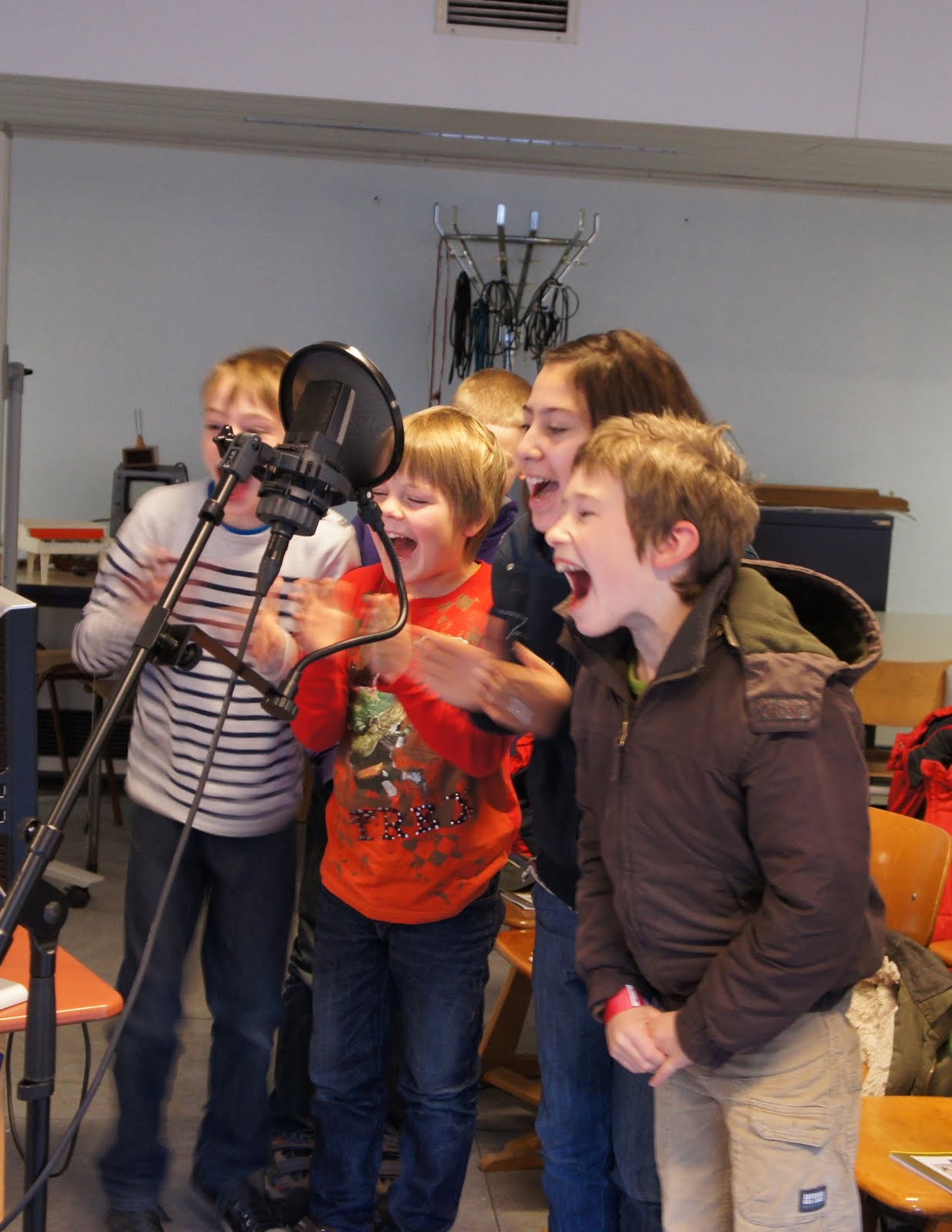  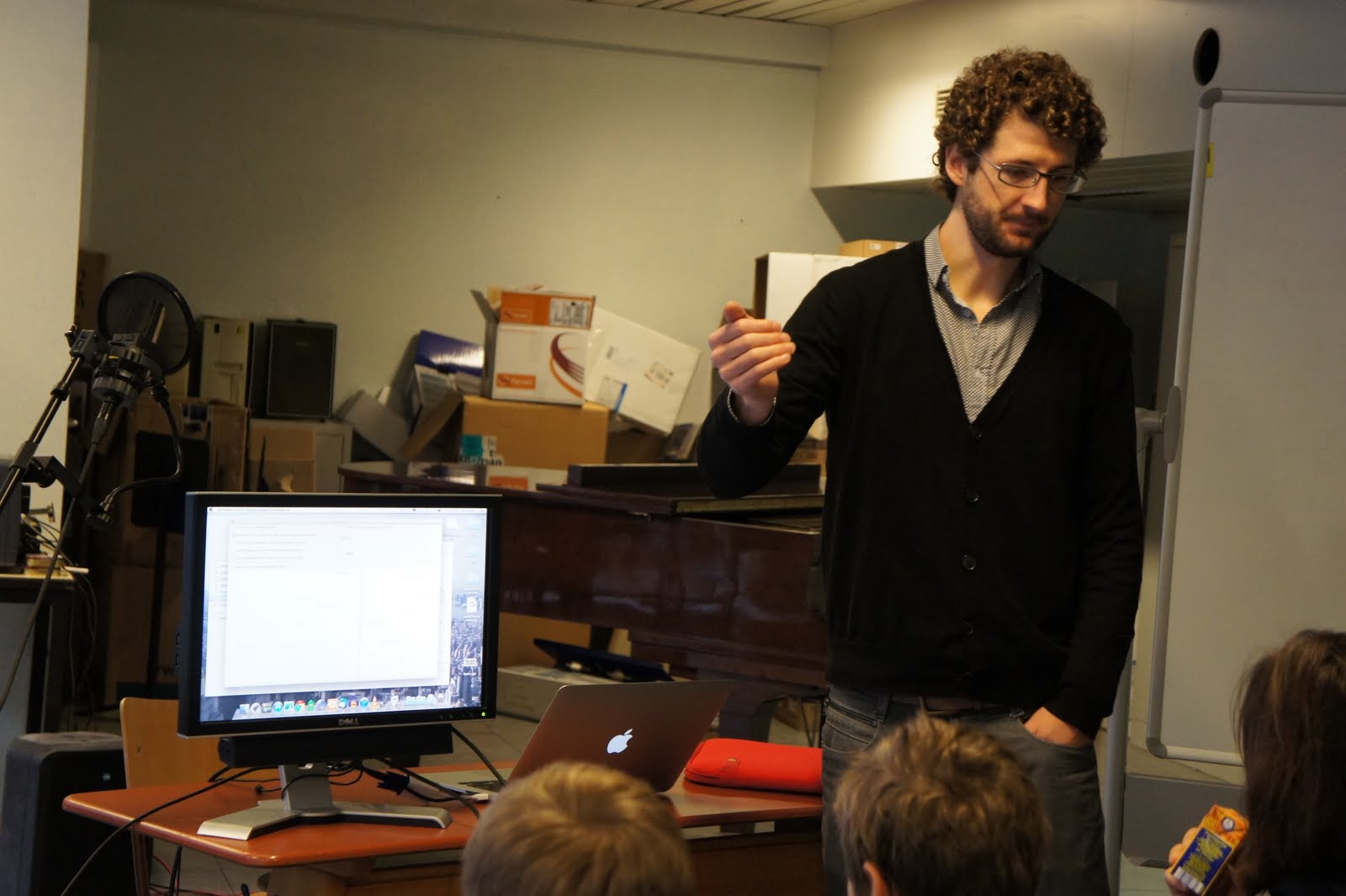 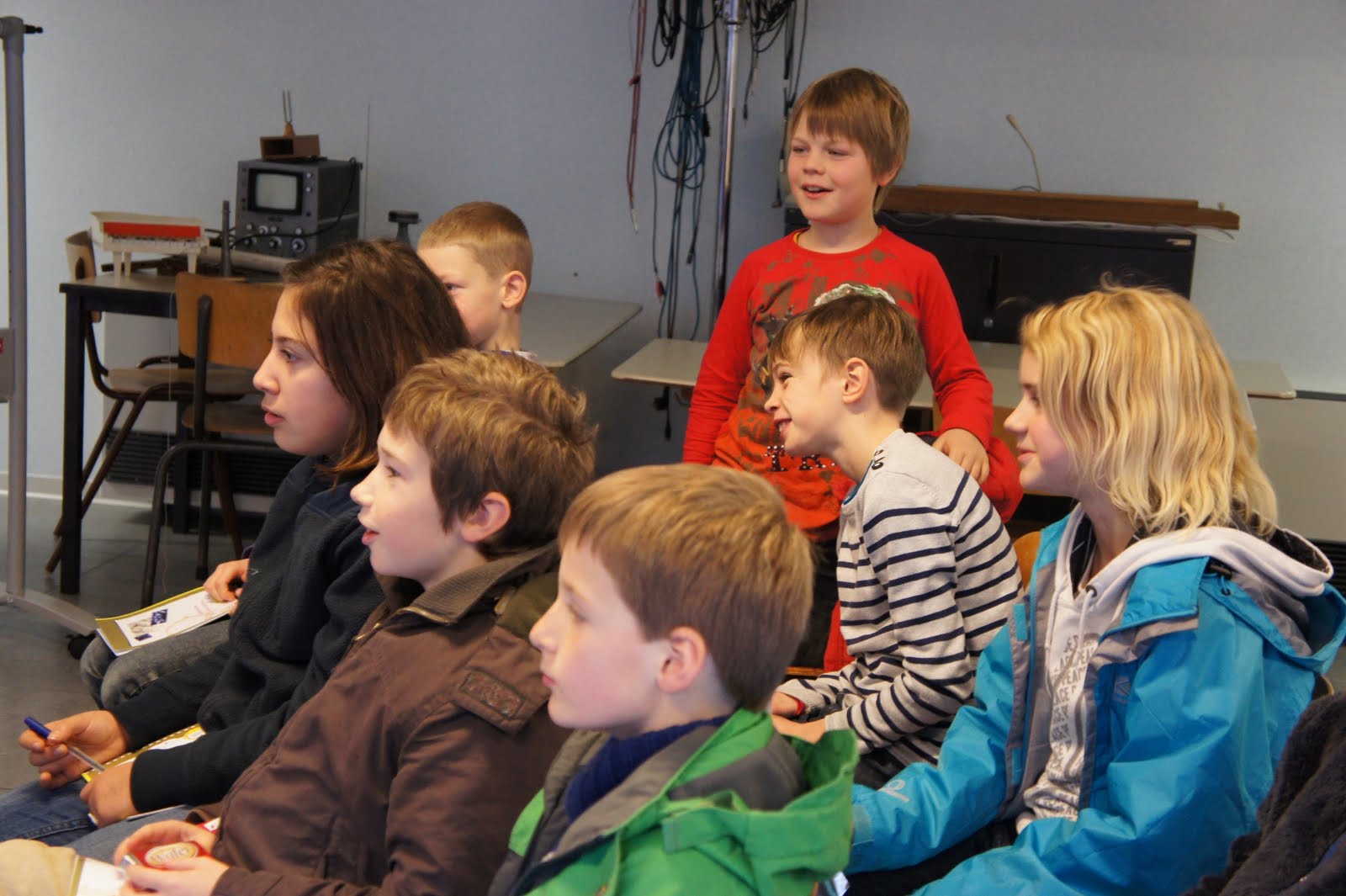 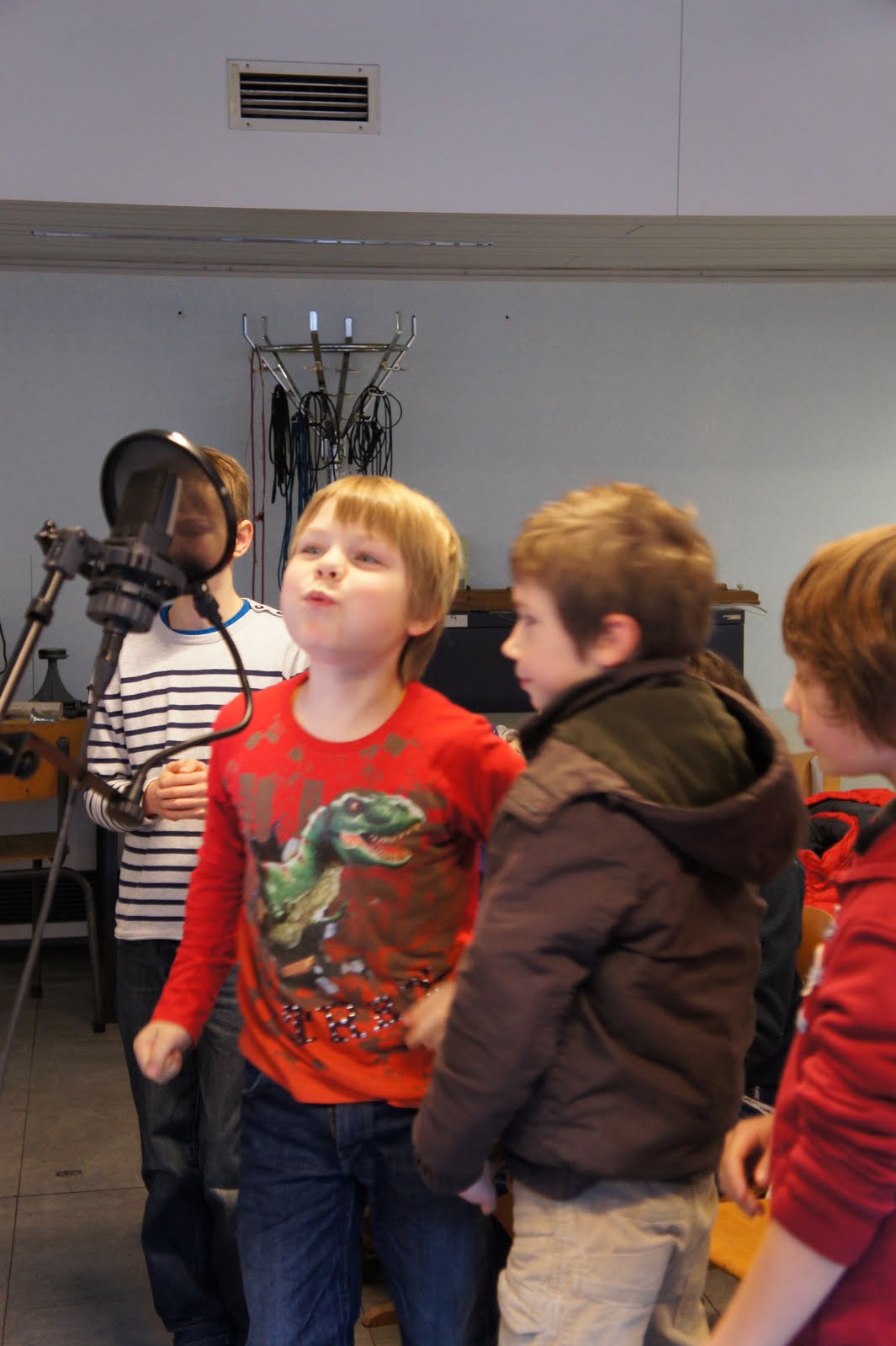 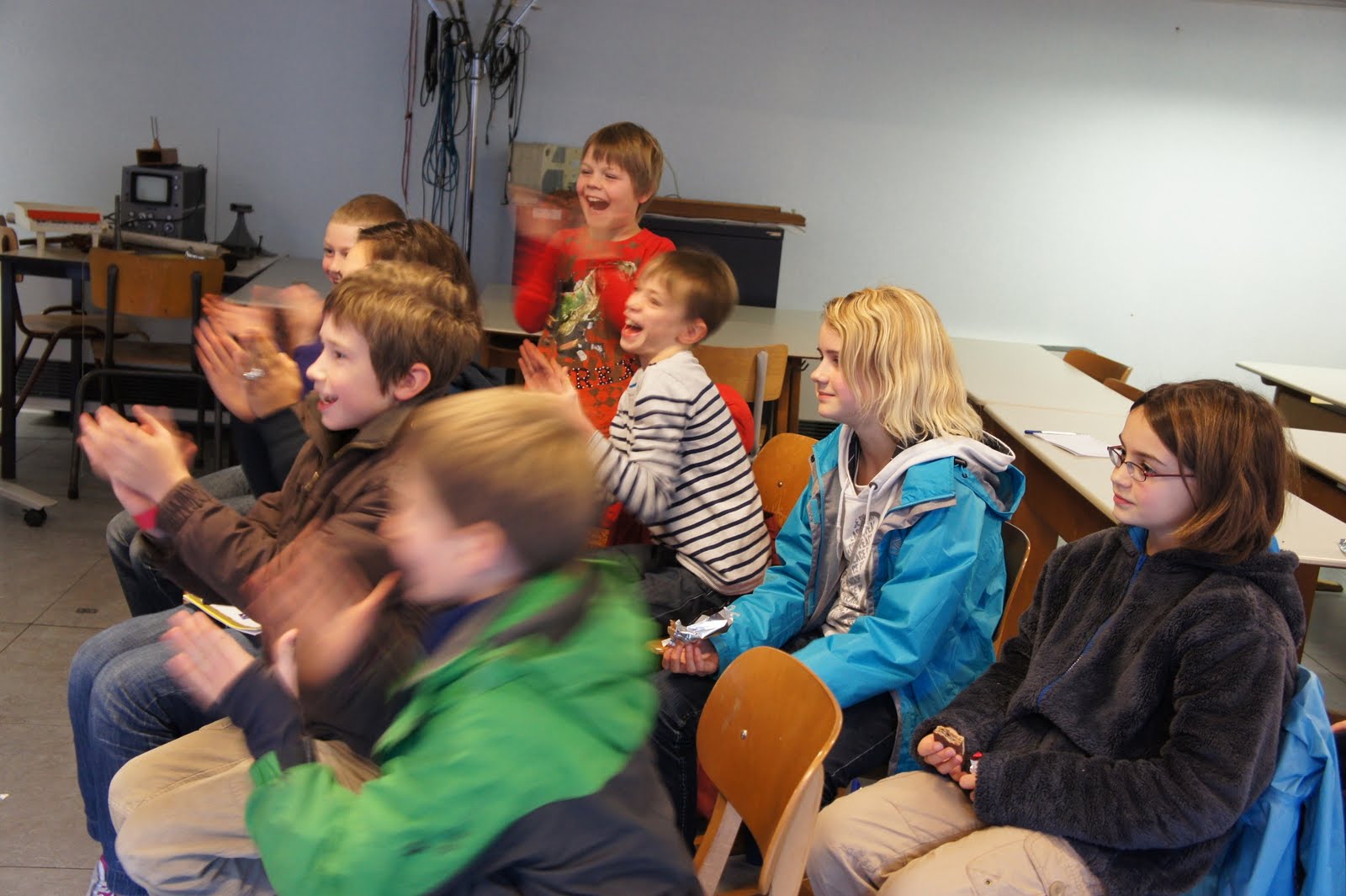 - [logo-with-arrow.png](https://0110.be/files/attachments/326/logo-with-arrow.png) - [UtterAsterisk.jar](https://0110.be/files/attachments/326/UtterAsterisk.jar) - [PercussionDetector.jar](https://0110.be/files/attachments/326/PercussionDetector.jar) - [PitchDetector.jar](https://0110.be/files/attachments/326/PitchDetector.jar) - [SoundDetector.jar](https://0110.be/files/attachments/326/SoundDetector.jar) --- ## [Robust Audio Fingerprinting with Tarsos and Pitch Class Histograms](https://0110.be/posts/Robust_Audio_Fingerprinting_with_Tarsos_and_Pitch_Class_Histograms.md) - Published: 2011-11-09T14:46:36Z - Updated: 2013-12-05T18:19:15Z - Author: Joren - ID: 378 - Canonical: https://0110.be/posts/Robust_Audio_Fingerprinting_with_Tarsos_and_Pitch_Class_Histograms - Tags: [Code](https://0110.be/tags/Code.md), [HoGent](https://0110.be/tags/HoGent.md), [Java](https://0110.be/tags/Java.md), [Music Information Retrieval](https://0110.be/tags/Music%20Information%20Retrieval.md), [Tarsos](https://0110.be/tags/Tarsos.md), [featured](https://0110.be/tags/featured.md) The aim of acoustic fingerprinting is to generate a small representation of an audio signal that can be used to identify or recognize similar audio samples in a large audio set. A robust fingerprint generates similar fingerprints for perceptually similar audio signals. A piece of music with a bit of noise added should generate an almost identical fingerprint as the original. The use cases for audio fingerprinting or acoustic fingerprinting are myriad: detection of duplicates, identifying songs, recognizing copyrighted material,... Using a pitch class histogram as a fingerprint seems like a good idea: it is unique for a song and it is reasonably robust to changes of the underlying audio (length, tempo, pitch, noise). The idea has probably been found a couple of times independently, but there is also a reference to it in the literature, by Tzanetakis, 2003: [Pitch Histograms in Audio and Symbolic Music Information Retrieval](http://marsyas.info/pdfs/0000/0008/jnmr03gtzan.pdf): > Although mainly designed for genre classification it is possible that features derived from Pitch Histograms might also be applicable to the problem of content-based audio identification or audio fingerprinting (for an example of such a system see (Allamanche et al., 2001)). We are planning to explore this possibility in the future. Unfortunately they never, as far as I know, did explore this possibility, and I also do not know if anybody else did. I found it worthwhile to implement a fingerprinting scheme on top of the Tarsos software foundation. Most elements are already available in the Tarsos API: a way to detect pitch, construct a pitch class histogram, correlate pitch class histograms with a pitch shift,... I created a GUI application which is presented here. It is, probably, the first open source acoustic / "audio fingerprinting system based on pitch class histograms":\[AudioFingerprinter.jar\].WORKSHOP - Muziek (ont)luisteren op de computer\ Is het mogelijk om piano te spelen op een tafel? Kan een computer luisteren naar muziek en er van genieten? Wat is muziek eigenlijk, en hoe werkt geluid?
\ Tijdens deze workshop worden de voorgaande vragen beantwoord met enkele computerprogramma's!
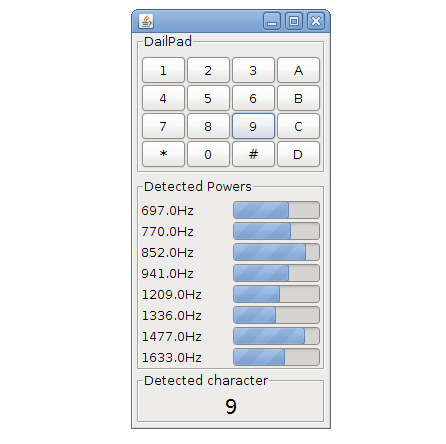
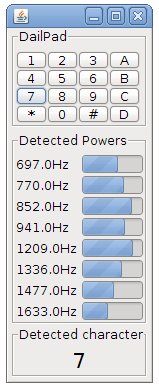 The DSP library of Tarsos, aptly named TarsosDSP, now contains an implementation of the Goertzel Algorithm. It is implemented using pure Java.
The [Goertzel algorithm](http://en.wikipedia.org/wiki/Goertzel_algorithm) can be used to detect if one or more predefined frequencies are present in a signal and it does this very efficiently. One of the classic applications of the Goertzel algorithm is decoding the tones generated on by touch tone telephones. These use [DTMF (Dual tone multi frequency)-signaling](http://en.wikipedia.org/wiki/Dual-tone_multi-frequency_signaling).
To make the algorithm visually appealing a Java Swing interface has been created(visible right). You can try this application by running the "Goertzel DTMF Jar-file":\[GoertzelDTMF.jar\]. The souce code is included in the jar and is avaliable as a separate "zip file":\[GoertzelDTMF_src.zip\]. The [TarsosDSP github page](https://github.com/JorenSix/TarsosDSP) also contains the source for the [Goertzel algorithm Java implementation](https://github.com/JorenSix/TarsosDSP/blob/master/src/be/hogent/tarsos/dsp/pitch/Goertzel.java).
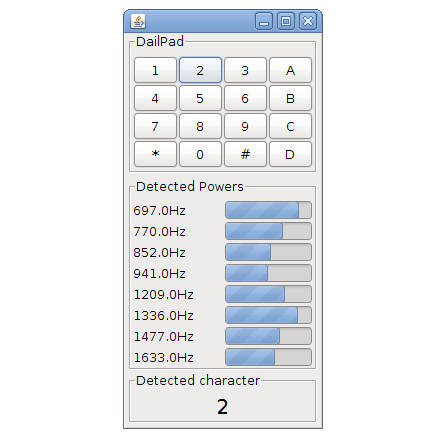
- [goertzel\_DTMF\_java\_7.png](https://0110.be/files/attachments/343/goertzel_DTMF_java_7.png)
- [GoertzelDTMF.jar](https://0110.be/files/attachments/343/GoertzelDTMF.jar)
- [GoertzelDTMF\_src.zip](https://0110.be/files/attachments/343/GoertzelDTMF_src.zip)
---
## [Rendering MIDI Using Arbitrary Tone Scales - Revisited](https://0110.be/posts/Rendering_MIDI_Using_Arbitrary_Tone_Scales_-_Revisited.md)
- Published: 2011-09-20T14:14:02Z
- Updated: 2013-12-05T18:19:15Z
- Author: Joren
- ID: 408
- Canonical: https://0110.be/posts/Rendering_MIDI_Using_Arbitrary_Tone_Scales_-_Revisited
- Tags: [Code](https://0110.be/tags/Code.md), [Computational musicology](https://0110.be/tags/Computational%20musicology.md), [HoGent](https://0110.be/tags/HoGent.md), [Java](https://0110.be/tags/Java.md)
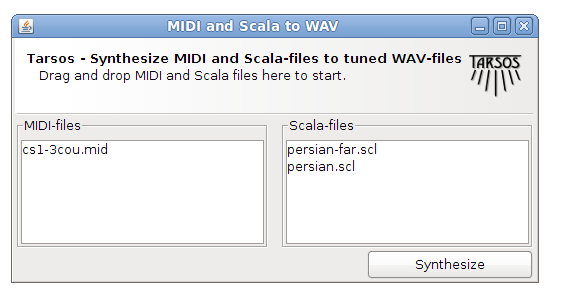
Tarsos can be used to render MIDI files to audio (WAV) files using arbitrary tone scales. This functionallity can be used to (automatically) verify tone scale extraction from audio files. Since I could not find a dataset with audio and corresponding tone scales creating one using MIDI seemed a good idea.
MIDI files can be found in spades (for example on [piano-midi.de](http://www.piano-midi.de/midi_files.htm) or [kunstderfuge.com](http://kunstderfuge.com)), tone scales on the other hand are harder to find. Luckily there is one massive source, the [Scala Tone Scale Archive](http://www.huygens-fokker.org/scala/downloads.html#scales): *A large collection of over 3700 tone scales*.
Using Scala tone scale files and a midi files a *Tone Scale - Audio* dataset can be generated. The quality of the audio depends on the (software) synthesizer and the [SoundFont](http://en.wikipedia.org/wiki/SoundFont) used. Tarsos currently uses the [Gervill synthesizer](https://gervill.dev.java.net/). Gervill is a pure Java software synthesizer with support for 24bit SoundFonts and the MIDI tuning standard.\
The DSP library of Tarsos, aptly named TarsosDSP, now contains an implementation of the Goertzel Algorithm. It is implemented using pure Java.
The [Goertzel algorithm](http://en.wikipedia.org/wiki/Goertzel_algorithm) can be used to detect if one or more predefined frequencies are present in a signal and it does this very efficiently. One of the classic applications of the Goertzel algorithm is decoding the tones generated on by touch tone telephones. These use [DTMF (Dual tone multi frequency)-signaling](http://en.wikipedia.org/wiki/Dual-tone_multi-frequency_signaling).
To make the algorithm visually appealing a Java Swing interface has been created(visible right). You can try this application by running the "Goertzel DTMF Jar-file":\[GoertzelDTMF.jar\]. The souce code is included in the jar and is avaliable as a separate "zip file":\[GoertzelDTMF_src.zip\]. The [TarsosDSP github page](https://github.com/JorenSix/TarsosDSP) also contains the source for the [Goertzel algorithm Java implementation](https://github.com/JorenSix/TarsosDSP/blob/master/src/be/hogent/tarsos/dsp/pitch/Goertzel.java).


- [goertzel\_DTMF\_java\_7.png](https://0110.be/files/attachments/343/goertzel_DTMF_java_7.png)
- [GoertzelDTMF.jar](https://0110.be/files/attachments/343/GoertzelDTMF.jar)
- [GoertzelDTMF\_src.zip](https://0110.be/files/attachments/343/GoertzelDTMF_src.zip)
---
## [Rendering MIDI Using Arbitrary Tone Scales - Revisited](https://0110.be/posts/Rendering_MIDI_Using_Arbitrary_Tone_Scales_-_Revisited.md)
- Published: 2011-09-20T14:14:02Z
- Updated: 2013-12-05T18:19:15Z
- Author: Joren
- ID: 408
- Canonical: https://0110.be/posts/Rendering_MIDI_Using_Arbitrary_Tone_Scales_-_Revisited
- Tags: [Code](https://0110.be/tags/Code.md), [Computational musicology](https://0110.be/tags/Computational%20musicology.md), [HoGent](https://0110.be/tags/HoGent.md), [Java](https://0110.be/tags/Java.md)
Tarsos can be used to render MIDI files to audio (WAV) files using arbitrary tone scales. This functionallity can be used to (automatically) verify tone scale extraction from audio files. Since I could not find a dataset with audio and corresponding tone scales creating one using MIDI seemed a good idea.
MIDI files can be found in spades (for example on [piano-midi.de](http://www.piano-midi.de/midi_files.htm) or [kunstderfuge.com](http://kunstderfuge.com)), tone scales on the other hand are harder to find. Luckily there is one massive source, the [Scala Tone Scale Archive](http://www.huygens-fokker.org/scala/downloads.html#scales): *A large collection of over 3700 tone scales*.
Using Scala tone scale files and a midi files a *Tone Scale - Audio* dataset can be generated. The quality of the audio depends on the (software) synthesizer and the [SoundFont](http://en.wikipedia.org/wiki/SoundFont) used. Tarsos currently uses the [Gervill synthesizer](https://gervill.dev.java.net/). Gervill is a pure Java software synthesizer with support for 24bit SoundFonts and the MIDI tuning standard.\
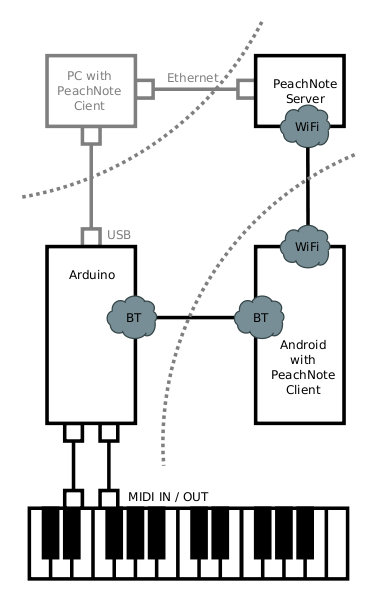 This is about PeachNote Piano, a project only tangentially related to Tarsos. PeachNote Piano aims to capture as many piano practice sessions as possible and offer useful services using this data. The system does this by capturing and redirecting MIDI events on a Bluetooth enabled smartphone. It is done together with [Vladimir Viro](http://www.peachnote.com/about.html) and builds on the existing [PeachNote](http://peachnote.com) infrastructure.
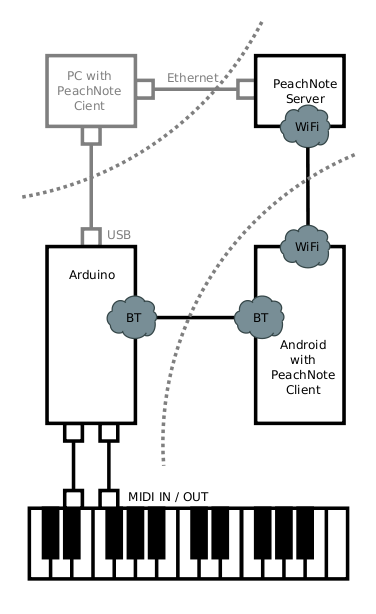
The schema - right - shows the components of the PeachNote Piano system. At the bottom you have a MIDI keyboard connected to the MIDI-Bluetooth-bridge. A smartphone (middle left) receives these MIDI events via Bluetooth and controls the communication to the server (top left). An alternative path goes through a standard computer (top right).
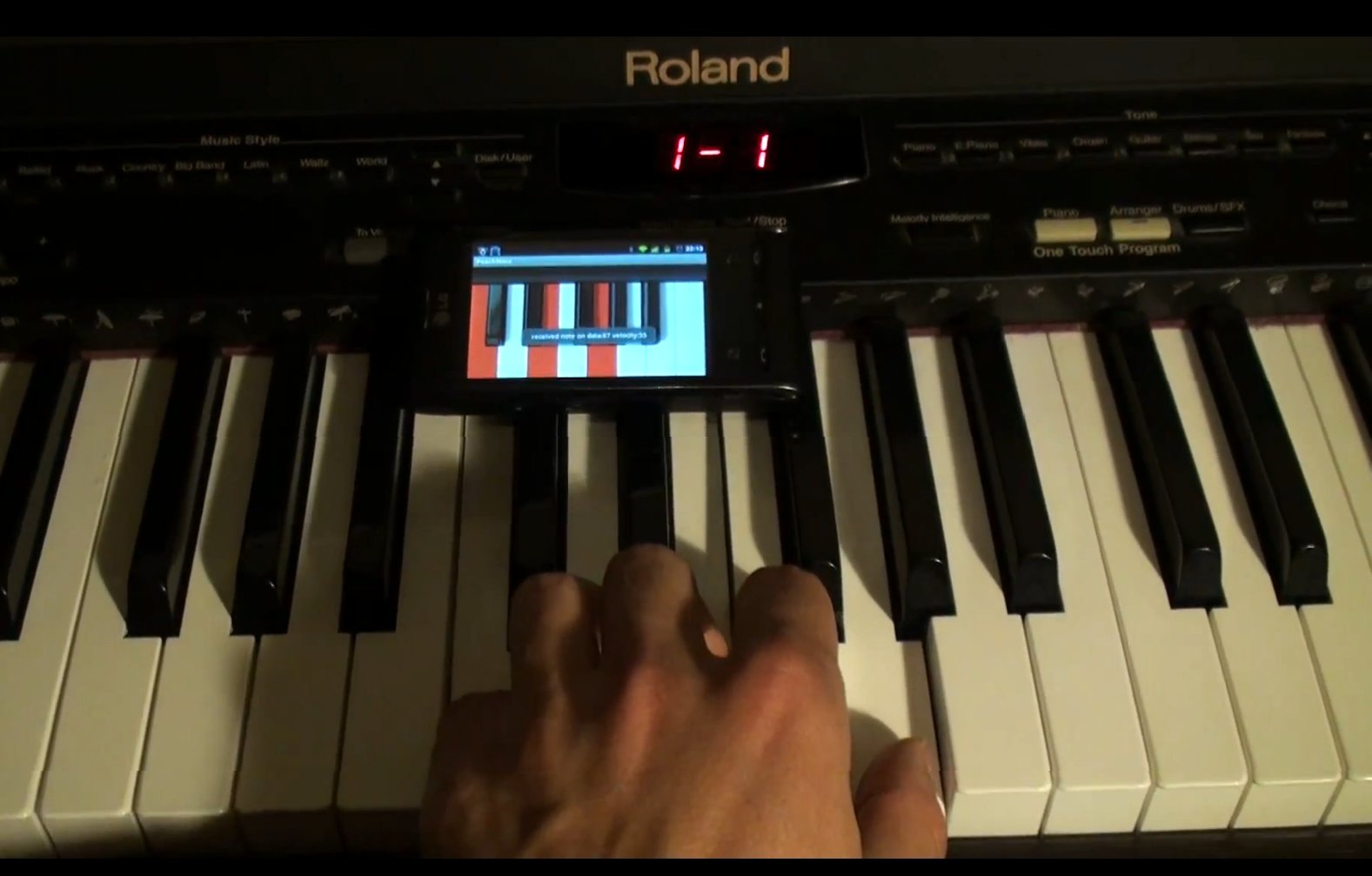
The Arduino based Bluetooth to MIDI bridge is an improvement on the work by [Peter Brinkmann](http://nettoyeur.noisepages.com/). The video below shows communication between USB-MIDI, Bluetooth MIDI and MIDI IN/OUT ports.
As an example application of the PeachNote Piano system we implemented a "Continue a Melody" service which works as follows: a user plays something on a keyboard, maybe just a few notes, and pauses for a few seconds. In the meantime, the server searches through a large database of MIDI piano recordings, finds the longest fuzzy match for the user's most recent input, and, after a short silence on the users part, starts streaming the continuation of the best matched performance from the database to the user. This mechanism, in fact, is way of browsing a music collection. Users may play a known leitmotiv or just improvise something, and the system continues playing a high quality recording, "replying" to the musical proposition of the user.
### More technical details
The melody matching is done on the server, which is implemented in Javascript in the Node.js framework. The whole dataset (about 350 hours of piano recordings) resides in memory in two representations: as a sequence of pitches, and as a sequence of "densities" at the corresponding places of the pitch sequence dataset. This second array is used to store the rough tempo information (number of notes per second) absent in the pitch sequence data.\
By combining the two search criteria we can achieve reasonable approximation of the tempo-aware search without its computational complexity.
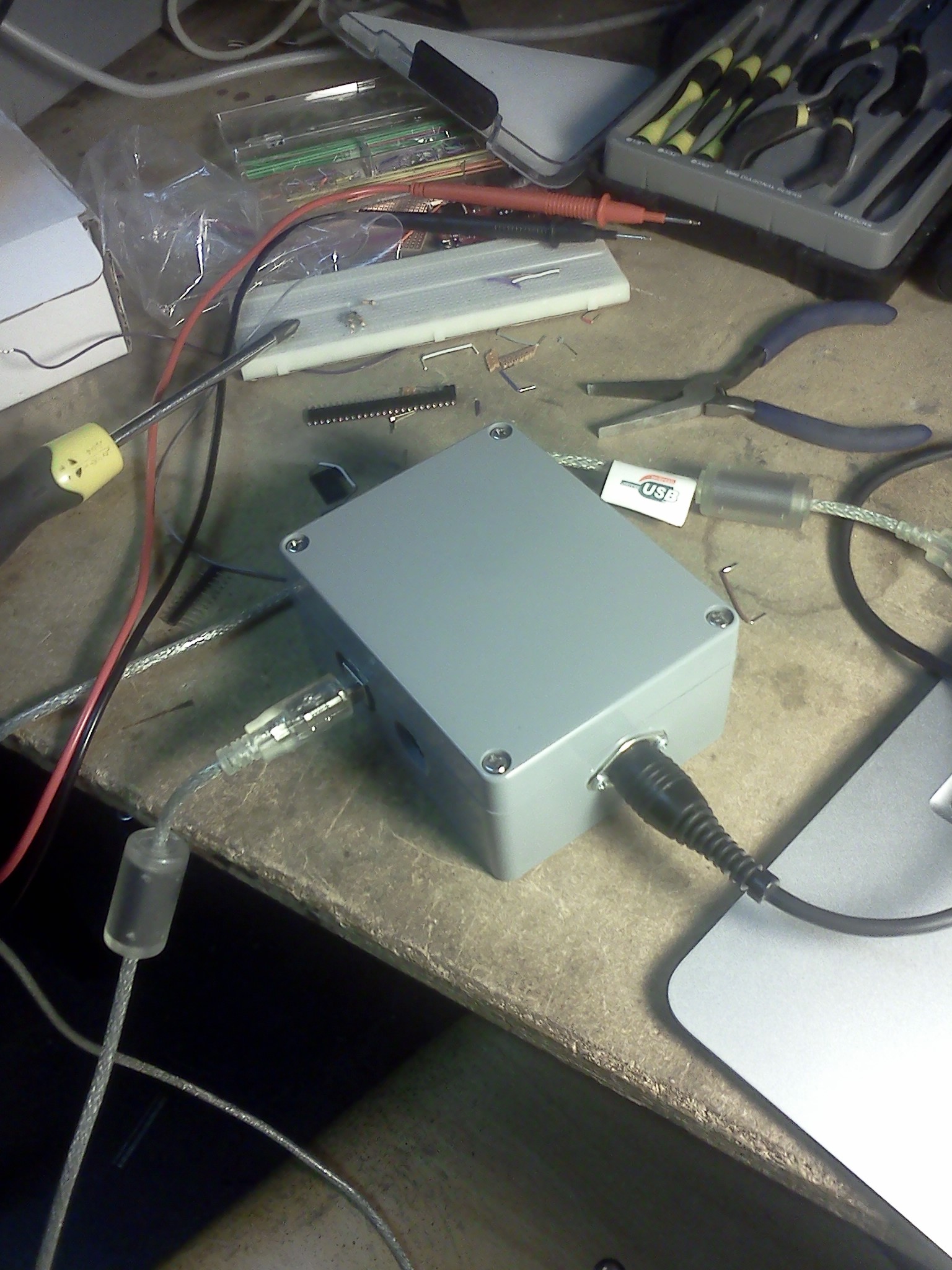
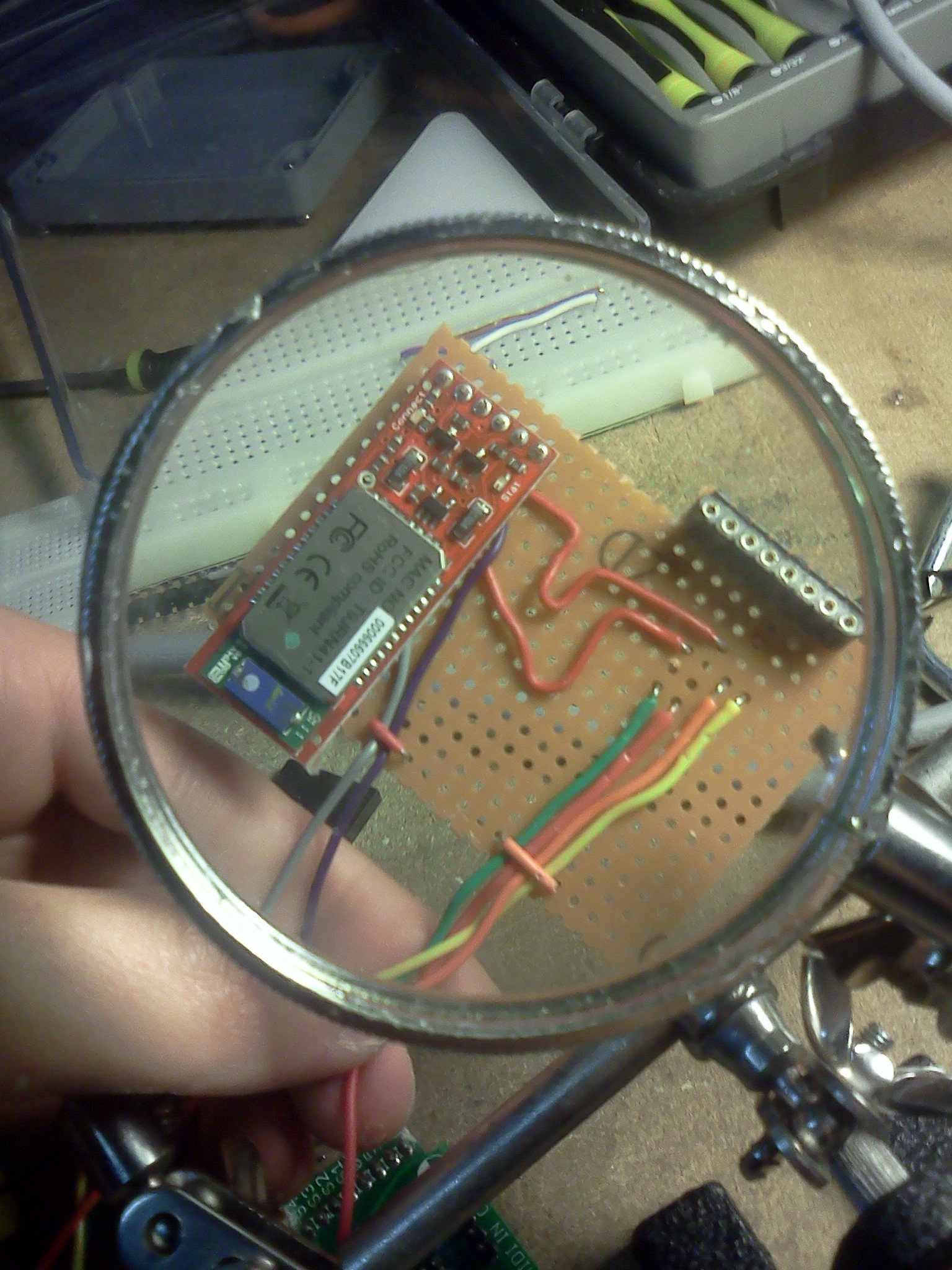
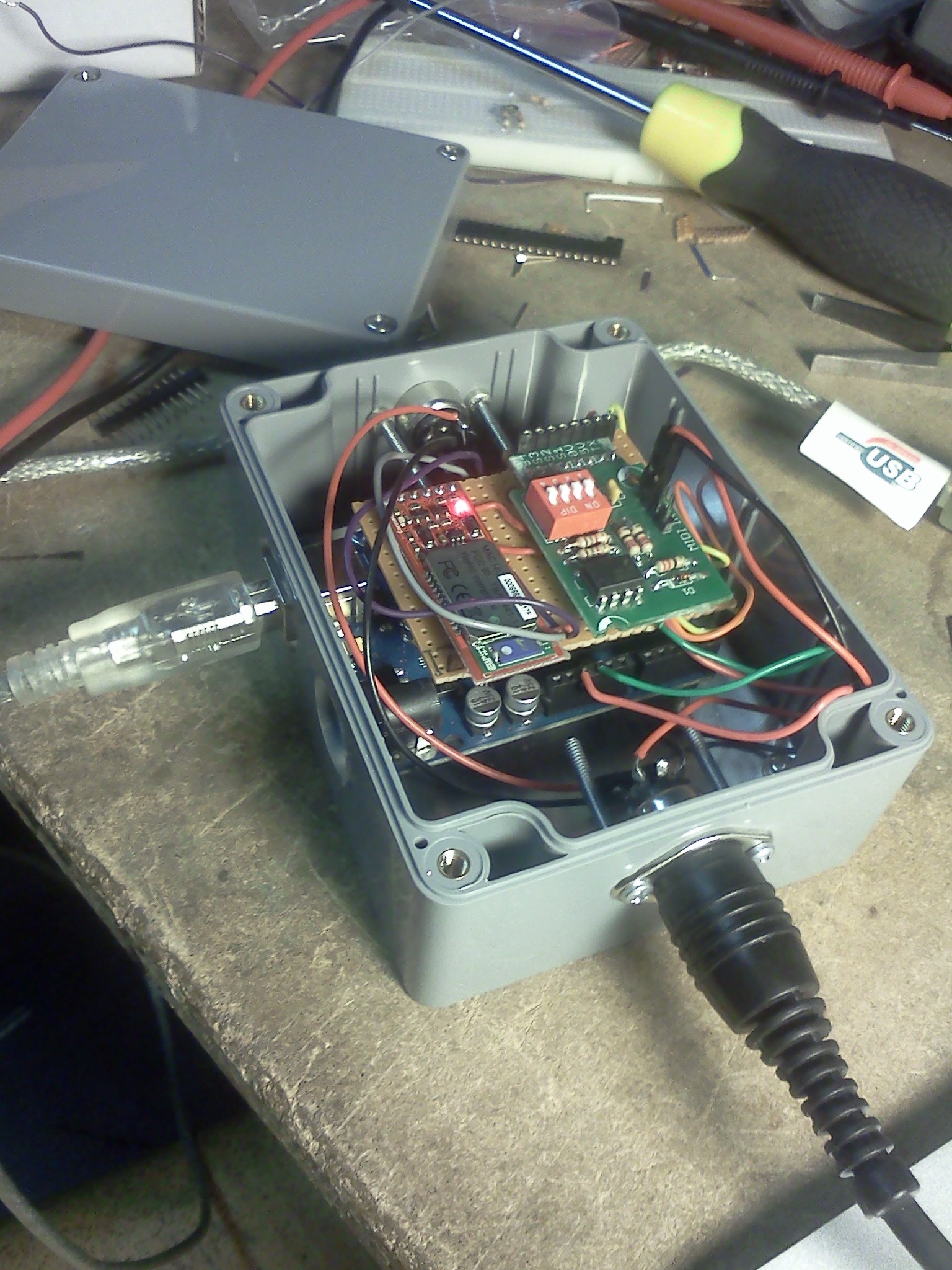
The implementation of the hardware is based on the open-source electronic prototyping platform Arduino. Optocoupled MIDI ports (IN/OUT) and the BlueSMiRF Bluetooth module were attached to the main board, as can be seen in the middle left block of the schema. The BlueTooth module is configured to use the Serial Port Profile (SPP) which emulates RS-232. The software on the Arduino manages bi-directional, low latency message passing between three serial ports: USB (through an FTDI chip), BlueTooth and the hardware MIDI-IN and OUT port.
The standard Arduino firmware has been replaced with firmware that implements the "Universal Serial Bus Device Class Definition for MIDI Devices": when attached to a computer via USB, the Arduino shows up as a standard MIDI device, which makes it compatible with all available MIDI software. The software client currently works on the Android smartphone platform. It is represented using the middle right block in the schema. The client can send and receive MIDI events over its Bluetooth port. Pairing, connecting and communicating with the device is done using the [Amarino software library](http://www.amarino-toolkit.net/). The client communicates with the Peachnote Piano server using TCP sockets implemented on the Dalvik Java runtime.
---
## [Makam Recognition with the Tarsos API](https://0110.be/posts/Makam_Recognition_with_the_Tarsos_API.md)
- Published: 2011-09-01T08:13:21Z
- Updated: 2013-12-05T18:19:15Z
- Author: Joren
- ID: 406
- Canonical: https://0110.be/posts/Makam_Recognition_with_the_Tarsos_API
- Tags: [Code](https://0110.be/tags/Code.md), [Computational ethnomusicology](https://0110.be/tags/Computational%20ethnomusicology.md), [HoGent](https://0110.be/tags/HoGent.md), [Java](https://0110.be/tags/Java.md), [Music Information Retrieval](https://0110.be/tags/Music%20Information%20Retrieval.md), [Tarsos](https://0110.be/tags/Tarsos.md)
This article describes how to do makam recognition with a script that uses the Tarsos API.
The task we want to do is to find the tone scales most similar to the one used in recorded music. To complete this task you need a small set of theoretical scales and a large set of music, each brought in one of the scales. To make it more concrete, an example of Turkish classical music is used.
In an [article by Bozkurt](http://dl.acm.org/citation.cfm?id=1688013) pitch histograms are used for - amongst other tasks - makam recognition. A maqam defines rules for a composition or performance of classical Turkish music. It specifies melodic shapes and pitch intervals, the scale. The task is to identify which of nine makams is used in a specific song. A simplified, generalized implementation of this task is shown here. In our implementation there is no tonic detection step. Also here we use only theoretical descriptions of the tone scales as a template and do not construct a template using the audio itself, as is done by Bozkurt. Ioannidis Leonidas wrote an interesting [master thesis about makam recognition](http://www.mtg.upf.edu/static/media/Ioannidis-Leonidas-Master-Thesis-2010.pdf). Since no knowledge of the music itself is used the approach is generally applicable.
The following is an implementation in [Scala](http://scala-lang.org) a general purpose programming language that is interoperable with Jave . The first step is to write the Scala header. This is just some boilerplate code to be able to run the script from the command line - it assumes a UNIX-like environment and tarsos.jar in the same directory:
\`\`\`ruby\
#!/bin/sh\
exec scala -cp tarsos.jar -savecompiled "\$0" "\$@"\
!#\
import be.hogent.tarsos.util.\_\
//other import statements\
\`\`\`
The second step constructs the templates the capability of Tarsos to create\
theoretical tone scale templates using Gaussian kernels is used, line 8. See the attached images for some examples.
\`\`\`ruby\
val makams = List( "hicaz","huseyni","huzzam","kurdili_hicazar",\
"nihavend","rast","saba","segah","ussak")
var theoreticKDEs = Map\[java.lang.String,KernelDensityEstimate\]()\
makams.foreach{ makam =\>\
val scalaFile = makam + ".scl"\
val scalaObject = new ScalaFile(scalaFile);\
val kde = HistogramFactory.createPichClassKDE(scalaObject,35)\
kde.normalize\
theoreticKDEs = theoreticKDEs + (makam -\> kde)\
}\
\`\`\`
The third and last step is matching. First a list of audio\
files is created by recursively iterating a directory and matching each file to\
a regular expression. Next, starting from line 4, each audio file is processed.\
The internal implementation of the YIN pitch detection\
algorithm is used on the audio file and a pitch class histogram is created\
(line 6,7). On line 10 normalization of the histogram is done, to\
make the correlation calculation meaningful. Line 11 until 15 compare the\
created histogram from the audio file with the templates calculated beforehand.\
The results are stored, ordered and eventually printed on line 19.
\`\`\`ruby\
val directory = "/home/joren/turkish_makams/"\
val audio_pattern = ".\*.(mp3\|wav\|ogg\|flac)"\
val audioFiles = FileUtils.glob(directory,audio_pattern,true).toList
audioFiles.foreach{ file =\>\
val audioFile = new AudioFile(file)\
val detectorYin = PitchDetectionMode.TARSOS_YIN.getPitchDetector(audioFile)\
val annotations = detectorYin.executePitchDetection()\
val actualKDE = HistogramFactory.createPichClassKDE(annotations,15);\
actualKDE.normalize\
var resultList = List\[Tuple2\[java.lang.String,Double\]\]()\
for ((name, theoreticKDE) \<- theoreticKDEs){\
val shift = actualKDE.shiftForOptimalCorrelation(theoreticKDE)\
val currentCorrelation = actualKDE.correlation(theoreticKDE,shift)\
resultList = (name -\> currentCorrelation) :: resultList\
}\
//order by correlation\
resultList = resultList.sortBy{\_.\_2}.reverse\
Console.println(file + " is brought in tone scale " + resultList(0).\_1)\
}\
\`\`\`
A complete version of this script can is available: "Tone scale matching script":\[guess_makam.scala\] Results of the script when ran on Bozkurt's dataset can be seen in the attached spreadsheet ("openoffice format":\[makam_recognition_results.ods\] or "excel format":\[makam_recognition_results.xls\]).
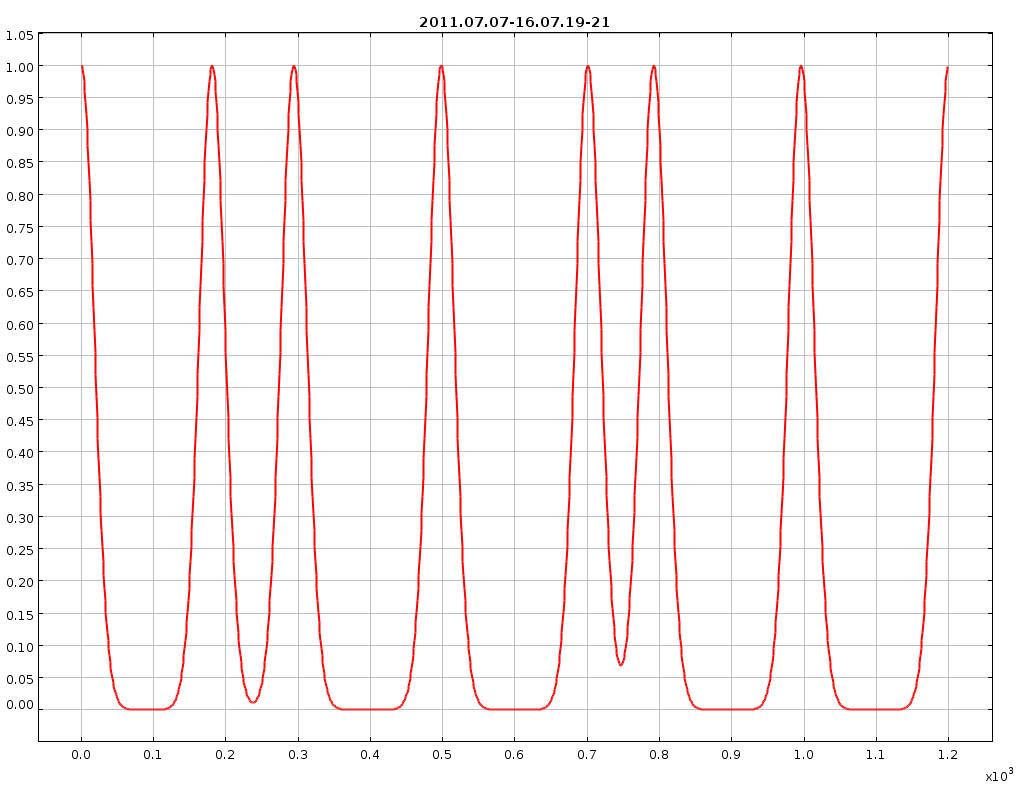
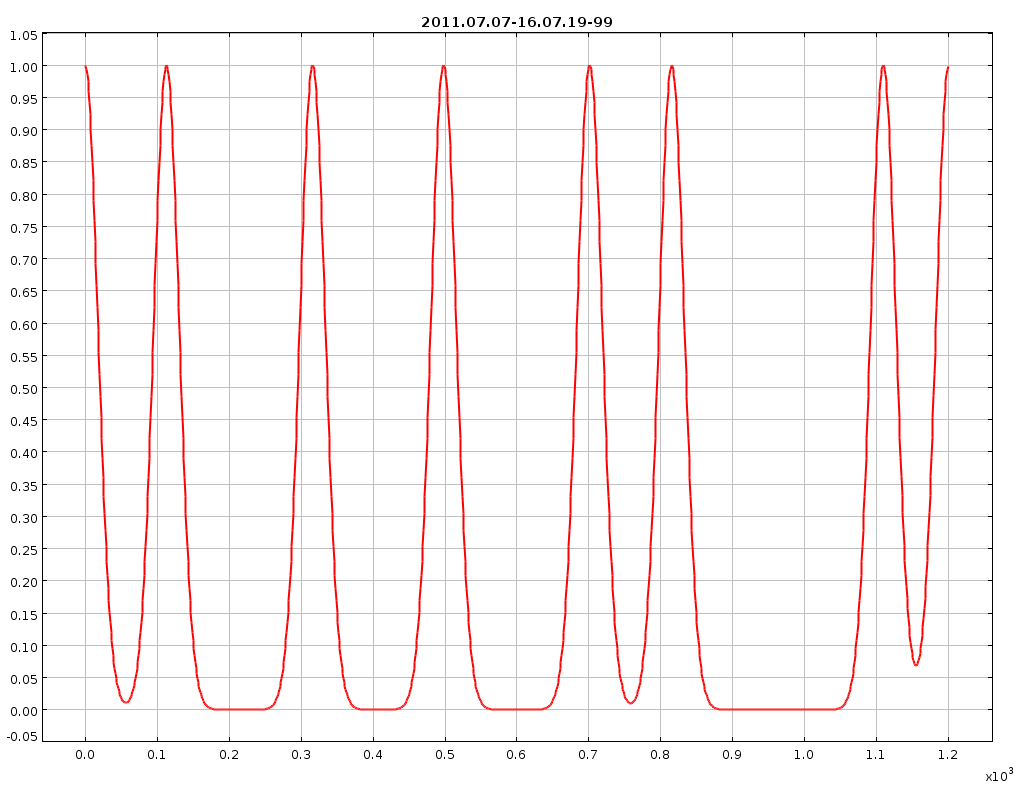
- [guess\_makam.scala](https://0110.be/files/attachments/406/guess_makam.scala)
- [makams.zip](https://0110.be/files/attachments/406/makams.zip)
- [makam\_recognition\_results.ods](https://0110.be/files/attachments/406/makam_recognition_results.ods)
- [makam\_recognition\_results.xls](https://0110.be/files/attachments/406/makam_recognition_results.xls)
---
## [Latex export functions](https://0110.be/posts/Latex_export_functions.md)
- Published: 2011-06-17T08:02:51Z
- Updated: 2013-12-05T18:19:15Z
- Author: Joren
- ID: 402
- Canonical: https://0110.be/posts/Latex_export_functions
- Tags: [Computational ethnomusicology](https://0110.be/tags/Computational%20ethnomusicology.md), [HoGent](https://0110.be/tags/HoGent.md), [Java](https://0110.be/tags/Java.md), [Tarsos](https://0110.be/tags/Tarsos.md)
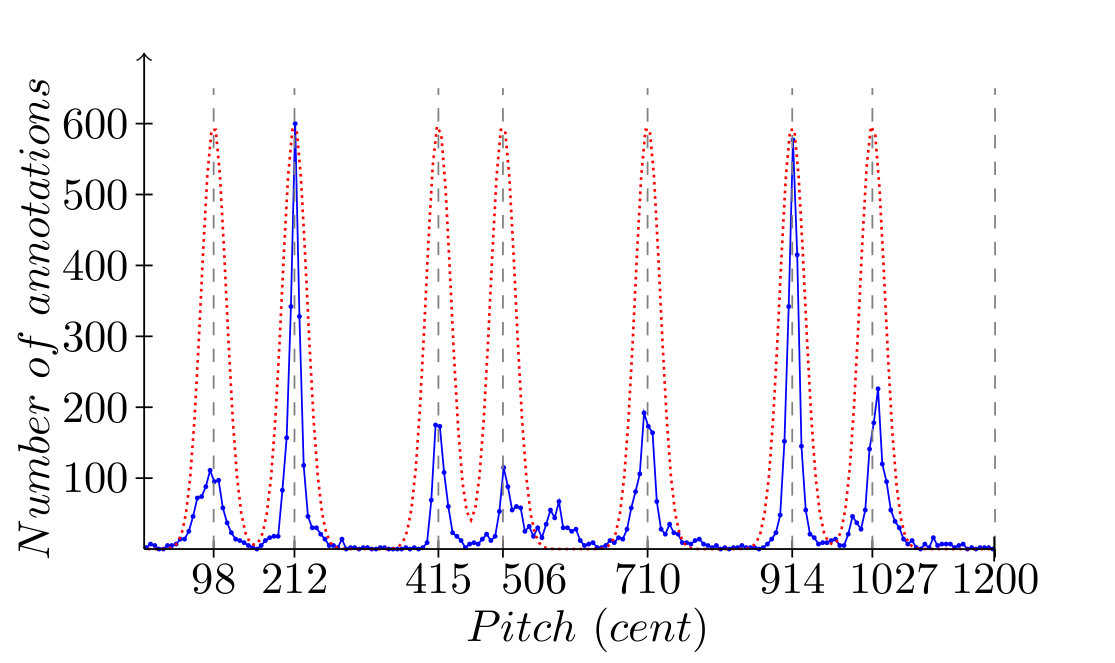
Tarsos, a software package to analyse pitch organization in music, contains a new output modality. It is now possible to export a pitch class histogram and a pitch class interval matrix to latex from within Tarsos. This makes documenting tone scales more efficient.
An example for "a pitch class histogram and pitch class interval matrix":\[latex_export.pdf\] can be seen. Also available is the "latex source code":\[latex_export.tex\].

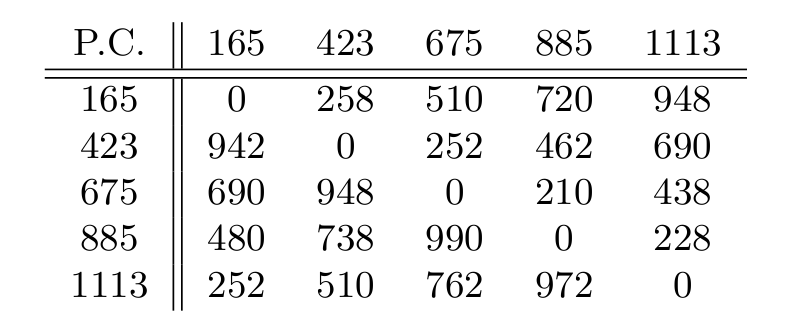
- [latex\_export.tex](https://0110.be/files/attachments/402/latex_export.tex)
- [latex\_export.pdf](https://0110.be/files/attachments/402/latex_export.pdf)
- [MR.1954.1.19-4.dat](https://0110.be/files/attachments/402/MR.1954.1.19-4.dat)
---
## [Resynthesis of Pitch Detection Annotations on a Flute Piece](https://0110.be/posts/Resynthesis_of_Pitch_Detection_Annotations_on_a_Flute_Piece.md)
- Published: 2011-06-16T14:43:10Z
- Updated: 2013-12-05T18:19:15Z
- Author: Joren
- ID: 403
- Canonical: https://0110.be/posts/Resynthesis_of_Pitch_Detection_Annotations_on_a_Flute_Piece
- Tags: [Code](https://0110.be/tags/Code.md), [Computational ethnomusicology](https://0110.be/tags/Computational%20ethnomusicology.md), [HoGent](https://0110.be/tags/HoGent.md), [Java](https://0110.be/tags/Java.md), [Music Information Retrieval](https://0110.be/tags/Music%20Information%20Retrieval.md), [Tarsos](https://0110.be/tags/Tarsos.md)
Tarsos, a software package to analyse pitch organization in music, contains a new output modality. Now it is possible to export resynthesized pitch annotations, detected by a pitch detection algorithm and compare those with the original sound. This can be interesting to see which errors a pitch detection algorithm makes.
Below you can listen to an example of synthesized pitch detection results compared with the original flute piece. The file starts with only the original flute sound (on the right channel) and gradually changes so only the synthesized annotations (on the left channel) can be heard.
Resynthesis of Pitch Detection Annotations on a Flute Piece by Joren Six
- [flute\_resynth.wav](https://0110.be/files/attachments/403/flute_resynth.wav)
---
## [PulseAudio Support for Sun Java 6 on Ubuntu](https://0110.be/posts/PulseAudio_Support_for_Sun_Java_6_on_Ubuntu.md)
- Published: 2011-05-27T09:59:31Z
- Updated: 2013-12-05T18:19:15Z
- Author: Joren
- ID: 394
- Canonical: https://0110.be/posts/PulseAudio_Support_for_Sun_Java_6_on_Ubuntu
- Tags: [Code](https://0110.be/tags/Code.md), [HoGent](https://0110.be/tags/HoGent.md), [Java](https://0110.be/tags/Java.md)
This article describes how to make sun-java6 play nice with the PulseAudio sound sytem on Ubuntu with an x64 processor architecture. With some changes the method should also work with other operating systems and other platforms.
The default way sun-java6 operates with respect to sound on Ubuntu is, well unrespectfull. When playing audio it claims an audio device, which then can not be used any more by other applications trying to access the same device. This is far from ideal. Also changing audio interfaces (by e.g. plugging in a USB audio interface) goes wrong most of the time.
This is about PeachNote Piano, a project only tangentially related to Tarsos. PeachNote Piano aims to capture as many piano practice sessions as possible and offer useful services using this data. The system does this by capturing and redirecting MIDI events on a Bluetooth enabled smartphone. It is done together with [Vladimir Viro](http://www.peachnote.com/about.html) and builds on the existing [PeachNote](http://peachnote.com) infrastructure.
The schema - right - shows the components of the PeachNote Piano system. At the bottom you have a MIDI keyboard connected to the MIDI-Bluetooth-bridge. A smartphone (middle left) receives these MIDI events via Bluetooth and controls the communication to the server (top left). An alternative path goes through a standard computer (top right).
The Arduino based Bluetooth to MIDI bridge is an improvement on the work by [Peter Brinkmann](http://nettoyeur.noisepages.com/). The video below shows communication between USB-MIDI, Bluetooth MIDI and MIDI IN/OUT ports.
As an example application of the PeachNote Piano system we implemented a "Continue a Melody" service which works as follows: a user plays something on a keyboard, maybe just a few notes, and pauses for a few seconds. In the meantime, the server searches through a large database of MIDI piano recordings, finds the longest fuzzy match for the user's most recent input, and, after a short silence on the users part, starts streaming the continuation of the best matched performance from the database to the user. This mechanism, in fact, is way of browsing a music collection. Users may play a known leitmotiv or just improvise something, and the system continues playing a high quality recording, "replying" to the musical proposition of the user.
### More technical details
The melody matching is done on the server, which is implemented in Javascript in the Node.js framework. The whole dataset (about 350 hours of piano recordings) resides in memory in two representations: as a sequence of pitches, and as a sequence of "densities" at the corresponding places of the pitch sequence dataset. This second array is used to store the rough tempo information (number of notes per second) absent in the pitch sequence data.\
By combining the two search criteria we can achieve reasonable approximation of the tempo-aware search without its computational complexity.
The implementation of the hardware is based on the open-source electronic prototyping platform Arduino. Optocoupled MIDI ports (IN/OUT) and the BlueSMiRF Bluetooth module were attached to the main board, as can be seen in the middle left block of the schema. The BlueTooth module is configured to use the Serial Port Profile (SPP) which emulates RS-232. The software on the Arduino manages bi-directional, low latency message passing between three serial ports: USB (through an FTDI chip), BlueTooth and the hardware MIDI-IN and OUT port.
The standard Arduino firmware has been replaced with firmware that implements the "Universal Serial Bus Device Class Definition for MIDI Devices": when attached to a computer via USB, the Arduino shows up as a standard MIDI device, which makes it compatible with all available MIDI software. The software client currently works on the Android smartphone platform. It is represented using the middle right block in the schema. The client can send and receive MIDI events over its Bluetooth port. Pairing, connecting and communicating with the device is done using the [Amarino software library](http://www.amarino-toolkit.net/). The client communicates with the Peachnote Piano server using TCP sockets implemented on the Dalvik Java runtime.





---
## [Makam Recognition with the Tarsos API](https://0110.be/posts/Makam_Recognition_with_the_Tarsos_API.md)
- Published: 2011-09-01T08:13:21Z
- Updated: 2013-12-05T18:19:15Z
- Author: Joren
- ID: 406
- Canonical: https://0110.be/posts/Makam_Recognition_with_the_Tarsos_API
- Tags: [Code](https://0110.be/tags/Code.md), [Computational ethnomusicology](https://0110.be/tags/Computational%20ethnomusicology.md), [HoGent](https://0110.be/tags/HoGent.md), [Java](https://0110.be/tags/Java.md), [Music Information Retrieval](https://0110.be/tags/Music%20Information%20Retrieval.md), [Tarsos](https://0110.be/tags/Tarsos.md)
This article describes how to do makam recognition with a script that uses the Tarsos API.
The task we want to do is to find the tone scales most similar to the one used in recorded music. To complete this task you need a small set of theoretical scales and a large set of music, each brought in one of the scales. To make it more concrete, an example of Turkish classical music is used.
In an [article by Bozkurt](http://dl.acm.org/citation.cfm?id=1688013) pitch histograms are used for - amongst other tasks - makam recognition. A maqam defines rules for a composition or performance of classical Turkish music. It specifies melodic shapes and pitch intervals, the scale. The task is to identify which of nine makams is used in a specific song. A simplified, generalized implementation of this task is shown here. In our implementation there is no tonic detection step. Also here we use only theoretical descriptions of the tone scales as a template and do not construct a template using the audio itself, as is done by Bozkurt. Ioannidis Leonidas wrote an interesting [master thesis about makam recognition](http://www.mtg.upf.edu/static/media/Ioannidis-Leonidas-Master-Thesis-2010.pdf). Since no knowledge of the music itself is used the approach is generally applicable.
The following is an implementation in [Scala](http://scala-lang.org) a general purpose programming language that is interoperable with Jave . The first step is to write the Scala header. This is just some boilerplate code to be able to run the script from the command line - it assumes a UNIX-like environment and tarsos.jar in the same directory:
\`\`\`ruby\
#!/bin/sh\
exec scala -cp tarsos.jar -savecompiled "\$0" "\$@"\
!#\
import be.hogent.tarsos.util.\_\
//other import statements\
\`\`\`
The second step constructs the templates the capability of Tarsos to create\
theoretical tone scale templates using Gaussian kernels is used, line 8. See the attached images for some examples.
\`\`\`ruby\
val makams = List( "hicaz","huseyni","huzzam","kurdili_hicazar",\
"nihavend","rast","saba","segah","ussak")
var theoreticKDEs = Map\[java.lang.String,KernelDensityEstimate\]()\
makams.foreach{ makam =\>\
val scalaFile = makam + ".scl"\
val scalaObject = new ScalaFile(scalaFile);\
val kde = HistogramFactory.createPichClassKDE(scalaObject,35)\
kde.normalize\
theoreticKDEs = theoreticKDEs + (makam -\> kde)\
}\
\`\`\`
The third and last step is matching. First a list of audio\
files is created by recursively iterating a directory and matching each file to\
a regular expression. Next, starting from line 4, each audio file is processed.\
The internal implementation of the YIN pitch detection\
algorithm is used on the audio file and a pitch class histogram is created\
(line 6,7). On line 10 normalization of the histogram is done, to\
make the correlation calculation meaningful. Line 11 until 15 compare the\
created histogram from the audio file with the templates calculated beforehand.\
The results are stored, ordered and eventually printed on line 19.
\`\`\`ruby\
val directory = "/home/joren/turkish_makams/"\
val audio_pattern = ".\*.(mp3\|wav\|ogg\|flac)"\
val audioFiles = FileUtils.glob(directory,audio_pattern,true).toList
audioFiles.foreach{ file =\>\
val audioFile = new AudioFile(file)\
val detectorYin = PitchDetectionMode.TARSOS_YIN.getPitchDetector(audioFile)\
val annotations = detectorYin.executePitchDetection()\
val actualKDE = HistogramFactory.createPichClassKDE(annotations,15);\
actualKDE.normalize\
var resultList = List\[Tuple2\[java.lang.String,Double\]\]()\
for ((name, theoreticKDE) \<- theoreticKDEs){\
val shift = actualKDE.shiftForOptimalCorrelation(theoreticKDE)\
val currentCorrelation = actualKDE.correlation(theoreticKDE,shift)\
resultList = (name -\> currentCorrelation) :: resultList\
}\
//order by correlation\
resultList = resultList.sortBy{\_.\_2}.reverse\
Console.println(file + " is brought in tone scale " + resultList(0).\_1)\
}\
\`\`\`
A complete version of this script can is available: "Tone scale matching script":\[guess_makam.scala\] Results of the script when ran on Bozkurt's dataset can be seen in the attached spreadsheet ("openoffice format":\[makam_recognition_results.ods\] or "excel format":\[makam_recognition_results.xls\]).



- [guess\_makam.scala](https://0110.be/files/attachments/406/guess_makam.scala)
- [makams.zip](https://0110.be/files/attachments/406/makams.zip)
- [makam\_recognition\_results.ods](https://0110.be/files/attachments/406/makam_recognition_results.ods)
- [makam\_recognition\_results.xls](https://0110.be/files/attachments/406/makam_recognition_results.xls)
---
## [Latex export functions](https://0110.be/posts/Latex_export_functions.md)
- Published: 2011-06-17T08:02:51Z
- Updated: 2013-12-05T18:19:15Z
- Author: Joren
- ID: 402
- Canonical: https://0110.be/posts/Latex_export_functions
- Tags: [Computational ethnomusicology](https://0110.be/tags/Computational%20ethnomusicology.md), [HoGent](https://0110.be/tags/HoGent.md), [Java](https://0110.be/tags/Java.md), [Tarsos](https://0110.be/tags/Tarsos.md)
Tarsos, a software package to analyse pitch organization in music, contains a new output modality. It is now possible to export a pitch class histogram and a pitch class interval matrix to latex from within Tarsos. This makes documenting tone scales more efficient.
An example for "a pitch class histogram and pitch class interval matrix":\[latex_export.pdf\] can be seen. Also available is the "latex source code":\[latex_export.tex\].


- [latex\_export.tex](https://0110.be/files/attachments/402/latex_export.tex)
- [latex\_export.pdf](https://0110.be/files/attachments/402/latex_export.pdf)
- [MR.1954.1.19-4.dat](https://0110.be/files/attachments/402/MR.1954.1.19-4.dat)
---
## [Resynthesis of Pitch Detection Annotations on a Flute Piece](https://0110.be/posts/Resynthesis_of_Pitch_Detection_Annotations_on_a_Flute_Piece.md)
- Published: 2011-06-16T14:43:10Z
- Updated: 2013-12-05T18:19:15Z
- Author: Joren
- ID: 403
- Canonical: https://0110.be/posts/Resynthesis_of_Pitch_Detection_Annotations_on_a_Flute_Piece
- Tags: [Code](https://0110.be/tags/Code.md), [Computational ethnomusicology](https://0110.be/tags/Computational%20ethnomusicology.md), [HoGent](https://0110.be/tags/HoGent.md), [Java](https://0110.be/tags/Java.md), [Music Information Retrieval](https://0110.be/tags/Music%20Information%20Retrieval.md), [Tarsos](https://0110.be/tags/Tarsos.md)
Tarsos, a software package to analyse pitch organization in music, contains a new output modality. Now it is possible to export resynthesized pitch annotations, detected by a pitch detection algorithm and compare those with the original sound. This can be interesting to see which errors a pitch detection algorithm makes.
Below you can listen to an example of synthesized pitch detection results compared with the original flute piece. The file starts with only the original flute sound (on the right channel) and gradually changes so only the synthesized annotations (on the left channel) can be heard.
Resynthesis of Pitch Detection Annotations on a Flute Piece by Joren Six
- [flute\_resynth.wav](https://0110.be/files/attachments/403/flute_resynth.wav)
---
## [PulseAudio Support for Sun Java 6 on Ubuntu](https://0110.be/posts/PulseAudio_Support_for_Sun_Java_6_on_Ubuntu.md)
- Published: 2011-05-27T09:59:31Z
- Updated: 2013-12-05T18:19:15Z
- Author: Joren
- ID: 394
- Canonical: https://0110.be/posts/PulseAudio_Support_for_Sun_Java_6_on_Ubuntu
- Tags: [Code](https://0110.be/tags/Code.md), [HoGent](https://0110.be/tags/HoGent.md), [Java](https://0110.be/tags/Java.md)
This article describes how to make sun-java6 play nice with the PulseAudio sound sytem on Ubuntu with an x64 processor architecture. With some changes the method should also work with other operating systems and other platforms.
The default way sun-java6 operates with respect to sound on Ubuntu is, well unrespectfull. When playing audio it claims an audio device, which then can not be used any more by other applications trying to access the same device. This is far from ideal. Also changing audio interfaces (by e.g. plugging in a USB audio interface) goes wrong most of the time.

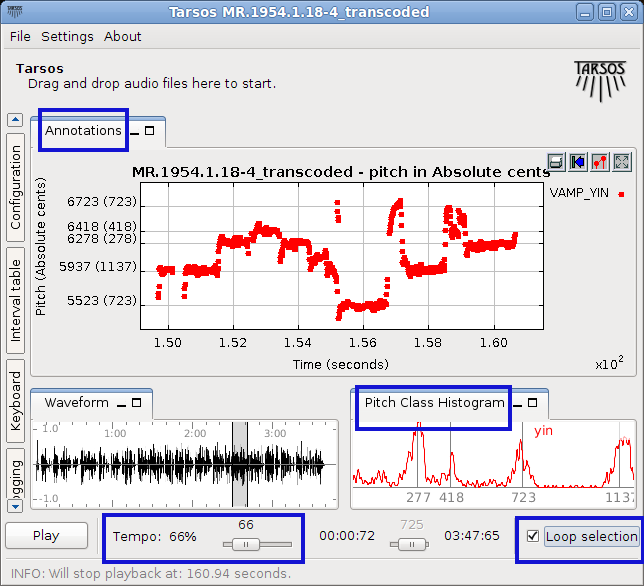 \
\