 ":\[A0-Poster.jpg\]
 The journal paper *Tarsos, a Modular Platform for Precise Pitch Analysis of Western and Non-Western Music* by Six, Cornelis, and Leman was published in a special issue about Computational Ethnomusicology of [the Journal of New Music Research (JNMR)](http://www.tandfonline.com/toc/nnmr20/current) on the 20th of august 2013. Below you can find the abstract for the article, and pointers to audio examples, the Tarsos software, and the author version of the article itself.
> **Abstract:** This paper presents Tarsos, a modular software platform used to extract and analyze pitch organization in music. With Tarsos pitch estimations are generated from an audio signal and those estimations are processed in order to form musicologically meaningful representations. Tarsos aims to offer a flexible system for pitch analysis through the combination of an interactive user interface, several pitch estimation algorithms, filtering options, immediate auditory feedback and data output modalities for every step. To study the most frequently used pitches, a fine-grained histogram that allows up to 1200 values per octave is constructed. This allows Tarsos to analyze deviations in Western music, or to analyze specific tone scales that differ from the 12 tone equal temperament, common in many non-Western musics. Tarsos has a graphical user interface or can be launched using an API - as a batch script. Therefore, it is fit for both the analysis of individual songs and the analysis of large music corpora. The interface allows several visual representations, and can indicate the scale of the piece under analysis. The extracted scale can be used immediately to tune a MIDI keyboard that can be played in the discovered scale. These features make Tarsos an interesting tool that can be used for musicological analysis, teaching and even artistic productions.
To read the full text you can either download "Tarsos, a Modular Platform for Precise Pitch Analysis of Western and Non-Western Music, Author version":\[2013.08.20.tarsos_jnmr_author_version.pdf\]. Or obtain the published version of [Tarsos, a Modular Platform for Precise Pitch Analysis of Western and Non-Western Music, published version](http://www.tandfonline.com/doi/full/10.1080/09298215.2013.797999)
Ladrang Kandamanyura (slendro pathet manyura), is the name of the piece used in the article throughout section 2. The album on which the piece can be found is available at [wergo](http://www.wergo.de/shop/en_UK/Audio_CDs/1000088/show,223736,n.html). Below a thirty second fragment is embedded. You can also "download":\[08.\_Ladrang_Kandamanyura_10s-20s_up.wav\] the thirty second fragment to analyse it yourself.
Below the BibTex entry for the article is embedded.
\`\`\`ruby\
\@article{six2013tarsos_jnmr,\
author = {Six, Joren and Cornelis, Olmo and Leman, Marc},\
title = {Tarsos, a Modular Platform for Precise Pitch Analysis\
of Western and Non-Western Music},\
journal = {Journal of New Music Research},\
volume = {42},\
number = {2},\
pages = {113-129},\
year = {2013},\
doi = {10.1080/09298215.2013.797999},\
URL = {http://www.tandfonline.com/doi/abs/10.1080/09298215.2013.797999}\
}\
\`\`\`
- [jnmr.cover.jpg](https://0110.be/files/attachments/331/jnmr.cover.jpg)
- [08.\_Ladrang\_Kandamanyura\_10s-20s\_up.wav](https://0110.be/files/attachments/331/08._Ladrang_Kandamanyura_10s-20s_up.wav)
- [2013.08.20.tarsos\_jnmr\_author\_version.pdf](https://0110.be/files/attachments/331/2013.08.20.tarsos_jnmr_author_version.pdf)
---
## [FMA 2013 - Computer Assisted Transcripton of Ethnic Music](https://0110.be/posts/FMA_2013_-_Computer_Assisted_Transcripton_of_Ethnic_Music.md)
- Published: 2013-06-14T00:00:00Z
- Updated: 2014-02-25T09:22:13Z
- Author: Joren
- ID: 377
- Canonical: https://0110.be/posts/FMA_2013_-_Computer_Assisted_Transcripton_of_Ethnic_Music
- Tags: [Computational ethnomusicology](https://0110.be/tags/Computational%20ethnomusicology.md), [Computational musicology](https://0110.be/tags/Computational%20musicology.md), [Folk Music Analysis (FMA) conference](https://0110.be/tags/Folk%20Music%20Analysis%20%28FMA%29%20conference.md), [HoGent](https://0110.be/tags/HoGent.md), [Java](https://0110.be/tags/Java.md), [Research papers](https://0110.be/tags/Research%20papers.md), [Tarsos](https://0110.be/tags/Tarsos.md), [featured](https://0110.be/tags/featured.md)
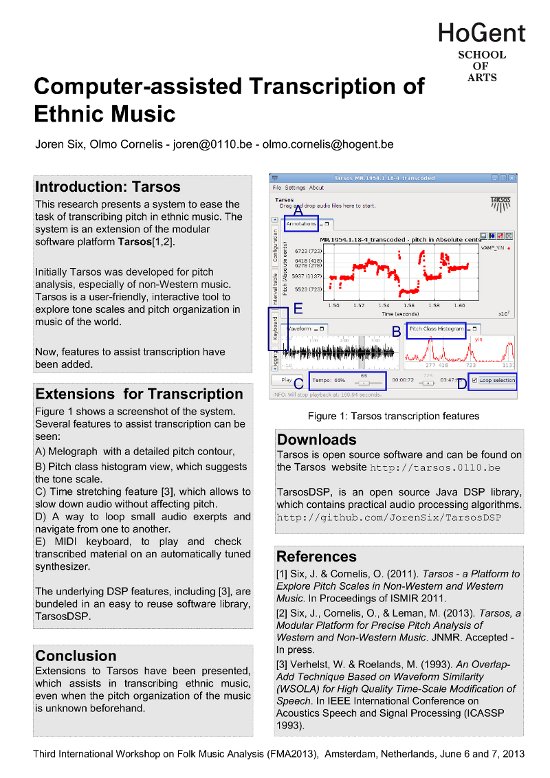
At [the third international workshop on Folk Music Analysis (FMA2013)](http://www.elab-oralculture.nl/fma2013) we presented a poster titled "Computer Assisted Transcription of Ethnic Music":\[A0-Poster.png\]. The workshop took place in Amsterdam, Netherlands, June 6 and 7, 2013.
In the extended abstract, also titled "Computer Assisted Transcription of Ethnic Music":\[FMA_2013.computer_assisted_transcription.pdf\], it is described how the Tarsos software program now has features aiding transcription. Tarsos is especially practical for ethnic music of which the tone scale is not known beforehand. [The proceedings of FMA 2013](http://igitur-archive.library.uu.nl/math/2013-0604-200726/UUindex.html) are available as well.
":\[A0-Poster.jpg\]
The journal paper *Tarsos, a Modular Platform for Precise Pitch Analysis of Western and Non-Western Music* by Six, Cornelis, and Leman was published in a special issue about Computational Ethnomusicology of [the Journal of New Music Research (JNMR)](http://www.tandfonline.com/toc/nnmr20/current) on the 20th of august 2013. Below you can find the abstract for the article, and pointers to audio examples, the Tarsos software, and the author version of the article itself.
> **Abstract:** This paper presents Tarsos, a modular software platform used to extract and analyze pitch organization in music. With Tarsos pitch estimations are generated from an audio signal and those estimations are processed in order to form musicologically meaningful representations. Tarsos aims to offer a flexible system for pitch analysis through the combination of an interactive user interface, several pitch estimation algorithms, filtering options, immediate auditory feedback and data output modalities for every step. To study the most frequently used pitches, a fine-grained histogram that allows up to 1200 values per octave is constructed. This allows Tarsos to analyze deviations in Western music, or to analyze specific tone scales that differ from the 12 tone equal temperament, common in many non-Western musics. Tarsos has a graphical user interface or can be launched using an API - as a batch script. Therefore, it is fit for both the analysis of individual songs and the analysis of large music corpora. The interface allows several visual representations, and can indicate the scale of the piece under analysis. The extracted scale can be used immediately to tune a MIDI keyboard that can be played in the discovered scale. These features make Tarsos an interesting tool that can be used for musicological analysis, teaching and even artistic productions.
To read the full text you can either download "Tarsos, a Modular Platform for Precise Pitch Analysis of Western and Non-Western Music, Author version":\[2013.08.20.tarsos_jnmr_author_version.pdf\]. Or obtain the published version of [Tarsos, a Modular Platform for Precise Pitch Analysis of Western and Non-Western Music, published version](http://www.tandfonline.com/doi/full/10.1080/09298215.2013.797999)
Ladrang Kandamanyura (slendro pathet manyura), is the name of the piece used in the article throughout section 2. The album on which the piece can be found is available at [wergo](http://www.wergo.de/shop/en_UK/Audio_CDs/1000088/show,223736,n.html). Below a thirty second fragment is embedded. You can also "download":\[08.\_Ladrang_Kandamanyura_10s-20s_up.wav\] the thirty second fragment to analyse it yourself.
Below the BibTex entry for the article is embedded.
\`\`\`ruby\
\@article{six2013tarsos_jnmr,\
author = {Six, Joren and Cornelis, Olmo and Leman, Marc},\
title = {Tarsos, a Modular Platform for Precise Pitch Analysis\
of Western and Non-Western Music},\
journal = {Journal of New Music Research},\
volume = {42},\
number = {2},\
pages = {113-129},\
year = {2013},\
doi = {10.1080/09298215.2013.797999},\
URL = {http://www.tandfonline.com/doi/abs/10.1080/09298215.2013.797999}\
}\
\`\`\`
- [jnmr.cover.jpg](https://0110.be/files/attachments/331/jnmr.cover.jpg)
- [08.\_Ladrang\_Kandamanyura\_10s-20s\_up.wav](https://0110.be/files/attachments/331/08._Ladrang_Kandamanyura_10s-20s_up.wav)
- [2013.08.20.tarsos\_jnmr\_author\_version.pdf](https://0110.be/files/attachments/331/2013.08.20.tarsos_jnmr_author_version.pdf)
---
## [FMA 2013 - Computer Assisted Transcripton of Ethnic Music](https://0110.be/posts/FMA_2013_-_Computer_Assisted_Transcripton_of_Ethnic_Music.md)
- Published: 2013-06-14T00:00:00Z
- Updated: 2014-02-25T09:22:13Z
- Author: Joren
- ID: 377
- Canonical: https://0110.be/posts/FMA_2013_-_Computer_Assisted_Transcripton_of_Ethnic_Music
- Tags: [Computational ethnomusicology](https://0110.be/tags/Computational%20ethnomusicology.md), [Computational musicology](https://0110.be/tags/Computational%20musicology.md), [Folk Music Analysis (FMA) conference](https://0110.be/tags/Folk%20Music%20Analysis%20%28FMA%29%20conference.md), [HoGent](https://0110.be/tags/HoGent.md), [Java](https://0110.be/tags/Java.md), [Research papers](https://0110.be/tags/Research%20papers.md), [Tarsos](https://0110.be/tags/Tarsos.md), [featured](https://0110.be/tags/featured.md)
At [the third international workshop on Folk Music Analysis (FMA2013)](http://www.elab-oralculture.nl/fma2013) we presented a poster titled "Computer Assisted Transcription of Ethnic Music":\[A0-Poster.png\]. The workshop took place in Amsterdam, Netherlands, June 6 and 7, 2013.
In the extended abstract, also titled "Computer Assisted Transcription of Ethnic Music":\[FMA_2013.computer_assisted_transcription.pdf\], it is described how the Tarsos software program now has features aiding transcription. Tarsos is especially practical for ethnic music of which the tone scale is not known beforehand. [The proceedings of FMA 2013](http://igitur-archive.library.uu.nl/math/2013-0604-200726/UUindex.html) are available as well.
":\[A0-Poster.jpg\]
 At this years ICMC Conference, [ICMC 2012](http://www.icmc2012.si/) we presented a paper describing a way to experiment with tone scales and how to use Tarsos as a compositional tool. What follows are some pointers to the presentation, paper and to other interesting talks that were presented there.
ICMC 2012 was organized in Ljubljana from the 9 to 14 septembre and had a very dense program of talks, posters, presentations, demos and concerts.
At this years ICMC Conference, [ICMC 2012](http://www.icmc2012.si/) we presented a paper describing a way to experiment with tone scales and how to use Tarsos as a compositional tool. What follows are some pointers to the presentation, paper and to other interesting talks that were presented there.
ICMC 2012 was organized in Ljubljana from the 9 to 14 septembre and had a very dense program of talks, posters, presentations, demos and concerts.
Since 1974 the International Computer Music Conference has been the major international forum for the presentation of the full range of outcomes from technical and musical research, both musical and theoretical, related to the use of computers in music. This annual conference regularly travels the globe, with recent conferences in the Americas, Europe and Asia. This year we welcome the conference to Slovenia for the first time.### Sound to Scale to Sound, a Setup for Microtonal Exploration and Composition Our contribution to the conference was a paper titled "Sound to Scale to Sound, a Setup for Microtonal Exploration and Composition":\[icmc2012_submission_45.pdf\]. If you want to cite our work, this BibTeX entry is included for your convenience: \`\`\`ruby\ \@inproceedings{cornelis2012sound_to_scale,\ author = {Olmo Cornelis and Joren Six},\ title = {{Sound to Scale to Sound, a Setup for Microtonal Exploration and Composition}},\ booktitle = {{Proceedings of the 2012 International Computer Music Conference,\ (ICMC 2012)}},\ year = {2012},\ publisher = {The International Computer Music Association}\ }\ \`\`\` ### Program highlights What follows are a number of pointers to my personal program highlights. Verena Thomas presented two very well polished software tools. One to detect patterns in scores, called motifviewer and a tool to search in score databases in a multi-modal way. The [Probado tool](http://probado.iai.uni-bonn.de:8080/) does score-to-audio alignment and much more. [Gibber](http://www.charlie-roberts.com/gibber/) is an impressive live-coding environment with an easy syntax. Since it is all done with javascript you can start playing with it immediately. [Overtone](http://overtone.github.com/) Another live-coding environment, presented at the conference by Sam Aaron, was equally impressive. It is programmed using the Closure language. At ICMC there were a number of tools to assist in composition. One of those is [The Bach Project](http://www.bachproject.net/bach/home_page.html), by Andrea Agostini. Togheter with CatART by Diemo Swartz it forms a very expressive platform to work with sound, which was demonstrated by Aaron Einbond and Christopher Trapani in their paper titled *Precise Pitch Control In Real Time Corpus-Based Concatenative Synthesis*. Diemo Swartz presented work on Audio Mosaicing, it can be seen as a follow-up to [AuidioGuild](http://crca.ucsd.edu/~ben/audioGuide/) by Ben Hackbarth. I also got to know the work by [Thomas Grill](http://grrrr.org), on his website a nice piece of software can be found a Python implementation of the [Non Stationary Gabor Transform (NSGT)](http://grrrr.org/research/software/nsgt/). Another software system I got to know is the functional signal processing programming language [FAUST](http://en.wikipedia.org/wiki/FAUST_(programming_language)) My personal highlights of the concert programme include the works by Johannes Kreidler, Aura Pon, Daniel Mayer, Alexander Schubert and the remarkable performance by Dexter Ford. The concept behind Soundlog by Johannes Kretz was also interesting. - [ICMC\_Logo.png](https://0110.be/files/attachments/369/ICMC_Logo.png) - [2012.09.08-Sound\_to\_Scale\_to\_Sound\_\_a\_Setup\_for\_Microtonal\_Exploration\_and\_Composition.odp](https://0110.be/files/attachments/369/2012.09.08-Sound_to_Scale_to_Sound__a_Setup_for_Microtonal_Exploration_and_Composition.odp) - [icmc2012\_submission\_45.pdf](https://0110.be/files/attachments/369/icmc2012_submission_45.pdf) --- ## [CIM 2012 - Revealing and Listening to Scales From the Past; Tone Scale Analysis of Archived Central-African Music Using Computational Means](https://0110.be/posts/CIM_2012_-_Revealing_and_Listening_to_Scales_From_the_Past%3B_Tone_Scale_Analysis_of_Archived_Central-African_Music_Using_Computational_Means.md) - Published: 2012-08-31T00:00:00Z - Updated: 2014-02-13T10:58:38Z - Author: Joren - ID: 351 - Canonical: https://0110.be/posts/CIM_2012_-_Revealing_and_Listening_to_Scales_From_the_Past%3B_Tone_Scale_Analysis_of_Archived_Central-African_Music_Using_Computational_Means - Tags: [Computational musicology](https://0110.be/tags/Computational%20musicology.md), [HoGent](https://0110.be/tags/HoGent.md), [Music Information Retrieval](https://0110.be/tags/Music%20Information%20Retrieval.md), [Presentation](https://0110.be/tags/Presentation.md), [Research papers](https://0110.be/tags/Research%20papers.md), [Tarsos](https://0110.be/tags/Tarsos.md), [featured](https://0110.be/tags/featured.md)
 What follows is about the [Conference on Interdisciplinary Musicology (CIM2012)](http://gfm2012.uni-goettingen.de/cim12/CIM12/Home.html) and the [15th international Conference of the Gesellschaft fur Musikfoschung](http://gfm2012.uni-goettingen.de/GfM2012/Home.html). First this text will give information about our contribution to CIM2012: *Revealing and Listening to Scales From the Past; Tone Scale Analysis of Archived Central-African Music Using Computational Means* and then a number of highlights of the conference follow. The joint conference took place from the 4th to the 8th of september 2012.
In 2012, CIM will tackle the subject of History. Hosted by the University of Göttingen, whose one time music director Johann Nikolaus Forkel is widely regarded as one of the founders of modern music historiography, CIM12 aims to promote collaborations that provoke and explore new methods and methodologies for establishing, evaluating, preserving and communicating knowledge of music and musical practices of past societies and the factors implicated in both the preservation and transformation of such practices over time.### Revealing and Listening to Scales From the Past; Tone Scale Analysis of Archived Central-African Music Using Computational Means Our contribution ton CIM 2012 is titled "Revealing and Listening to Scales From the Past; Tone Scale Analysis of Archived Central-African Music Using Computational Means":\[CIM12_Submission.pdf\]. The aim was to show how tone scales of the past, e.g. organ tuning, can be extracted and sonified. During the demo special attention was given to historic Central African tuning systems. The presentation I gave is included below and or available for "download":\[2012.09.05-Revealing_and_listening_to_scales_from_the_past\_\_tone_scale_analysis_of_archived_Central-African_music_using_computational_means..ppt\] ### Highlights What follows are some personal highlights for the [Conference on Interdisciplinary Musicology (CIM2012)](http://gfm2012.uni-goettingen.de/cim12/CIM12/Home.html) and the [15th international Conference of the Gesellschaft fur Musikfoschung](http://gfm2012.uni-goettingen.de/GfM2012/Home.html). The joint conference took place from the 4th to the 8th of september 2012. The work presented by Rytis Ambrazevicius et al. *Modal changes in traditional Lithuanian singing: Diachronic aspect* has a lot in common with our research, it was interesting to see their approach. Another highlight of the conference was the whole session organized by Klaus-Peter Brenner around Mbira music. Rainer Polak gave a talk titled *'Swing, Groove and Metre. Asymmetric Feels, Metric Ambiguity and Metric Transformation in African Musics'*. He showed how research about rhythm in jazz research, music theory and empirical musicology ( amongst others) could be bridged and applied to ethnic music. The overview Eleanore Selfridge-Field gave during her talk *Between an Analogue Past and a Digital Future: The Evolving Digital Present* was refreshing. She had a really clear view on all the different ways musicology and digital media can benifit from each-other. From the concert programme I found two especially interesting: the lecture-performance by Margarete Maierhofer-Lischka and Frauke Aulbert of [*Lotofagos*](http://www.youtube.com/watch?v=tYD30v0PgoI), a piece by Beat Furrer and *Burdocks* composed and performed by Christian Wolff and a bunch of enthusiastic students. - [Forkeljpg.jpg](https://0110.be/files/attachments/351/Forkeljpg.jpg) - [CIM12\_Submission.pdf](https://0110.be/files/attachments/351/CIM12_Submission.pdf) - [2012.09.05-Revealing\_and\_listening\_to\_scales\_from\_the\_past\_\_tone\_scale\_analysis\_of\_archived\_Central-African\_music\_using\_computational\_means..ppt](https://0110.be/files/attachments/351/2012.09.05-Revealing_and_listening_to_scales_from_the_past__tone_scale_analysis_of_archived_Central-African_music_using_computational_means..ppt) --- ## [Analytical Approaches To World Music - Microtonal Scale Exploration in Central Africa](https://0110.be/posts/Analytical_Approaches_To_World_Music_-_Microtonal_Scale_Exploration_in_Central_Africa.md) - Published: 2012-06-06T06:54:04Z - Updated: 2013-12-05T18:19:15Z - Author: Joren - ID: 342 - Canonical: https://0110.be/posts/Analytical_Approaches_To_World_Music_-_Microtonal_Scale_Exploration_in_Central_Africa - Tags: [Computational ethnomusicology](https://0110.be/tags/Computational%20ethnomusicology.md), [Computational musicology](https://0110.be/tags/Computational%20musicology.md), [HoGent](https://0110.be/tags/HoGent.md), [Presentation](https://0110.be/tags/Presentation.md), [Tarsos](https://0110.be/tags/Tarsos.md), [featured](https://0110.be/tags/featured.md) At the 2012 [AAWM (Analytical Approaches To World Music)](http://www.aawmconference.com/aawm2012/papers.htm) conference we presented a way to explore tone scales in the music of Central Africa. Since the audience consisted of (ethno)musicologists, the main focus of the presentation was on the applicication part, the technical aspects were only briefly mentioned. The extended abstract can be consulted: [Towards the tangible: microtonal scale exploration in Central-African music](http://www.aawmconference.com/aawm2012/papers/cornelis_p.pdf) The conference program itself was very diverse and interesting. - [2012.05.11-Towards\_the\_Tangible\_-\_Microtonal\_Scale\_Exploration\_in\_Central-African\_Music.odp](https://0110.be/files/attachments/342/2012.05.11-Towards_the_Tangible_-_Microtonal_Scale_Exploration_in_Central-African_Music.odp) - [AAWM\_abstract\_short.doc](https://0110.be/files/attachments/342/AAWM_abstract_short.doc) --- ## [Démonstration de Tarsos](https://0110.be/posts/D%C3%A9monstration_de_Tarsos.md) - Published: 2012-02-10T12:58:38Z - Updated: 2013-12-05T18:19:15Z - Author: Joren - ID: 376 - Canonical: https://0110.be/posts/D%C3%A9monstration_de_Tarsos - Tags: [Computational musicology](https://0110.be/tags/Computational%20musicology.md), [HoGent](https://0110.be/tags/HoGent.md), [Tarsos](https://0110.be/tags/Tarsos.md), [français](https://0110.be/tags/fran%C3%A7ais.md) Nous avons creé une video pour expliquer des possibilités de Tarsos, et maintenant en français.

\
java -jar TimeStretch.jar in.wav out.wav 2.0\
_______ _____ _____ _____
|__ __| | __ \ / ____| __ \
| | __ _ _ __ ___ ___ ___| | | | (___ | |__) |
| |/ _` | '__/ __|/ _ \/ __| | | |\___ \| ___/
| | (_| | | \__ \ (_) \__ \ |__| |____) | |
|_|\__,_|_| |___/\___/|___/_____/|_____/|_|
----------------------------------------------------
Name:
TarsosDSP Time stretch utility.
----------------------------------------------------
Synopsis:
java -jar TimeStretch.jar source.wav target.wav factor
----------------------------------------------------
Description:
Change the play back speed of audio without changing the pitch.
source.wav A readable, mono wav file.
target.wav Target location for the time stretched file.
factor Time stretching factor: 2.0 means double the length, 0.5 half. 1.0 is no change.
The source code of the Java implementation of WSOLA can be found on the [TarsosDSP github page](https://github.com/JorenSix/TarsosDSP/blob/master/src/be/hogent/tarsos/dsp/filters/WaveformSimilarityBasedOverlapAdd.java).
- [time\_stretching\_in\_java.png](https://0110.be/files/attachments/372/time_stretching_in_java.png)
- [08.\_Ladrang\_Kandamanyura\_10s-20s.wav](https://0110.be/files/attachments/372/08._Ladrang_Kandamanyura_10s-20s.wav)
- [TimeStretch.jar](https://0110.be/files/attachments/372/TimeStretch.jar)
---
## [Tarsos CLI: Detect Pitch](https://0110.be/posts/Tarsos_CLI%3A__Detect_Pitch.md)
- Published: 2012-02-03T15:00:06Z
- Updated: 2013-12-05T18:19:15Z
- Author: Joren
- ID: 390
- Canonical: https://0110.be/posts/Tarsos_CLI%3A__Detect_Pitch
- Tags: [Code](https://0110.be/tags/Code.md), [Command Line Application](https://0110.be/tags/Command%20Line%20Application.md), [HoGent](https://0110.be/tags/HoGent.md), [Java](https://0110.be/tags/Java.md), [Music Information Retrieval](https://0110.be/tags/Music%20Information%20Retrieval.md), [Tarsos](https://0110.be/tags/Tarsos.md)
 Tarsos contains a couple of useful command line applications. They can be used to execute common tasks on lots of files. [Dowload Tarsos](http://tarsos.0110.be/attachment/tarsos.jar) and call the applications using the following format:
`java -jar tarsos.jar command [argument...] [--option [value]...]`
The first part `java -jar tarsos.jar` tells the Java Runtime to start the correct application. The first argument for Tarsos defines the command line application to execute. Depending on the command, required arguments and options can follow.
`java -jar tarsos.jar detect_pitch in.wav --detector TARSOS_YIN`
To get a list of available commands, type `java -jar tarsos.jar -h`. If you want more information about a command type `java -jar tarsos.jar command -h`
## Detect Pitch
Detects pitch for one or more input audio files using a pitch detector. If a directory is given it traverses the directory *recursively*. It writes CSV data to standard out with five columns. The first is the start of the analyzed window (seconds), the second the estimated pitch, the third the saillence of the pitch. The name of the algorithm follows and the last column shows the original filename.
Synopsis
--------
java -jar tarsos.jar detect_pitch [option] input_file...
Option Description
------ -----------
-?, -h, --help Show help
--detector
Tarsos contains a couple of useful command line applications. They can be used to execute common tasks on lots of files. [Dowload Tarsos](http://tarsos.0110.be/attachment/tarsos.jar) and call the applications using the following format:
`java -jar tarsos.jar command [argument...] [--option [value]...]`
The first part `java -jar tarsos.jar` tells the Java Runtime to start the correct application. The first argument for Tarsos defines the command line application to execute. Depending on the command, required arguments and options can follow.
`java -jar tarsos.jar detect_pitch in.wav --detector TARSOS_YIN`
To get a list of available commands, type `java -jar tarsos.jar -h`. If you want more information about a command type `java -jar tarsos.jar command -h`
## Detect Pitch
Detects pitch for one or more input audio files using a pitch detector. If a directory is given it traverses the directory *recursively*. It writes CSV data to standard out with five columns. The first is the start of the analyzed window (seconds), the second the estimated pitch, the third the saillence of the pitch. The name of the algorithm follows and the last column shows the original filename.
Synopsis
--------
java -jar tarsos.jar detect_pitch [option] input_file...
Option Description
------ -----------
-?, -h, --help Show help
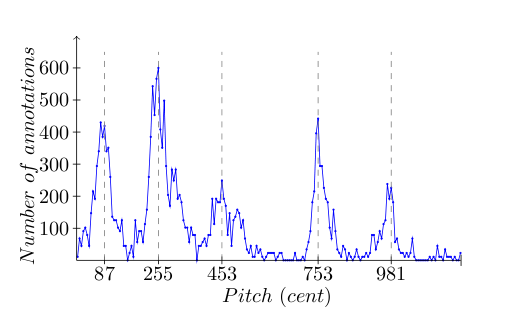
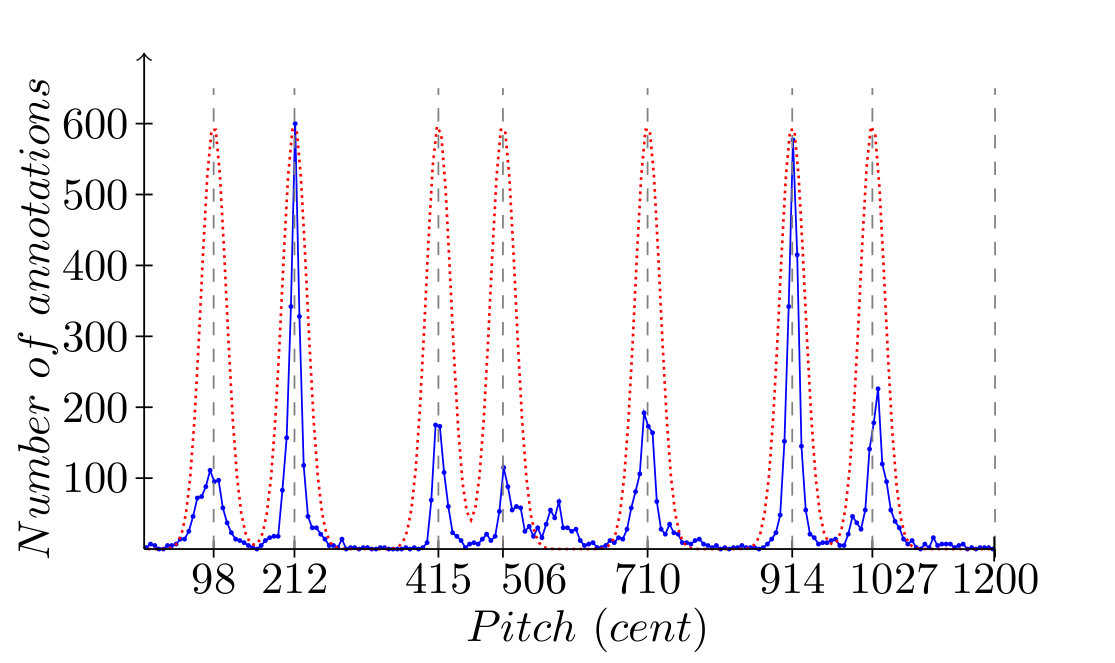
--detector This document describes how pitch can be represented using various units. More specifically it documents how a software program to analyse pitch in music, Tarsos, represents pitch. This document contains definitions of and remarks on different pitch and pitch interval representations. For good measure we need a definition of pitch, here the definition from \[McLeod 2009\] is used: *The pitch frequency is the frequency of a pure sine wave which has the same perceived sound as the sound of interest.* For remarks and examples of cases where the pitch frequency does not coincide with the fundamental frequency of the signal, also see \[McLeod 2009\] . In this text pitch, pitch interval and pitch ratio are briefly discussed.- [pitch\_representation.pdf](https://0110.be/files/attachments/354/pitch_representation.pdf) --- ## [The Power of the Pentatonic Scale](https://0110.be/posts/The_Power_of_the_Pentatonic_Scale.md) - Published: 2011-12-06T14:05:56Z - Updated: 2013-12-05T18:19:15Z - Author: Joren - ID: 387 - Canonical: https://0110.be/posts/The_Power_of_the_Pentatonic_Scale - Tags: [Computational musicology](https://0110.be/tags/Computational%20musicology.md), [HoGent](https://0110.be/tags/HoGent.md), [Tarsos](https://0110.be/tags/Tarsos.md), [featured](https://0110.be/tags/featured.md) The following video shows Bobby McFerrin demonstrating the power of the pentatonic scale. It is a fascinating demonstration of how quickly a (western) audience of the World Science Festival 2009 adapts to an unusual tone scale: With Tarsos the scale used in the example can be found. This is the result of a quick analysis: it becomes clear that this, in fact, a pentatonic scale with an unequal octave division. A perfect fifth is present between 255 and 753 cents:
 The 17th of Octobre 2011 Tarsos was presented at the [Study Day: Tuning and Temperament](http://music.sas.ac.uk/imr-events/imr-conferences-colloquia-performance-events/study-day-tuning-and-temperament.html) which was held at the Institue of Music Research in Londen. The study day was organised by Dan Tidhar. A short description of the aim of the study day:
This is an interdisciplinary study day, bringing together musicologists, harpsichord specialists, and digital music specialists, with the aim of exploring the different angles these fields provide on the subject, and how these can be fruitfully interconnected. We offer an optional introduction to temperament for non specialists, to equip all potential listeners with the basic concepts and terminology used throughout the day.--- ## [Tarsos presentation at 'ISMIR 2011'](https://0110.be/posts/Tarsos_presentation_at_%27ISMIR_2011%27.md) - Published: 2011-10-25T21:55:27Z - Updated: 2013-12-05T18:19:15Z - Author: Joren - ID: 368 - Canonical: https://0110.be/posts/Tarsos_presentation_at_%27ISMIR_2011%27 - Tags: [Computational ethnomusicology](https://0110.be/tags/Computational%20ethnomusicology.md), [HoGent](https://0110.be/tags/HoGent.md), [ISMIR](https://0110.be/tags/ISMIR.md), [Music Information Retrieval](https://0110.be/tags/Music%20Information%20Retrieval.md), [Presentation](https://0110.be/tags/Presentation.md), [Research papers](https://0110.be/tags/Research%20papers.md), [Tarsos](https://0110.be/tags/Tarsos.md)
Olmo Cornelis and myself just gave a presentation about Tarsos at the at the [12th International Society for Music Information Retrieval Conference](http://ismir2011.ismir.net/) which is held at Miami.
The live demo we gave went well and we got a lot of positive, interesting feedback. The [presentation about Tarsos](https://0110.be/25.10.2011.ismir_tarsos.pdf) is available here.
It was the first time in the history of ISMIR that there was a session with oral [presentations about Non-Western Music](http://ismir2011.ismir.net/program.html#OS2). We were pleased to be part of this.
The peer reviewed paper about our work: [Tarsos - a Platform to Explore Pitch Scales in Non-Western and Western Music](http://ismir2011.ismir.net/program.html#OS2) is available from the ISMIR website and embedded below:
- [2011.10.25.ismir\_tarsos.pdf](https://0110.be/files/attachments/368/2011.10.25.ismir_tarsos.pdf)
---
## [Tarsos at 'WASPAA 2011'](https://0110.be/posts/Tarsos_at_%27WASPAA_2011%27.md)
- Published: 2011-10-18T13:59:12Z
- Updated: 2013-12-05T18:19:15Z
- Author: Joren
- ID: 367
- Canonical: https://0110.be/posts/Tarsos_at_%27WASPAA_2011%27
- Tags: [HoGent](https://0110.be/tags/HoGent.md), [Presentation](https://0110.be/tags/Presentation.md), [Tarsos](https://0110.be/tags/Tarsos.md), [featured](https://0110.be/tags/featured.md)
During the the demo session of the [IEEE Workshop on Applications of Signal Processing to Audio and Acoustics (WASPAA)](http://waspaa.com) a demonstration of Tarsos was given. During the demo, [the 18th of Octobre 2011](http://www.waspaa.com/waspaa11/information-for-attendees/schedule/index.html#DM) feedback was gathered.
During the conference I met interesting people and their work:
Carnatic Music Analysis: Shadja, Swara Identification and Raga Verification in Alapana using Stochastic Models\
Ranjani HG, Arthi S, Sreenivas TV
Simulation of the Violin Section Sound based on the analysis of orchestra performance\
Jukka Pätynen, Sakari Tervo, Tapio Lokki
Another interesting paper is [Informed Source Separation: Source Coding Meets Source Separation](http://hal.inria.fr/docs/00/61/05/26/PDF/Ozerov_et_al_WASPAA11_v6.pdf). A demo of this can be found [here](http://www.irisa.fr/metiss/ozerov/ciss_demo.html).
---
## [Makam Recognition with the Tarsos API](https://0110.be/posts/Makam_Recognition_with_the_Tarsos_API.md)
- Published: 2011-09-01T08:13:21Z
- Updated: 2013-12-05T18:19:15Z
- Author: Joren
- ID: 406
- Canonical: https://0110.be/posts/Makam_Recognition_with_the_Tarsos_API
- Tags: [Code](https://0110.be/tags/Code.md), [Computational ethnomusicology](https://0110.be/tags/Computational%20ethnomusicology.md), [HoGent](https://0110.be/tags/HoGent.md), [Java](https://0110.be/tags/Java.md), [Music Information Retrieval](https://0110.be/tags/Music%20Information%20Retrieval.md), [Tarsos](https://0110.be/tags/Tarsos.md)
This article describes how to do makam recognition with a script that uses the Tarsos API.
The task we want to do is to find the tone scales most similar to the one used in recorded music. To complete this task you need a small set of theoretical scales and a large set of music, each brought in one of the scales. To make it more concrete, an example of Turkish classical music is used.
In an [article by Bozkurt](http://dl.acm.org/citation.cfm?id=1688013) pitch histograms are used for - amongst other tasks - makam recognition. A maqam defines rules for a composition or performance of classical Turkish music. It specifies melodic shapes and pitch intervals, the scale. The task is to identify which of nine makams is used in a specific song. A simplified, generalized implementation of this task is shown here. In our implementation there is no tonic detection step. Also here we use only theoretical descriptions of the tone scales as a template and do not construct a template using the audio itself, as is done by Bozkurt. Ioannidis Leonidas wrote an interesting [master thesis about makam recognition](http://www.mtg.upf.edu/static/media/Ioannidis-Leonidas-Master-Thesis-2010.pdf). Since no knowledge of the music itself is used the approach is generally applicable.
The following is an implementation in [Scala](http://scala-lang.org) a general purpose programming language that is interoperable with Jave . The first step is to write the Scala header. This is just some boilerplate code to be able to run the script from the command line - it assumes a UNIX-like environment and tarsos.jar in the same directory:
\`\`\`ruby\
#!/bin/sh\
exec scala -cp tarsos.jar -savecompiled "\$0" "\$@"\
!#\
import be.hogent.tarsos.util.\_\
//other import statements\
\`\`\`
The second step constructs the templates the capability of Tarsos to create\
theoretical tone scale templates using Gaussian kernels is used, line 8. See the attached images for some examples.
\`\`\`ruby\
val makams = List( "hicaz","huseyni","huzzam","kurdili_hicazar",\
"nihavend","rast","saba","segah","ussak")
var theoreticKDEs = Map\[java.lang.String,KernelDensityEstimate\]()\
makams.foreach{ makam =\>\
val scalaFile = makam + ".scl"\
val scalaObject = new ScalaFile(scalaFile);\
val kde = HistogramFactory.createPichClassKDE(scalaObject,35)\
kde.normalize\
theoreticKDEs = theoreticKDEs + (makam -\> kde)\
}\
\`\`\`
The third and last step is matching. First a list of audio\
files is created by recursively iterating a directory and matching each file to\
a regular expression. Next, starting from line 4, each audio file is processed.\
The internal implementation of the YIN pitch detection\
algorithm is used on the audio file and a pitch class histogram is created\
(line 6,7). On line 10 normalization of the histogram is done, to\
make the correlation calculation meaningful. Line 11 until 15 compare the\
created histogram from the audio file with the templates calculated beforehand.\
The results are stored, ordered and eventually printed on line 19.
\`\`\`ruby\
val directory = "/home/joren/turkish_makams/"\
val audio_pattern = ".\*.(mp3\|wav\|ogg\|flac)"\
val audioFiles = FileUtils.glob(directory,audio_pattern,true).toList
audioFiles.foreach{ file =\>\
val audioFile = new AudioFile(file)\
val detectorYin = PitchDetectionMode.TARSOS_YIN.getPitchDetector(audioFile)\
val annotations = detectorYin.executePitchDetection()\
val actualKDE = HistogramFactory.createPichClassKDE(annotations,15);\
actualKDE.normalize\
var resultList = List\[Tuple2\[java.lang.String,Double\]\]()\
for ((name, theoreticKDE) \<- theoreticKDEs){\
val shift = actualKDE.shiftForOptimalCorrelation(theoreticKDE)\
val currentCorrelation = actualKDE.correlation(theoreticKDE,shift)\
resultList = (name -\> currentCorrelation) :: resultList\
}\
//order by correlation\
resultList = resultList.sortBy{\_.\_2}.reverse\
Console.println(file + " is brought in tone scale " + resultList(0).\_1)\
}\
\`\`\`
A complete version of this script can is available: "Tone scale matching script":\[guess_makam.scala\] Results of the script when ran on Bozkurt's dataset can be seen in the attached spreadsheet ("openoffice format":\[makam_recognition_results.ods\] or "excel format":\[makam_recognition_results.xls\]).
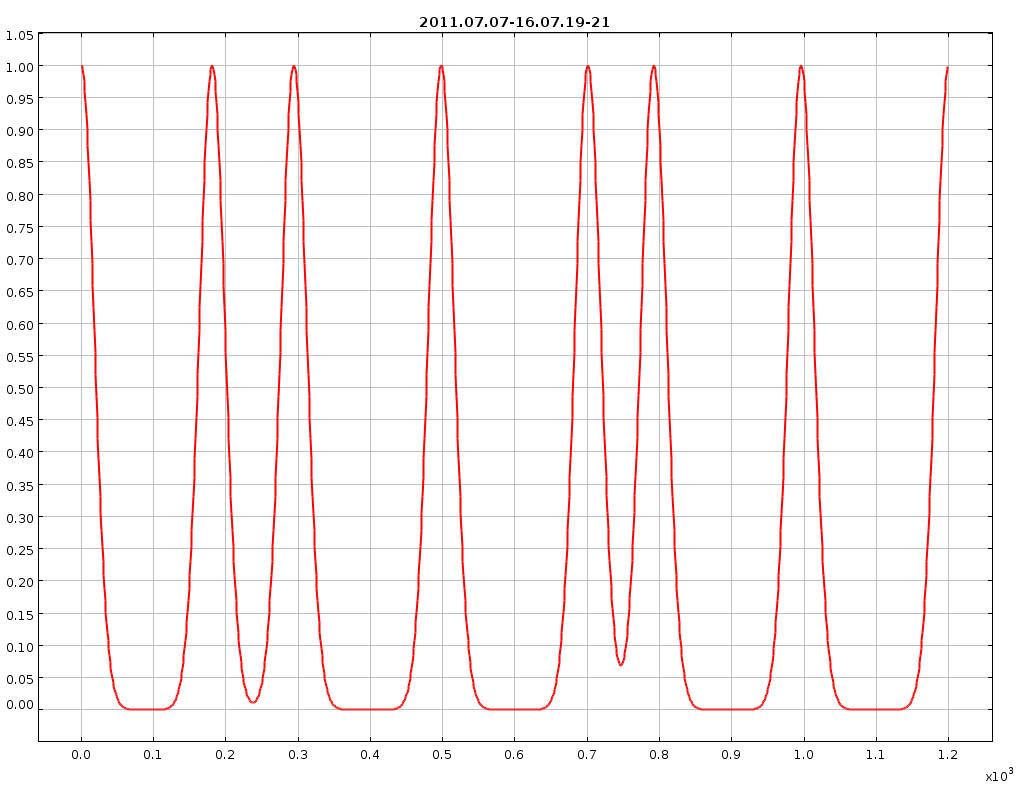
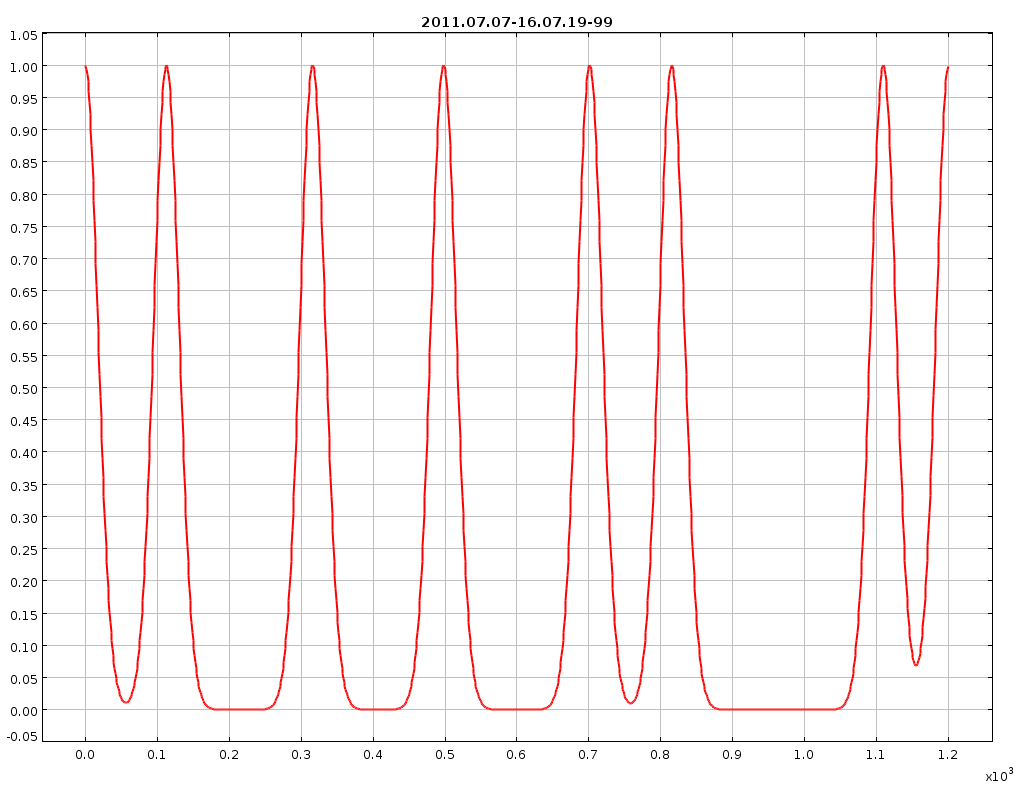
- [guess\_makam.scala](https://0110.be/files/attachments/406/guess_makam.scala)
- [makams.zip](https://0110.be/files/attachments/406/makams.zip)
- [makam\_recognition\_results.ods](https://0110.be/files/attachments/406/makam_recognition_results.ods)
- [makam\_recognition\_results.xls](https://0110.be/files/attachments/406/makam_recognition_results.xls)
---
## [Tarsos at 'ISMIR 2011'](https://0110.be/posts/Tarsos_at_%27ISMIR_2011%27.md)
- Published: 2011-08-22T08:26:09Z
- Updated: 2013-12-05T18:19:15Z
- Author: Joren
- ID: 405
- Canonical: https://0110.be/posts/Tarsos_at_%27ISMIR_2011%27
- Tags: [Code](https://0110.be/tags/Code.md), [Computational ethnomusicology](https://0110.be/tags/Computational%20ethnomusicology.md), [HoGent](https://0110.be/tags/HoGent.md), [ISMIR](https://0110.be/tags/ISMIR.md), [Music Information Retrieval](https://0110.be/tags/Music%20Information%20Retrieval.md), [Research papers](https://0110.be/tags/Research%20papers.md), [Tarsos](https://0110.be/tags/Tarsos.md), [featured](https://0110.be/tags/featured.md)
A paper about Tarsos was submitted for review at the [12th International Society for Music Information Retrieval Conference](http://ismir2011.ismir.net/) which will be held in Miami. The paper "Tarsos - a Platform to Explore Pitch Scales in Non-Western and Western Music":\[tarsos_ismir_2011.pdf\] was reviewed and accepted, it will be published in this year's proceedings of the ISMIR conference. It can be read below as well.
An oral presentation about Tarsos is going to take place Tuesday, the 25 of October during the afternoon, as can be seen on the [ISMIR preliminary program schedule](http://ismir2011.ismir.net/program.html#OS2).
If you want to cite our work, please use the following data:
\`\`\`ruby\
\@inproceedings{six2011tarsos,\
author = {Joren Six and Olmo Cornelis},\
title = {Tarsos - a Platform to Explore Pitch Scales\
in Non-Western and Western Music},\
booktitle = {Proceedings of the 12th International\
Society for Music Information Retrieval Conference,\
ISMIR 2011},\
year = {2011},\
publisher = {International Society for Music Information Retrieval}\
}\
\`\`\`
- [tarsos\_ismir\_paper.bibtex.txt](https://0110.be/files/attachments/405/tarsos_ismir_paper.bibtex.txt)
- [tarsos\_ismir\_2011.pdf](https://0110.be/files/attachments/405/tarsos_ismir_2011.pdf)
---
## [Latex export functions](https://0110.be/posts/Latex_export_functions.md)
- Published: 2011-06-17T08:02:51Z
- Updated: 2013-12-05T18:19:15Z
- Author: Joren
- ID: 402
- Canonical: https://0110.be/posts/Latex_export_functions
- Tags: [Computational ethnomusicology](https://0110.be/tags/Computational%20ethnomusicology.md), [HoGent](https://0110.be/tags/HoGent.md), [Java](https://0110.be/tags/Java.md), [Tarsos](https://0110.be/tags/Tarsos.md)
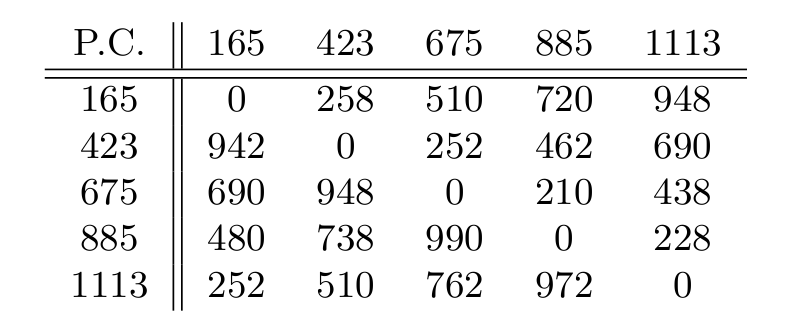
Tarsos, a software package to analyse pitch organization in music, contains a new output modality. It is now possible to export a pitch class histogram and a pitch class interval matrix to latex from within Tarsos. This makes documenting tone scales more efficient.
An example for "a pitch class histogram and pitch class interval matrix":\[latex_export.pdf\] can be seen. Also available is the "latex source code":\[latex_export.tex\].

- [latex\_export.tex](https://0110.be/files/attachments/402/latex_export.tex)
- [latex\_export.pdf](https://0110.be/files/attachments/402/latex_export.pdf)
- [MR.1954.1.19-4.dat](https://0110.be/files/attachments/402/MR.1954.1.19-4.dat)
---
## [Resynthesis of Pitch Detection Annotations on a Flute Piece](https://0110.be/posts/Resynthesis_of_Pitch_Detection_Annotations_on_a_Flute_Piece.md)
- Published: 2011-06-16T14:43:10Z
- Updated: 2013-12-05T18:19:15Z
- Author: Joren
- ID: 403
- Canonical: https://0110.be/posts/Resynthesis_of_Pitch_Detection_Annotations_on_a_Flute_Piece
- Tags: [Code](https://0110.be/tags/Code.md), [Computational ethnomusicology](https://0110.be/tags/Computational%20ethnomusicology.md), [HoGent](https://0110.be/tags/HoGent.md), [Java](https://0110.be/tags/Java.md), [Music Information Retrieval](https://0110.be/tags/Music%20Information%20Retrieval.md), [Tarsos](https://0110.be/tags/Tarsos.md)
Tarsos, a software package to analyse pitch organization in music, contains a new output modality. Now it is possible to export resynthesized pitch annotations, detected by a pitch detection algorithm and compare those with the original sound. This can be interesting to see which errors a pitch detection algorithm makes.
Below you can listen to an example of synthesized pitch detection results compared with the original flute piece. The file starts with only the original flute sound (on the right channel) and gradually changes so only the synthesized annotations (on the left channel) can be heard.
Resynthesis of Pitch Detection Annotations on a Flute Piece by Joren Six
- [flute\_resynth.wav](https://0110.be/files/attachments/403/flute_resynth.wav)
---
## [Tarsos at 'IPEM Open House'](https://0110.be/posts/Tarsos_at_%27IPEM_Open_House%27.md)
- Published: 2011-05-27T10:02:51Z
- Updated: 2013-12-05T18:19:15Z
- Author: Joren
- ID: 400
- Canonical: https://0110.be/posts/Tarsos_at_%27IPEM_Open_House%27
- Tags: [Computational ethnomusicology](https://0110.be/tags/Computational%20ethnomusicology.md), [Computational musicology](https://0110.be/tags/Computational%20musicology.md), [HoGent](https://0110.be/tags/HoGent.md), [Presentation](https://0110.be/tags/Presentation.md), [Tarsos](https://0110.be/tags/Tarsos.md), [featured](https://0110.be/tags/featured.md)
 The 25th of May 2011 Tarsos was present at the [IPEM (Institute for Psychoacoustics and Electronic Music)](http://www.ipem.ugent.be/) open house.
> IPEM (Institute for Psychoacoustics and Electronic Music) is the research center of the Department of Musicology, which is part of the Department of Art, Music and Theater Studies of Ghent University. IPEM provides a scientific basis for the cultural and creative sector, especially for music and performance arts, and does pioneering research work on the relationship between music body movement and new technologies. The institute consists of an interdisciplinary team but also welcomes visiting researchers from all over the world. One of its aims is also to actively try and validate research results during public events and by means of user studies.
There are close relations between the Royal Conservatory Ghent, where we are located, and IPEM. There is more information [about the IPEM open house](http://www.ipem.ugent.be/node/292) available. Also available is [the program of the IPEM open house 2011](http://www.ipem.ugent.be/node/293)
Tarsos was presented using a poster, a flyer and a live demo. The "poster about Tarsos":\[tarsos_poster.pdf\] and the "flyer about Tarsos":\[tarsos_flyer.pdf\] are both downloadable.
- [tarsos\_flyer.pdf](https://0110.be/files/attachments/400/tarsos_flyer.pdf)
- [tarsos\_poster.pdf](https://0110.be/files/attachments/400/tarsos_poster.pdf)
- [ipem\_logo.gif](https://0110.be/files/attachments/400/ipem_logo.gif)
---
## [Tarsos at 'First International Workhop of Folk Music Analysis'](https://0110.be/posts/Tarsos_at_%27First_International_Workhop_of_Folk_Music_Analysis%27.md)
- Published: 2011-05-13T09:46:54Z
- Updated: 2013-12-05T18:19:15Z
- Author: Joren
- ID: 393
- Canonical: https://0110.be/posts/Tarsos_at_%27First_International_Workhop_of_Folk_Music_Analysis%27
- Tags: [Computational musicology](https://0110.be/tags/Computational%20musicology.md), [Computational musicology](https://0110.be/tags/Computational%20musicology.md), [HoGent](https://0110.be/tags/HoGent.md), [Presentation](https://0110.be/tags/Presentation.md), [Tarsos](https://0110.be/tags/Tarsos.md), [featured](https://0110.be/tags/featured.md)
Tarsos will be presented at the [First International Workhop of Folk Music Analysis: Symbolic and Signal Processing](http://www.arehna.di.uoa.gr/fma/):
> "The First International Workhop of Folk Music Analysis: Symbolic and Signal Processing, will take place in Athens, Greece, on the 19th and 20th of May, 2011. ... The purpose of the event is to gather reseachers who work in the area of computational folk music analysis, using symbolic or singal processing methods, to present their work, discuss and exchange views on the topic."
The "submitted abstract about Tarsos":\[Tarsos_FMA_2011.pdf\] can be downloaded. "A presentation about Tarsos":\[2011-05-20-tarsos_at_athens.pdf\] is also available.
- [Tarsos\_FMA\_2011.pdf](https://0110.be/files/attachments/393/Tarsos_FMA_2011.pdf)
- [2011-05-20-tarsos\_at\_athens.pdf](https://0110.be/files/attachments/393/2011-05-20-tarsos_at_athens.pdf)
---
## [TarsosDSP: a small JAVA audio processing library](https://0110.be/posts/TarsosDSP%3A_a_small_JAVA_audio_processing_library.md)
- Published: 2011-03-25T15:58:59Z
- Updated: 2013-12-05T18:19:15Z
- Author: Joren
- ID: 392
- Canonical: https://0110.be/posts/TarsosDSP%3A_a_small_JAVA_audio_processing_library
- Tags: [Code](https://0110.be/tags/Code.md), [HoGent](https://0110.be/tags/HoGent.md), [Java](https://0110.be/tags/Java.md), [Tarsos](https://0110.be/tags/Tarsos.md), [TarsosDSP](https://0110.be/tags/TarsosDSP.md), [featured](https://0110.be/tags/featured.md)
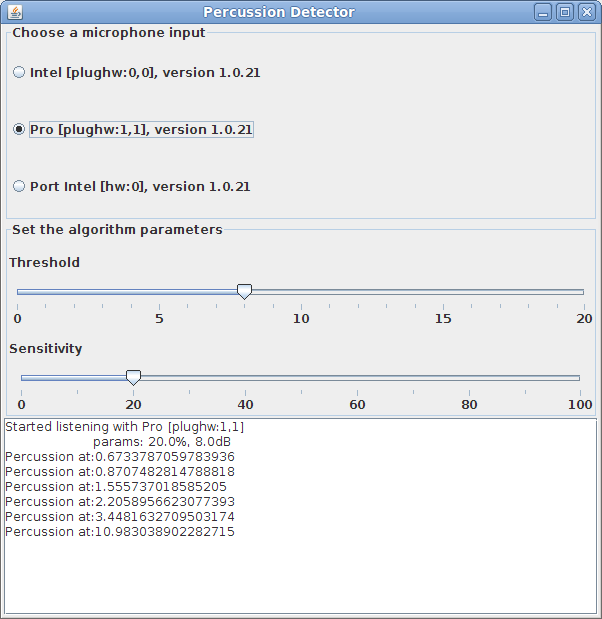
TarsosDSP is a collection of classes to do simple audio processing. It features an implementation of a percussion onset detector and two pitch detection algorithms: Yin and the Mcleod Pitch method.
Its aim is to provide a simple interface to some audio (signal) processing algorithms implemented in JAVA.
To make some of the possibilities clear I coded some examples.
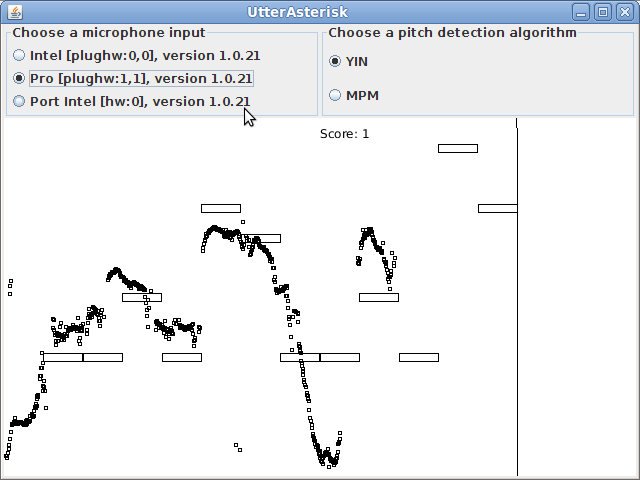
- "TarsosDSP UtterAsterisk":\[UtterAsterisk.jar\] a game that shows real-time pitch detection with YIN.
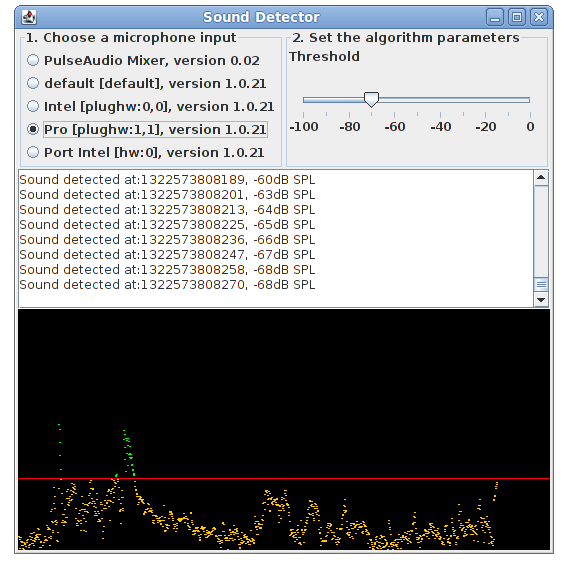
- "TarsosDSP Sound Detector":\[SoundDetector.jar\] is simply to show how to react when (loud) sound is available.
- "TarsosDSP Percussion Detector":\[PercussionDetector.jar\] is capable of detecting percussion onsets using the method described [here](http://arrow.dit.ie/cgi/viewcontent.cgi?article=1018&context=argcon). It plays a sound from [freesound.org](http://freesound.org) when percussion is detected.
The [source code of TarsosDSP](https://github.com/JorenSix/TarsosDSP) is available on github.
### Presentation at Newline
Saturday the 25th of March TarsosDSP was presented at [Newline](http://0x20.be/Newline/Schedule), a small conference organized by [whitespace](http://0x20.be). Here you can download "the slides I used to present TarsosDSP":\[tarsosDSP_presentation.pdf\], I also created "an introductory text on sound and Java":\[sound_and_java.pdf\].
- [PitchDetector.jar](https://0110.be/files/attachments/392/PitchDetector.jar)
- [PercussionDetector.jar](https://0110.be/files/attachments/392/PercussionDetector.jar)
- [tarsosDSP\_presentation.pdf](https://0110.be/files/attachments/392/tarsosDSP_presentation.pdf)
- [sound\_and\_java.pdf](https://0110.be/files/attachments/392/sound_and_java.pdf)
- [UtterAsterisk.jar](https://0110.be/files/attachments/392/UtterAsterisk.jar)
- [SoundDetector.jar](https://0110.be/files/attachments/392/SoundDetector.jar)
---
## [Tarsos praktisch](https://0110.be/posts/Tarsos_praktisch.md)
- Published: 2011-03-21T13:54:41Z
- Updated: 2013-12-05T18:19:15Z
- Author: Joren
- ID: 397
- Canonical: https://0110.be/posts/Tarsos_praktisch
- Tags: [Dutch](https://0110.be/tags/Dutch.md), [HoGent](https://0110.be/tags/HoGent.md), [Tarsos](https://0110.be/tags/Tarsos.md)
### Wat
Tarsos is een softwareprogramma waarmee toonhoogte in muziek onderzocht kan worden in onder meer etnische muziek. Het kan gebruikt worden om toonintervallen en toonladders te identificeren. Het maakt kwarttonen of andere (ongewone) intervallen visueel duidelijk. Tarsos heeft nu ook real-time mogelijkheden. Geluid afkomstig van een microfoon wordt meteen geanalyseerd en onmiddellijke feedback toont een gespeeld of gezongen interval. Zangers of instrumentalisten die willen experimenteren met intonatie kunnen Tarsos zelf uit te proberen.
Meer info over de werking van Tarsos is te vinden in een "kort artikel over de werking van Tarsos":\[tarsos_werking.pdf\]. Daarin wordt ook de betekenis van de verschillende vensters in Tarsos duidelijk.
### Installatie
Om Tarsos te kunnen gebruiken heb je, naast Tarsos zelf, Java nodig. Java staat waarschijnlijk al op je pc. Dit is te controleren op [java.com](http://java.com). Daar zijn ook instructies te vinden hoe je Java kan installeren.
Met een werkende Java is Tarsos installeren eenvoudig: download [Tarsos](https://0110.be/attachment/tarsos.jar) en voer het uit (dubbel klikken).
### Toonladder detecteren
Om een toonladder te detecteren in een muziekbestand met Tarsos doe je het volgende.
1. Open het bestand door via `file - open...` het bestand te kiezen. Een voorbeeld van een muziek bestand in een vreemde toonladder is hier te vinden het is "een cello suite van Bach gespeeld in een toonladder met 10 gelijke delen - intervallen van 120 cents":\[bach_BWV_1007_120.mp3\]
2. Laat het algoritme het bestand analyseren.
3. Detecteer de pieken in het histogram door met de slider `peakpicking` te bewegen. Als niet alle pieken gedetecteerd worden kan je een piek toevoegen door met `alt` en een muisbeweging over het pitch class histogram te bewegen. Klik om de positie van de piek te bevestigen. Met `ctrl` kunnen pieken verplaatst worden.
Deze stappen zijn ook te zien in een screenshot in de bijlage. Om de informatie te exporteren kan je bij de uitvoeropties kijken. Met `file - export - scala...` kan je een scala bestand exporteren. Dit zijn tekstbestanden met daarin een toonladder die gebruikt kunnen worden in het [Scala programma](http://www.huygens-fokker.org/scala/).
### Real time analyse
Met de real time analyse kan je intervallen inspelen en via visuele feedback meteen te weten komen hoe dicht je intonatie bij het gewenste resultaat zat. Je hebt er een microfoon voor nodig. Door `Settings - Tarsos Live` te kiezen en daarna Tarsos af te sluiten en opnieuw te starten luistert Tarsos naar geluid afkomstig van een microfoon. Speel toonhoogte intervallen en die worden visueel duidelijk. De reset knop wist het histogram.

- [tarsos\_werking.pdf](https://0110.be/files/attachments/397/tarsos_werking.pdf)
- [bach\_BWV\_1007\_120.mp3](https://0110.be/files/attachments/397/bach_BWV_1007_120.mp3)
---
## [Tarsos at 'Lectures on Computational Ethnomusicology'](https://0110.be/posts/Tarsos_at_%27Lectures_on_Computational_Ethnomusicology%27.md)
- Published: 2011-02-24T13:09:23Z
- Updated: 2013-12-05T18:19:15Z
- Author: Joren
- ID: 385
- Canonical: https://0110.be/posts/Tarsos_at_%27Lectures_on_Computational_Ethnomusicology%27
- Tags: [Computational ethnomusicology](https://0110.be/tags/Computational%20ethnomusicology.md), [HoGent](https://0110.be/tags/HoGent.md), [Presentation](https://0110.be/tags/Presentation.md), [Tarsos](https://0110.be/tags/Tarsos.md), [featured](https://0110.be/tags/featured.md)
This monday the 28th of February Tarsos will be presented at "Lectures on Computational Ethnomusicology" which is held at Izmir, Turkey. "The presentation of Tarsos":\[2011-02-28_tarsos_at_izmir.pdf\] is available here.
Next to the interesting "programme":\[programme_lectures_on_comp_ethno_izmir.pdf\] it is a great opportunity to meet [Baris Bozkurt](http://web.iyte.edu.tr/~barisbozkurt/) who has been working on similar research but applied to [Makam music](http://likya.iyte.edu.tr/eee/labs/audio/Main.html).
On wednesday the second of March there is a small seminar at Electrical and Electronics Eng. Dept. of [İzmir Yüksek Teknoloji Enstitüsü](http://www.iyte.edu.tr/) where Tarsos will be presented also.
- [2011-02-28\_tarsos\_at\_izmir.pdf](https://0110.be/files/attachments/385/2011-02-28_tarsos_at_izmir.pdf)
- [2011-02-28-tarsos\_at\_izmir.odp](https://0110.be/files/attachments/385/2011-02-28-tarsos_at_izmir.odp)
- [programme\_lectures\_on\_comp\_ethno\_izmir.pdf](https://0110.be/files/attachments/385/programme_lectures_on_comp_ethno_izmir.pdf)
---
## [ARIP: Artistic Research In Progress](https://0110.be/posts/ARIP%3A_Artistic_Research_In_Progress.md)
- Published: 2011-02-01T10:35:52Z
- Updated: 2013-12-05T18:19:15Z
- Author: Joren
- ID: 386
- Canonical: https://0110.be/posts/ARIP%3A_Artistic_Research_In_Progress
- Tags: [ARIP](https://0110.be/tags/ARIP.md), [Computational ethnomusicology](https://0110.be/tags/Computational%20ethnomusicology.md), [Computational musicology](https://0110.be/tags/Computational%20musicology.md), [HoGent](https://0110.be/tags/HoGent.md), [Presentation](https://0110.be/tags/Presentation.md), [Research papers](https://0110.be/tags/Research%20papers.md), [Tarsos](https://0110.be/tags/Tarsos.md)
Voor ARIP (Artistic Research In Progress) heb ik een "artikel over Tarsos":\[arip.pdf\] geschreven. Het motiveert kort de bestaansredenen van Tarsos - een applicatie om toonhoogtegebruik in muziek te analyseren - en het artikel geeft een overzicht van de werking van Tarsos aan de hand van een voorbeeld. Hieronder zijn multimediale aanvullingen te vinden bij het artikel.
Ladrang Kandamanyura (slendro pathet manyura), zo heet het muziekfragment dat gebruikt werd in het artikel als voorbeeld van een stuk muziek met een ongewone (voor onze westerse oren toch) toonladder. De CD waarop het stuk te vinden is, is bij [wergo](http://www.wergo.de/shop/en_UK/Audio_CDs/1000088/show,223736,n.html) te verkrijgen. Een fragment van 30 seconden is hier te beluisteren:
Het fragment kan je ook "downloaden":\[08.\_Ladrang_Kandamanyura_10s-20s.wav\] om zelf te analyseren met Tarsos.
Ladrang Kandamanyura (slendro pathet manyura) A new version of Tarsos was uploaded today and it contains an exciting (at least my kind of exciting) new feature. It is capable of real-time pitch analysis and tone scale construction. A video should make its use clear:
The immediate feedback is practical for educational purposes: it makes rather vague things like quarter tones or (uncommon) pitch intervals in general quite tangible. It could be used by singers or string players to explore microtonality or to improve their technique. Another use case is ethnomusicologic field-work: if you would want to research Kora tuning (an African harp) Tarsos could be a practical tool for real-time analysis.
Thanks to [Olmo Cornelis](http://cons.hogent.be/nl/onderzoek/onderzoeksprojecten/olmo-cornelis) and [Wannes Gonnissen](http://cons.hogent.be/nl/onderzoek/onderzoeksprojecten/wannes-gonnissen) for playing the thumb piano and Saz respectively.
---
## [Tarsos in het jaarboek Orpheus instituut](https://0110.be/posts/Tarsos_in_het_jaarboek_Orpheus_instituut.md)
- Published: 2011-01-14T14:54:35Z
- Updated: 2013-12-05T18:19:15Z
- Author: Joren
- ID: 380
- Canonical: https://0110.be/posts/Tarsos_in_het_jaarboek_Orpheus_instituut
- Tags: [Computational ethnomusicology](https://0110.be/tags/Computational%20ethnomusicology.md), [Dutch](https://0110.be/tags/Dutch.md), [HoGent](https://0110.be/tags/HoGent.md), [Music Information Retrieval](https://0110.be/tags/Music%20Information%20Retrieval.md), [Tarsos](https://0110.be/tags/Tarsos.md)
Naar jaarlijkse gewoonte wordt er in het [Orpheus instituut](http://www.orpheusinstituut.be/nl/home) de [Dag van het Artistiek onderzoek](http://www.orpheusinstituut.be/nl/seminaries/studiedagen-2010-2011#DAO) georganiseerd. Hieronder volgt een tekstje over het onderzoeksproject rond Tarsos dat in het jaarboek komt. Het jaarboek is een boekje met daarin een overzicht van artistieke onderzoeksprojecten aan Vlaamse instituten. Het wordt gepubliceerd naar aanleiding van de eerder aangehaalde "Dag van het Artistiek Onderzoek".
Het doel van dit onderzoeksproject is het ontwikkelen van een methode om een cultuuronafhankelijke kijk op muzikale parameters te verkrijgen. Meer concreet worden er technieken aangewend uit Music Information Retrieval om toonhoogte, tempo en timbre te bestuderen. Aanpassing van bestaande, meestal westers georiënteerde, MIR-methodes moet leiden tot een gestructureerde documentatie van verschillende klankkleuren, toonschalen, metrische verhoudingen en muzikale vormen. Die beschrijving kan dienen als inspiratie voor de ontwikkeling van een artistieke compsitionele taal of kan gebruikt worden als bronmateriaal voor wetenschappelijk onderzoek rond ethnische muziek. Bijvoorbeeld om (de eventuele\
teloorgang van) de eigenheid van orale muziekculturen objectief aan te tonen.
The 25th of May 2011 Tarsos was present at the [IPEM (Institute for Psychoacoustics and Electronic Music)](http://www.ipem.ugent.be/) open house.
> IPEM (Institute for Psychoacoustics and Electronic Music) is the research center of the Department of Musicology, which is part of the Department of Art, Music and Theater Studies of Ghent University. IPEM provides a scientific basis for the cultural and creative sector, especially for music and performance arts, and does pioneering research work on the relationship between music body movement and new technologies. The institute consists of an interdisciplinary team but also welcomes visiting researchers from all over the world. One of its aims is also to actively try and validate research results during public events and by means of user studies.
There are close relations between the Royal Conservatory Ghent, where we are located, and IPEM. There is more information [about the IPEM open house](http://www.ipem.ugent.be/node/292) available. Also available is [the program of the IPEM open house 2011](http://www.ipem.ugent.be/node/293)
Tarsos was presented using a poster, a flyer and a live demo. The "poster about Tarsos":\[tarsos_poster.pdf\] and the "flyer about Tarsos":\[tarsos_flyer.pdf\] are both downloadable.
- [tarsos\_flyer.pdf](https://0110.be/files/attachments/400/tarsos_flyer.pdf)
- [tarsos\_poster.pdf](https://0110.be/files/attachments/400/tarsos_poster.pdf)
- [ipem\_logo.gif](https://0110.be/files/attachments/400/ipem_logo.gif)
---
## [Tarsos at 'First International Workhop of Folk Music Analysis'](https://0110.be/posts/Tarsos_at_%27First_International_Workhop_of_Folk_Music_Analysis%27.md)
- Published: 2011-05-13T09:46:54Z
- Updated: 2013-12-05T18:19:15Z
- Author: Joren
- ID: 393
- Canonical: https://0110.be/posts/Tarsos_at_%27First_International_Workhop_of_Folk_Music_Analysis%27
- Tags: [Computational musicology](https://0110.be/tags/Computational%20musicology.md), [Computational musicology](https://0110.be/tags/Computational%20musicology.md), [HoGent](https://0110.be/tags/HoGent.md), [Presentation](https://0110.be/tags/Presentation.md), [Tarsos](https://0110.be/tags/Tarsos.md), [featured](https://0110.be/tags/featured.md)
Tarsos will be presented at the [First International Workhop of Folk Music Analysis: Symbolic and Signal Processing](http://www.arehna.di.uoa.gr/fma/):
> "The First International Workhop of Folk Music Analysis: Symbolic and Signal Processing, will take place in Athens, Greece, on the 19th and 20th of May, 2011. ... The purpose of the event is to gather reseachers who work in the area of computational folk music analysis, using symbolic or singal processing methods, to present their work, discuss and exchange views on the topic."
The "submitted abstract about Tarsos":\[Tarsos_FMA_2011.pdf\] can be downloaded. "A presentation about Tarsos":\[2011-05-20-tarsos_at_athens.pdf\] is also available.
- [Tarsos\_FMA\_2011.pdf](https://0110.be/files/attachments/393/Tarsos_FMA_2011.pdf)
- [2011-05-20-tarsos\_at\_athens.pdf](https://0110.be/files/attachments/393/2011-05-20-tarsos_at_athens.pdf)
---
## [TarsosDSP: a small JAVA audio processing library](https://0110.be/posts/TarsosDSP%3A_a_small_JAVA_audio_processing_library.md)
- Published: 2011-03-25T15:58:59Z
- Updated: 2013-12-05T18:19:15Z
- Author: Joren
- ID: 392
- Canonical: https://0110.be/posts/TarsosDSP%3A_a_small_JAVA_audio_processing_library
- Tags: [Code](https://0110.be/tags/Code.md), [HoGent](https://0110.be/tags/HoGent.md), [Java](https://0110.be/tags/Java.md), [Tarsos](https://0110.be/tags/Tarsos.md), [TarsosDSP](https://0110.be/tags/TarsosDSP.md), [featured](https://0110.be/tags/featured.md)
TarsosDSP is a collection of classes to do simple audio processing. It features an implementation of a percussion onset detector and two pitch detection algorithms: Yin and the Mcleod Pitch method.
Its aim is to provide a simple interface to some audio (signal) processing algorithms implemented in JAVA.
To make some of the possibilities clear I coded some examples.
- "TarsosDSP UtterAsterisk":\[UtterAsterisk.jar\] a game that shows real-time pitch detection with YIN.
- "TarsosDSP Sound Detector":\[SoundDetector.jar\] is simply to show how to react when (loud) sound is available.
- "TarsosDSP Percussion Detector":\[PercussionDetector.jar\] is capable of detecting percussion onsets using the method described [here](http://arrow.dit.ie/cgi/viewcontent.cgi?article=1018&context=argcon). It plays a sound from [freesound.org](http://freesound.org) when percussion is detected.
The [source code of TarsosDSP](https://github.com/JorenSix/TarsosDSP) is available on github.
### Presentation at Newline
Saturday the 25th of March TarsosDSP was presented at [Newline](http://0x20.be/Newline/Schedule), a small conference organized by [whitespace](http://0x20.be). Here you can download "the slides I used to present TarsosDSP":\[tarsosDSP_presentation.pdf\], I also created "an introductory text on sound and Java":\[sound_and_java.pdf\].



- [PitchDetector.jar](https://0110.be/files/attachments/392/PitchDetector.jar)
- [PercussionDetector.jar](https://0110.be/files/attachments/392/PercussionDetector.jar)
- [tarsosDSP\_presentation.pdf](https://0110.be/files/attachments/392/tarsosDSP_presentation.pdf)
- [sound\_and\_java.pdf](https://0110.be/files/attachments/392/sound_and_java.pdf)
- [UtterAsterisk.jar](https://0110.be/files/attachments/392/UtterAsterisk.jar)
- [SoundDetector.jar](https://0110.be/files/attachments/392/SoundDetector.jar)
---
## [Tarsos praktisch](https://0110.be/posts/Tarsos_praktisch.md)
- Published: 2011-03-21T13:54:41Z
- Updated: 2013-12-05T18:19:15Z
- Author: Joren
- ID: 397
- Canonical: https://0110.be/posts/Tarsos_praktisch
- Tags: [Dutch](https://0110.be/tags/Dutch.md), [HoGent](https://0110.be/tags/HoGent.md), [Tarsos](https://0110.be/tags/Tarsos.md)
### Wat
Tarsos is een softwareprogramma waarmee toonhoogte in muziek onderzocht kan worden in onder meer etnische muziek. Het kan gebruikt worden om toonintervallen en toonladders te identificeren. Het maakt kwarttonen of andere (ongewone) intervallen visueel duidelijk. Tarsos heeft nu ook real-time mogelijkheden. Geluid afkomstig van een microfoon wordt meteen geanalyseerd en onmiddellijke feedback toont een gespeeld of gezongen interval. Zangers of instrumentalisten die willen experimenteren met intonatie kunnen Tarsos zelf uit te proberen.
Meer info over de werking van Tarsos is te vinden in een "kort artikel over de werking van Tarsos":\[tarsos_werking.pdf\]. Daarin wordt ook de betekenis van de verschillende vensters in Tarsos duidelijk.
### Installatie
Om Tarsos te kunnen gebruiken heb je, naast Tarsos zelf, Java nodig. Java staat waarschijnlijk al op je pc. Dit is te controleren op [java.com](http://java.com). Daar zijn ook instructies te vinden hoe je Java kan installeren.
Met een werkende Java is Tarsos installeren eenvoudig: download [Tarsos](https://0110.be/attachment/tarsos.jar) en voer het uit (dubbel klikken).
### Toonladder detecteren
Om een toonladder te detecteren in een muziekbestand met Tarsos doe je het volgende.
1. Open het bestand door via `file - open...` het bestand te kiezen. Een voorbeeld van een muziek bestand in een vreemde toonladder is hier te vinden het is "een cello suite van Bach gespeeld in een toonladder met 10 gelijke delen - intervallen van 120 cents":\[bach_BWV_1007_120.mp3\]
2. Laat het algoritme het bestand analyseren.
3. Detecteer de pieken in het histogram door met de slider `peakpicking` te bewegen. Als niet alle pieken gedetecteerd worden kan je een piek toevoegen door met `alt` en een muisbeweging over het pitch class histogram te bewegen. Klik om de positie van de piek te bevestigen. Met `ctrl` kunnen pieken verplaatst worden.
Deze stappen zijn ook te zien in een screenshot in de bijlage. Om de informatie te exporteren kan je bij de uitvoeropties kijken. Met `file - export - scala...` kan je een scala bestand exporteren. Dit zijn tekstbestanden met daarin een toonladder die gebruikt kunnen worden in het [Scala programma](http://www.huygens-fokker.org/scala/).
### Real time analyse
Met de real time analyse kan je intervallen inspelen en via visuele feedback meteen te weten komen hoe dicht je intonatie bij het gewenste resultaat zat. Je hebt er een microfoon voor nodig. Door `Settings - Tarsos Live` te kiezen en daarna Tarsos af te sluiten en opnieuw te starten luistert Tarsos naar geluid afkomstig van een microfoon. Speel toonhoogte intervallen en die worden visueel duidelijk. De reset knop wist het histogram.

- [tarsos\_werking.pdf](https://0110.be/files/attachments/397/tarsos_werking.pdf)
- [bach\_BWV\_1007\_120.mp3](https://0110.be/files/attachments/397/bach_BWV_1007_120.mp3)
---
## [Tarsos at 'Lectures on Computational Ethnomusicology'](https://0110.be/posts/Tarsos_at_%27Lectures_on_Computational_Ethnomusicology%27.md)
- Published: 2011-02-24T13:09:23Z
- Updated: 2013-12-05T18:19:15Z
- Author: Joren
- ID: 385
- Canonical: https://0110.be/posts/Tarsos_at_%27Lectures_on_Computational_Ethnomusicology%27
- Tags: [Computational ethnomusicology](https://0110.be/tags/Computational%20ethnomusicology.md), [HoGent](https://0110.be/tags/HoGent.md), [Presentation](https://0110.be/tags/Presentation.md), [Tarsos](https://0110.be/tags/Tarsos.md), [featured](https://0110.be/tags/featured.md)
This monday the 28th of February Tarsos will be presented at "Lectures on Computational Ethnomusicology" which is held at Izmir, Turkey. "The presentation of Tarsos":\[2011-02-28_tarsos_at_izmir.pdf\] is available here.
Next to the interesting "programme":\[programme_lectures_on_comp_ethno_izmir.pdf\] it is a great opportunity to meet [Baris Bozkurt](http://web.iyte.edu.tr/~barisbozkurt/) who has been working on similar research but applied to [Makam music](http://likya.iyte.edu.tr/eee/labs/audio/Main.html).
On wednesday the second of March there is a small seminar at Electrical and Electronics Eng. Dept. of [İzmir Yüksek Teknoloji Enstitüsü](http://www.iyte.edu.tr/) where Tarsos will be presented also.
- [2011-02-28\_tarsos\_at\_izmir.pdf](https://0110.be/files/attachments/385/2011-02-28_tarsos_at_izmir.pdf)
- [2011-02-28-tarsos\_at\_izmir.odp](https://0110.be/files/attachments/385/2011-02-28-tarsos_at_izmir.odp)
- [programme\_lectures\_on\_comp\_ethno\_izmir.pdf](https://0110.be/files/attachments/385/programme_lectures_on_comp_ethno_izmir.pdf)
---
## [ARIP: Artistic Research In Progress](https://0110.be/posts/ARIP%3A_Artistic_Research_In_Progress.md)
- Published: 2011-02-01T10:35:52Z
- Updated: 2013-12-05T18:19:15Z
- Author: Joren
- ID: 386
- Canonical: https://0110.be/posts/ARIP%3A_Artistic_Research_In_Progress
- Tags: [ARIP](https://0110.be/tags/ARIP.md), [Computational ethnomusicology](https://0110.be/tags/Computational%20ethnomusicology.md), [Computational musicology](https://0110.be/tags/Computational%20musicology.md), [HoGent](https://0110.be/tags/HoGent.md), [Presentation](https://0110.be/tags/Presentation.md), [Research papers](https://0110.be/tags/Research%20papers.md), [Tarsos](https://0110.be/tags/Tarsos.md)
Voor ARIP (Artistic Research In Progress) heb ik een "artikel over Tarsos":\[arip.pdf\] geschreven. Het motiveert kort de bestaansredenen van Tarsos - een applicatie om toonhoogtegebruik in muziek te analyseren - en het artikel geeft een overzicht van de werking van Tarsos aan de hand van een voorbeeld. Hieronder zijn multimediale aanvullingen te vinden bij het artikel.
Ladrang Kandamanyura (slendro pathet manyura), zo heet het muziekfragment dat gebruikt werd in het artikel als voorbeeld van een stuk muziek met een ongewone (voor onze westerse oren toch) toonladder. De CD waarop het stuk te vinden is, is bij [wergo](http://www.wergo.de/shop/en_UK/Audio_CDs/1000088/show,223736,n.html) te verkrijgen. Een fragment van 30 seconden is hier te beluisteren:
Het fragment kan je ook "downloaden":\[08.\_Ladrang_Kandamanyura_10s-20s.wav\] om zelf te analyseren met Tarsos.
Ladrang Kandamanyura (slendro pathet manyura) A new version of Tarsos was uploaded today and it contains an exciting (at least my kind of exciting) new feature. It is capable of real-time pitch analysis and tone scale construction. A video should make its use clear:
The immediate feedback is practical for educational purposes: it makes rather vague things like quarter tones or (uncommon) pitch intervals in general quite tangible. It could be used by singers or string players to explore microtonality or to improve their technique. Another use case is ethnomusicologic field-work: if you would want to research Kora tuning (an African harp) Tarsos could be a practical tool for real-time analysis.
Thanks to [Olmo Cornelis](http://cons.hogent.be/nl/onderzoek/onderzoeksprojecten/olmo-cornelis) and [Wannes Gonnissen](http://cons.hogent.be/nl/onderzoek/onderzoeksprojecten/wannes-gonnissen) for playing the thumb piano and Saz respectively.
---
## [Tarsos in het jaarboek Orpheus instituut](https://0110.be/posts/Tarsos_in_het_jaarboek_Orpheus_instituut.md)
- Published: 2011-01-14T14:54:35Z
- Updated: 2013-12-05T18:19:15Z
- Author: Joren
- ID: 380
- Canonical: https://0110.be/posts/Tarsos_in_het_jaarboek_Orpheus_instituut
- Tags: [Computational ethnomusicology](https://0110.be/tags/Computational%20ethnomusicology.md), [Dutch](https://0110.be/tags/Dutch.md), [HoGent](https://0110.be/tags/HoGent.md), [Music Information Retrieval](https://0110.be/tags/Music%20Information%20Retrieval.md), [Tarsos](https://0110.be/tags/Tarsos.md)
Naar jaarlijkse gewoonte wordt er in het [Orpheus instituut](http://www.orpheusinstituut.be/nl/home) de [Dag van het Artistiek onderzoek](http://www.orpheusinstituut.be/nl/seminaries/studiedagen-2010-2011#DAO) georganiseerd. Hieronder volgt een tekstje over het onderzoeksproject rond Tarsos dat in het jaarboek komt. Het jaarboek is een boekje met daarin een overzicht van artistieke onderzoeksprojecten aan Vlaamse instituten. Het wordt gepubliceerd naar aanleiding van de eerder aangehaalde "Dag van het Artistiek Onderzoek".
Het doel van dit onderzoeksproject is het ontwikkelen van een methode om een cultuuronafhankelijke kijk op muzikale parameters te verkrijgen. Meer concreet worden er technieken aangewend uit Music Information Retrieval om toonhoogte, tempo en timbre te bestuderen. Aanpassing van bestaande, meestal westers georiënteerde, MIR-methodes moet leiden tot een gestructureerde documentatie van verschillende klankkleuren, toonschalen, metrische verhoudingen en muzikale vormen. Die beschrijving kan dienen als inspiratie voor de ontwikkeling van een artistieke compsitionele taal of kan gebruikt worden als bronmateriaal voor wetenschappelijk onderzoek rond ethnische muziek. Bijvoorbeeld om (de eventuele\
teloorgang van) de eigenheid van orale muziekculturen objectief aan te tonen.
 In de eerste fase van het onderzoek ligt de focus van het onderzoek op één van de meer tastbare parameters: toonhoogte. In etnische muziek is het gebruik van toonhoogte vaak radicaal anders dan westerse muziek die meestal gebaseerd is op de onderverdeling van een octaaf in twaalf gelijke delen. Om toonladders uit\
muziek te extraheren en weer te geven werd het software platform Tarsos ontwikkeld. Met Tarsos is het mogelijk om automatische toonladderanlyse uit te voeren op een grote dataset of om manueel een gedetailleerde analyse te verkrijgen van enkele muziekstukken. De cultuuronafhankelijke analysemethode waarvan Tarsos gebruik maakt kan even goed toegepast worden op Indonesische, Westerse of Afrikaanse muziek.
Onze bedoeling is om Tarsos te gebruiken om evoluties in toonladdergebruik te ontdekken in de enorme dataset van het Koninklijk Museum voor Midden-Afrika. Is toonladderdiversiteit in Afrika aan het wegkwijnen onder invloed van Westerse muziek? Zijn er specifieke kenmerken te vinden over eventueel 'uitgestorven' muziekculturen? Dit zijn vragen die kaderen in het overkoepelende onderzoeksproject van Olmo Cornelis en waar we met behulp van Tarsos een antwoord op proberen te vinden.
Later krijgen de twee overige muzikale parameters, tempo en timbre, een gelijkaardige behandeling. In de laatste fase van dit toch wel ambitieuze onderzoekproject wordt de relatie tussen de parameters onderzocht.
In de eerste fase van het onderzoek ligt de focus van het onderzoek op één van de meer tastbare parameters: toonhoogte. In etnische muziek is het gebruik van toonhoogte vaak radicaal anders dan westerse muziek die meestal gebaseerd is op de onderverdeling van een octaaf in twaalf gelijke delen. Om toonladders uit\
muziek te extraheren en weer te geven werd het software platform Tarsos ontwikkeld. Met Tarsos is het mogelijk om automatische toonladderanlyse uit te voeren op een grote dataset of om manueel een gedetailleerde analyse te verkrijgen van enkele muziekstukken. De cultuuronafhankelijke analysemethode waarvan Tarsos gebruik maakt kan even goed toegepast worden op Indonesische, Westerse of Afrikaanse muziek.
Onze bedoeling is om Tarsos te gebruiken om evoluties in toonladdergebruik te ontdekken in de enorme dataset van het Koninklijk Museum voor Midden-Afrika. Is toonladderdiversiteit in Afrika aan het wegkwijnen onder invloed van Westerse muziek? Zijn er specifieke kenmerken te vinden over eventueel 'uitgestorven' muziekculturen? Dit zijn vragen die kaderen in het overkoepelende onderzoeksproject van Olmo Cornelis en waar we met behulp van Tarsos een antwoord op proberen te vinden.
Later krijgen de twee overige muzikale parameters, tempo en timbre, een gelijkaardige behandeling. In de laatste fase van dit toch wel ambitieuze onderzoekproject wordt de relatie tussen de parameters onderzocht.
 There is more to Tarsos then meets te eye. The graphical user interface only exposes some functionality; the API (Application Programmer Interface) exposes all of Tarsos' capabilities.
Tarsos is programmed in Java so the API is accessible trough Java and other programming languages targeting the JVM (Java Virtual Machine) like JRuby, Scala and Groovy. The following examples use [the Groovy programming language](http://groovy.codehaus.org/) because I find it the most aesthetically pleasing with regards to interoperability and it gets the job done without getting in your way.
To run the examples a copy of the [Tarsos JAR-file](http://0110.be/releases/Tarsos) needs to be added to the Classpath and the Groovy runtime must be installed correctly. I'll leave this as an exercise for the reader: godspeed to you, brave soul. Quick protip: placing a copy of the jar in the extensions directory seems to work best, e.g. see [important java directories on mac OS X.](http://developer.apple.com/library/mac/#qa/qa2001/qa1170.html)
The first example extracts pitch class histograms from a bunch of files and saves them as EPS (Encapsulated PostScript)-files. It iterates a directory recursively and handles each file that matches a given regular expression. In this example the regular expression matches all WAV-files. Batch processing is one of those things scripting is ideal for, doing the same thing with the user interface would be tedious or even mind-numbingly boring, not groovy at all indeed.
\`\`\`ruby\
import be.hogent.tarsos.\*\
import be.hogent.tarsos.util.\*\
import be.hogent.tarsos.util.histogram.ToneScaleHistogram\
import be.hogent.tarsos.sampled.pitch.Annotation\
import be.hogent.tarsos.sampled.pitch.PitchDetectionMode
dir = "/home/joren/audio"
FileUtils.glob(dir,".\*.wav",true).each { file -\>\
audioFile = new AudioFile(file)\
pitchDetector = PitchDetectionMode.TARSOS_YIN.getPitchDetector(audioFile)\
pitchDetector.executePitchDetection()\
//get some annotations\
annotations = pitchDetector.getAnnotations()\
//create an ambitus and tone scale histogram\
ambitusHistogram = Annotation.ambitusHistogram(annotations)\
toneScaleHisto = ambitusHistogram.toneScaleHistogram()\
//plot a smoothed version of the histogram\
p = new SimplePlot()\
p.addData 0, toneScaleHisto.gaussianSmooth(0.2)\
p.save FileUtils.basename( file) + ".eps"\
}\
\`\`\`
The second example uses functionality that is currently only available trough the API. It takes a MIDI-file and synthesizes it to a wave file using an arbitrary scale. In this case 10-TET. The heavy-work is done by the [Gervill synthesizer](https://gervill.dev.java.net/). The resulting file is available for download, micro---macro?---tonal Bach is great: "BWV 1013 in 10-TET":\[BWV_1013_10-TET.mp3\]. The result of "an analysis with Tarsos on the synthesized audio":\[120.png\] clearly shows an interval of 120 cents with some deviations.
\`\`\`ruby\
import java.io.File\
import be.hogent.tarsos.midi.MidiToWavRenderer\
import be.hogent.tarsos.util.ScalaFile
midiFile = new File("BWV_1013.mid")\
outFile = new File("out.wav")
tuning = \[0,120,240,360,480,600,720,840,960,1080\] as double \[\]
MidiToWavRenderer renderer\
renderer = new MidiToWavRenderer()\
renderer.setTuning(tuning)\
renderer.createWavFile(midiFile, outFile)\
\`\`\`
An extended version of this second example script could be used to generate a dataset with audio and corresponding tone scale information on the fly. The dataset could then be used as a baseline.
The API is not yet well documented and is still in flux or more correctly: superflux. Note to self: I will provide documentation and a number of useful examples when the dust settles down. I'm not even sure if I will stick with Groovy. Scala has a nice Lispy feel to it and seems more developed. Groovy has a less steep learning curve, especially if you have some experience with Ruby. JRuby is also nice but the interoperability with legacy Java looks like an ugly hack.
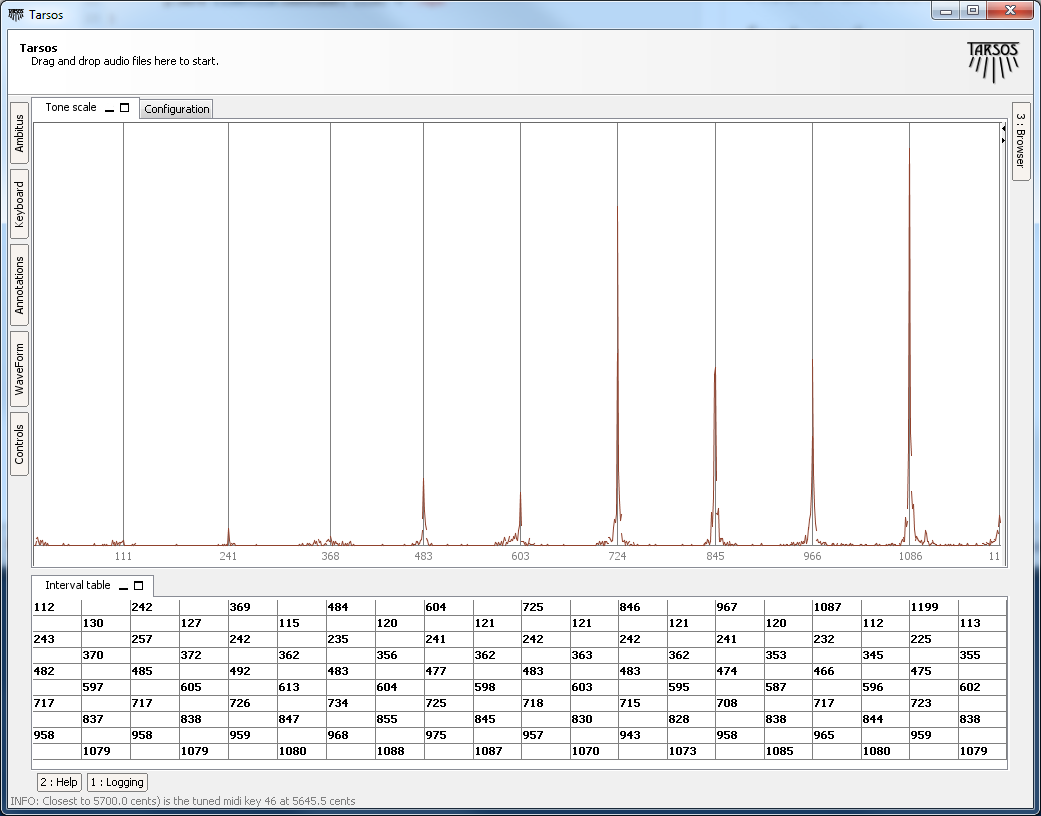
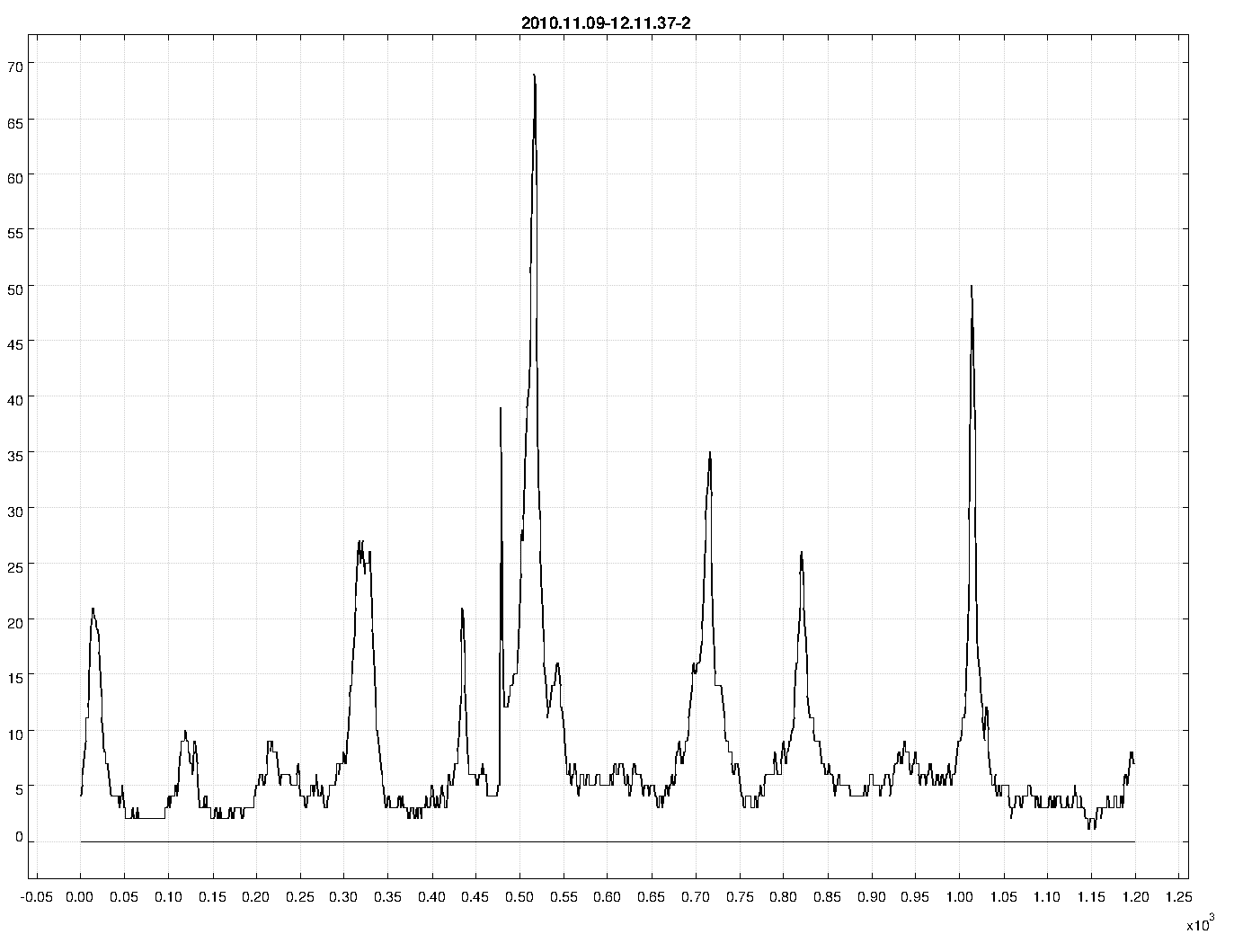
- [medium.png](https://0110.be/files/attachments/346/medium.png)
- [120.png](https://0110.be/files/attachments/346/120.png)
- [BWV\_1013\_10-TET.mp3](https://0110.be/files/attachments/346/BWV_1013_10-TET.mp3)
---
## [Tarsos Screencast](https://0110.be/posts/Tarsos_Screencast.md)
- Published: 2010-10-08T15:16:47Z
- Updated: 2013-12-05T18:19:15Z
- Author: Joren
- ID: 344
- Canonical: https://0110.be/posts/Tarsos_Screencast
- Tags: [Computational ethnomusicology](https://0110.be/tags/Computational%20ethnomusicology.md), [HoGent](https://0110.be/tags/HoGent.md), [Tarsos](https://0110.be/tags/Tarsos.md)
This afternoon I created [a screencast showing the main features of Tarsos](http://www.youtube.com/watch?v=nzDdYvqgcOo). If everything goes well it should be visible below.
To give Tarsos a try you can start Tarsos using JAVA WebStart or download the [executable Tarsos JAR-file](https://0110.be/attachment/tarsos.jar). A JAVA 1.5 runtime is required.
---
## [Tarsos User Interface Prototype](https://0110.be/posts/Tarsos_User_Interface_Prototype.md)
- Published: 2010-08-30T13:33:20Z
- Updated: 2013-12-05T18:19:15Z
- Author: Joren
- ID: 345
- Canonical: https://0110.be/posts/Tarsos_User_Interface_Prototype
- Tags: [Computational ethnomusicology](https://0110.be/tags/Computational%20ethnomusicology.md), [HoGent](https://0110.be/tags/HoGent.md), [Java](https://0110.be/tags/Java.md), [Tarsos](https://0110.be/tags/Tarsos.md), [featured](https://0110.be/tags/featured.md)
Tarsos now has an easy to use drag and drop User Interface. It can be used to extract tone scale information from audio files.
Start tarsos using JAVA WebStart.
Drag and drop works for scala tone scale files and different kinds of audio files. Audiofiles are transcoded automagically using an embedded ffmpeg binary which is platform dependend. It works on linux and windows, on other platforms only WAV files are supported.
Some of the current features:
- Scala file extraction from audio
- Real time pitch tracking
- Real time pitch class histogram visualization
- Alignment of pitch intervals with histogram using mouse dragging
- MIDI Tuning messages based on scala files.
- Histogram smoothing functions
- ... a lot more is available under the hood.
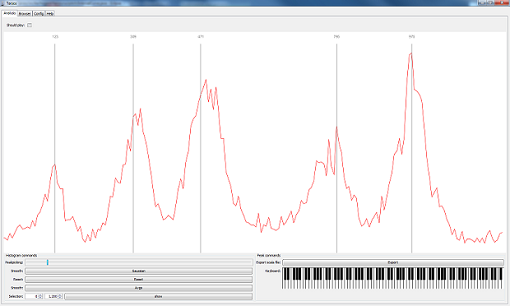
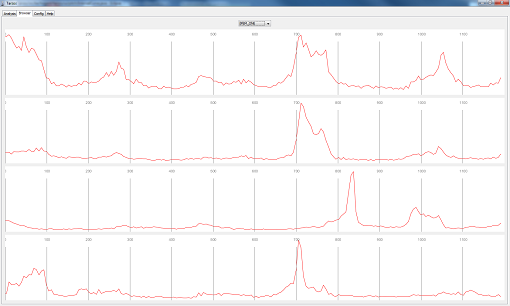
---
[Older posts](https://0110.be/tags/Tarsos.md?page=1)
There is more to Tarsos then meets te eye. The graphical user interface only exposes some functionality; the API (Application Programmer Interface) exposes all of Tarsos' capabilities.
Tarsos is programmed in Java so the API is accessible trough Java and other programming languages targeting the JVM (Java Virtual Machine) like JRuby, Scala and Groovy. The following examples use [the Groovy programming language](http://groovy.codehaus.org/) because I find it the most aesthetically pleasing with regards to interoperability and it gets the job done without getting in your way.
To run the examples a copy of the [Tarsos JAR-file](http://0110.be/releases/Tarsos) needs to be added to the Classpath and the Groovy runtime must be installed correctly. I'll leave this as an exercise for the reader: godspeed to you, brave soul. Quick protip: placing a copy of the jar in the extensions directory seems to work best, e.g. see [important java directories on mac OS X.](http://developer.apple.com/library/mac/#qa/qa2001/qa1170.html)
The first example extracts pitch class histograms from a bunch of files and saves them as EPS (Encapsulated PostScript)-files. It iterates a directory recursively and handles each file that matches a given regular expression. In this example the regular expression matches all WAV-files. Batch processing is one of those things scripting is ideal for, doing the same thing with the user interface would be tedious or even mind-numbingly boring, not groovy at all indeed.
\`\`\`ruby\
import be.hogent.tarsos.\*\
import be.hogent.tarsos.util.\*\
import be.hogent.tarsos.util.histogram.ToneScaleHistogram\
import be.hogent.tarsos.sampled.pitch.Annotation\
import be.hogent.tarsos.sampled.pitch.PitchDetectionMode
dir = "/home/joren/audio"
FileUtils.glob(dir,".\*.wav",true).each { file -\>\
audioFile = new AudioFile(file)\
pitchDetector = PitchDetectionMode.TARSOS_YIN.getPitchDetector(audioFile)\
pitchDetector.executePitchDetection()\
//get some annotations\
annotations = pitchDetector.getAnnotations()\
//create an ambitus and tone scale histogram\
ambitusHistogram = Annotation.ambitusHistogram(annotations)\
toneScaleHisto = ambitusHistogram.toneScaleHistogram()\
//plot a smoothed version of the histogram\
p = new SimplePlot()\
p.addData 0, toneScaleHisto.gaussianSmooth(0.2)\
p.save FileUtils.basename( file) + ".eps"\
}\
\`\`\`
The second example uses functionality that is currently only available trough the API. It takes a MIDI-file and synthesizes it to a wave file using an arbitrary scale. In this case 10-TET. The heavy-work is done by the [Gervill synthesizer](https://gervill.dev.java.net/). The resulting file is available for download, micro---macro?---tonal Bach is great: "BWV 1013 in 10-TET":\[BWV_1013_10-TET.mp3\]. The result of "an analysis with Tarsos on the synthesized audio":\[120.png\] clearly shows an interval of 120 cents with some deviations.
\`\`\`ruby\
import java.io.File\
import be.hogent.tarsos.midi.MidiToWavRenderer\
import be.hogent.tarsos.util.ScalaFile
midiFile = new File("BWV_1013.mid")\
outFile = new File("out.wav")
tuning = \[0,120,240,360,480,600,720,840,960,1080\] as double \[\]
MidiToWavRenderer renderer\
renderer = new MidiToWavRenderer()\
renderer.setTuning(tuning)\
renderer.createWavFile(midiFile, outFile)\
\`\`\`
An extended version of this second example script could be used to generate a dataset with audio and corresponding tone scale information on the fly. The dataset could then be used as a baseline.
The API is not yet well documented and is still in flux or more correctly: superflux. Note to self: I will provide documentation and a number of useful examples when the dust settles down. I'm not even sure if I will stick with Groovy. Scala has a nice Lispy feel to it and seems more developed. Groovy has a less steep learning curve, especially if you have some experience with Ruby. JRuby is also nice but the interoperability with legacy Java looks like an ugly hack.


- [medium.png](https://0110.be/files/attachments/346/medium.png)
- [120.png](https://0110.be/files/attachments/346/120.png)
- [BWV\_1013\_10-TET.mp3](https://0110.be/files/attachments/346/BWV_1013_10-TET.mp3)
---
## [Tarsos Screencast](https://0110.be/posts/Tarsos_Screencast.md)
- Published: 2010-10-08T15:16:47Z
- Updated: 2013-12-05T18:19:15Z
- Author: Joren
- ID: 344
- Canonical: https://0110.be/posts/Tarsos_Screencast
- Tags: [Computational ethnomusicology](https://0110.be/tags/Computational%20ethnomusicology.md), [HoGent](https://0110.be/tags/HoGent.md), [Tarsos](https://0110.be/tags/Tarsos.md)
This afternoon I created [a screencast showing the main features of Tarsos](http://www.youtube.com/watch?v=nzDdYvqgcOo). If everything goes well it should be visible below.
To give Tarsos a try you can start Tarsos using JAVA WebStart or download the [executable Tarsos JAR-file](https://0110.be/attachment/tarsos.jar). A JAVA 1.5 runtime is required.
---
## [Tarsos User Interface Prototype](https://0110.be/posts/Tarsos_User_Interface_Prototype.md)
- Published: 2010-08-30T13:33:20Z
- Updated: 2013-12-05T18:19:15Z
- Author: Joren
- ID: 345
- Canonical: https://0110.be/posts/Tarsos_User_Interface_Prototype
- Tags: [Computational ethnomusicology](https://0110.be/tags/Computational%20ethnomusicology.md), [HoGent](https://0110.be/tags/HoGent.md), [Java](https://0110.be/tags/Java.md), [Tarsos](https://0110.be/tags/Tarsos.md), [featured](https://0110.be/tags/featured.md)
Tarsos now has an easy to use drag and drop User Interface. It can be used to extract tone scale information from audio files.
Start tarsos using JAVA WebStart.
Drag and drop works for scala tone scale files and different kinds of audio files. Audiofiles are transcoded automagically using an embedded ffmpeg binary which is platform dependend. It works on linux and windows, on other platforms only WAV files are supported.
Some of the current features:
- Scala file extraction from audio
- Real time pitch tracking
- Real time pitch class histogram visualization
- Alignment of pitch intervals with histogram using mouse dragging
- MIDI Tuning messages based on scala files.
- Histogram smoothing functions
- ... a lot more is available under the hood.


---
[Older posts](https://0110.be/tags/Tarsos.md?page=1)
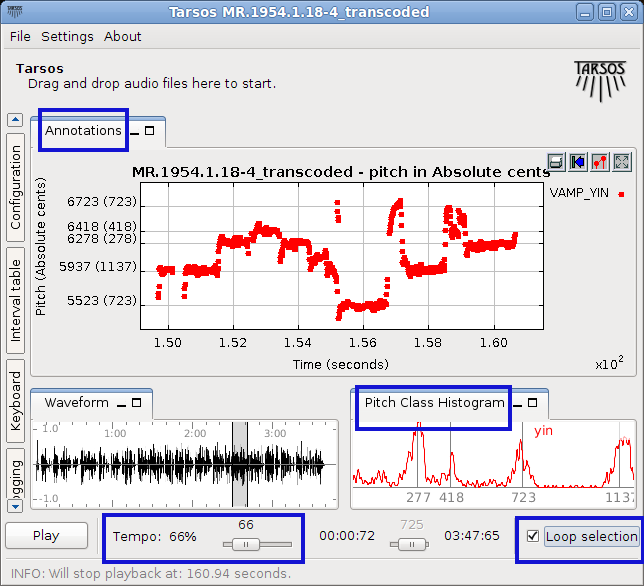 \
\