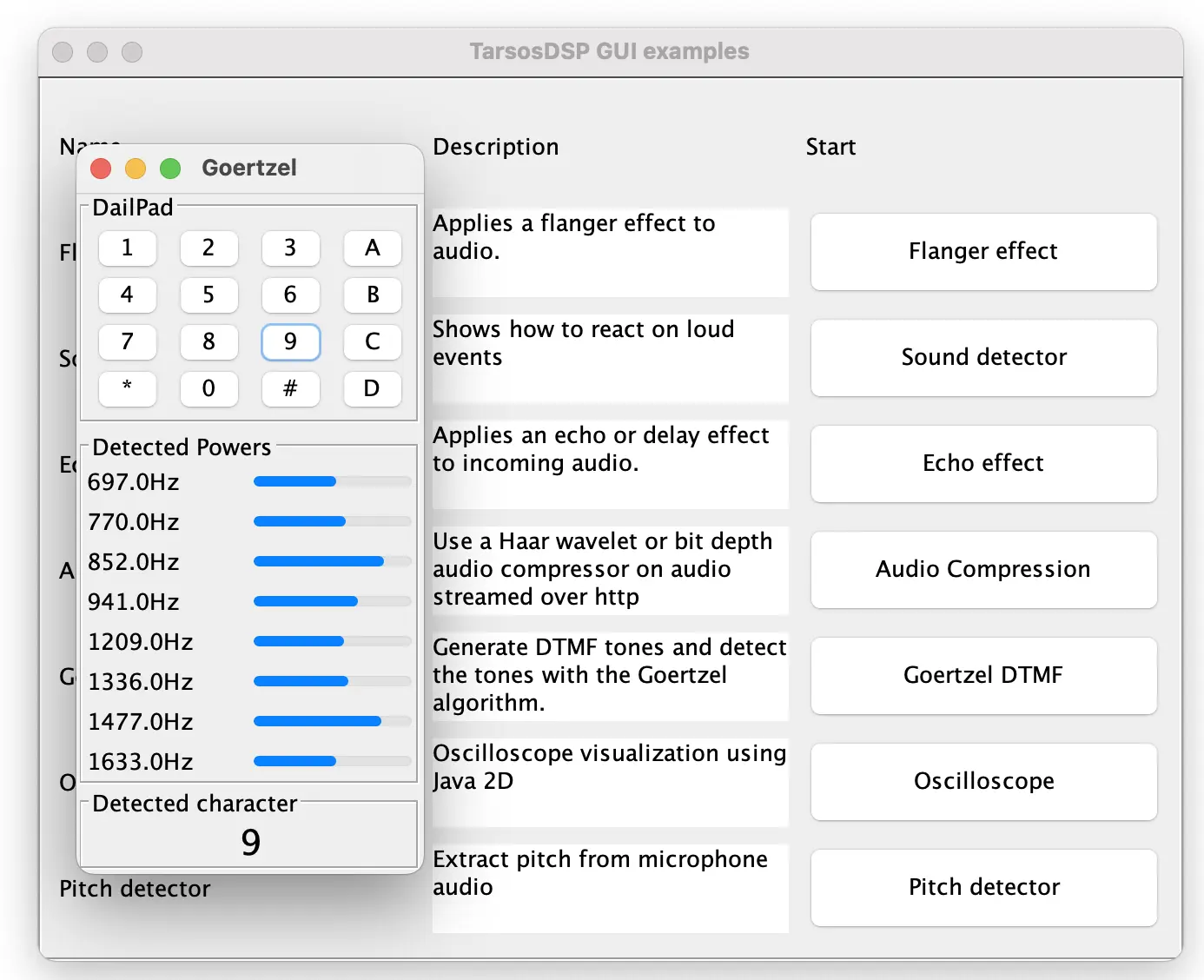
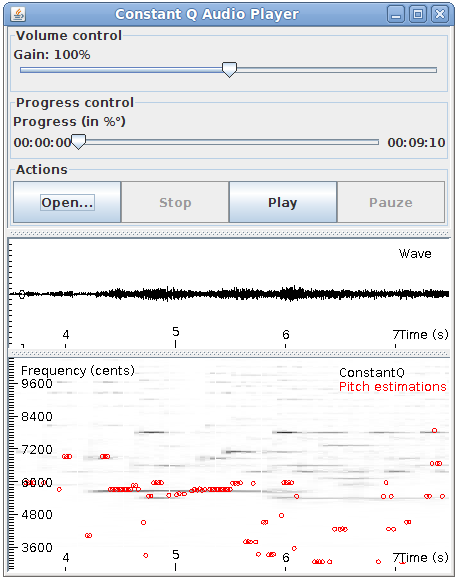
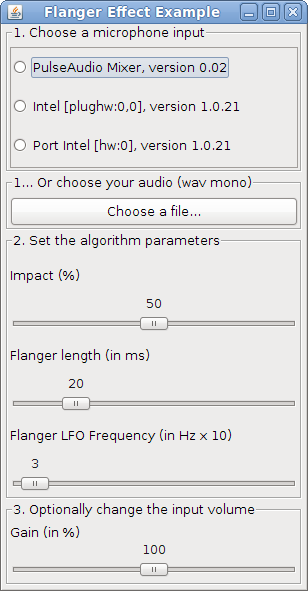
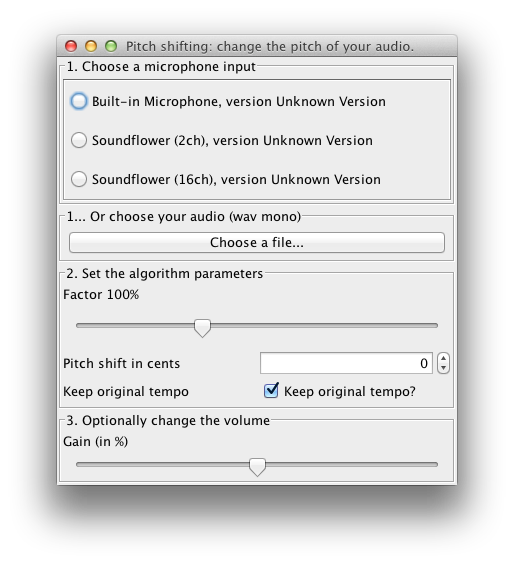
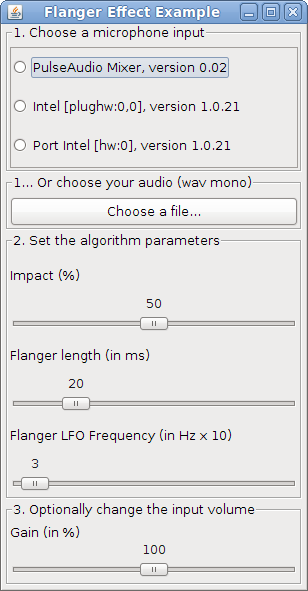
\ Fig: The updated TarsosDSP release contains many CLI and GUI example applications.
 TarsosDSP, the is a real-time audio processing library written in Java, is featured in [EFY (Electronics For Your) Plus Magazine of July 2015](http://www.efymag.com/currentissue.asp?id=12). It is a leading electronics magazine with a history going back more than 40 years and about 300 000 subscribers mainly in India. The index mentions this:
> *TarsosDSP: A Real-Time Audio Analysis and Processing Framework*\
> In last month's EFY Plus, we discussed Essentia, a C library for audio analysis. In this issue we will discuss a Java based real-time audio analysis and processing framework known as TarsosDSP
To read the full article, buy a ([digital](https://play.google.com/store/apps/details?id=com.vserv.electronicsforyou&hl=en)) copy of the magazine.
---
## [SINGmaster Android App uses TarsosDSP](https://0110.be/posts/SINGmaster_Android_App_uses_TarsosDSP.md)
- Published: 2015-04-24T00:00:00Z
- Updated: 2015-07-10T12:09:11Z
- Author: Joren
- ID: 431
- Canonical: https://0110.be/posts/SINGmaster_Android_App_uses_TarsosDSP
- Tags: [Code](https://0110.be/tags/Code.md), [Java](https://0110.be/tags/Java.md), [Muziek](https://0110.be/tags/Muziek.md), [TarsosDSP](https://0110.be/tags/TarsosDSP.md), [UGent](https://0110.be/tags/UGent.md)
TarsosDSP, the is a real-time audio processing library written in Java, is featured in [EFY (Electronics For Your) Plus Magazine of July 2015](http://www.efymag.com/currentissue.asp?id=12). It is a leading electronics magazine with a history going back more than 40 years and about 300 000 subscribers mainly in India. The index mentions this:
> *TarsosDSP: A Real-Time Audio Analysis and Processing Framework*\
> In last month's EFY Plus, we discussed Essentia, a C library for audio analysis. In this issue we will discuss a Java based real-time audio analysis and processing framework known as TarsosDSP
To read the full article, buy a ([digital](https://play.google.com/store/apps/details?id=com.vserv.electronicsforyou&hl=en)) copy of the magazine.
---
## [SINGmaster Android App uses TarsosDSP](https://0110.be/posts/SINGmaster_Android_App_uses_TarsosDSP.md)
- Published: 2015-04-24T00:00:00Z
- Updated: 2015-07-10T12:09:11Z
- Author: Joren
- ID: 431
- Canonical: https://0110.be/posts/SINGmaster_Android_App_uses_TarsosDSP
- Tags: [Code](https://0110.be/tags/Code.md), [Java](https://0110.be/tags/Java.md), [Muziek](https://0110.be/tags/Muziek.md), [TarsosDSP](https://0110.be/tags/TarsosDSP.md), [UGent](https://0110.be/tags/UGent.md)
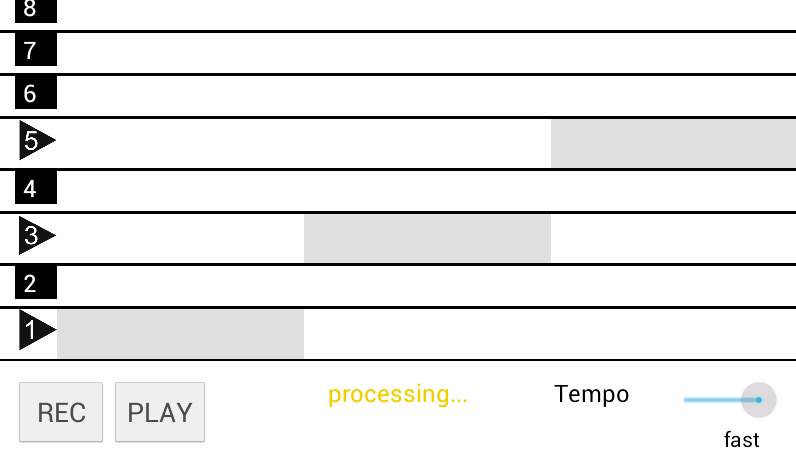
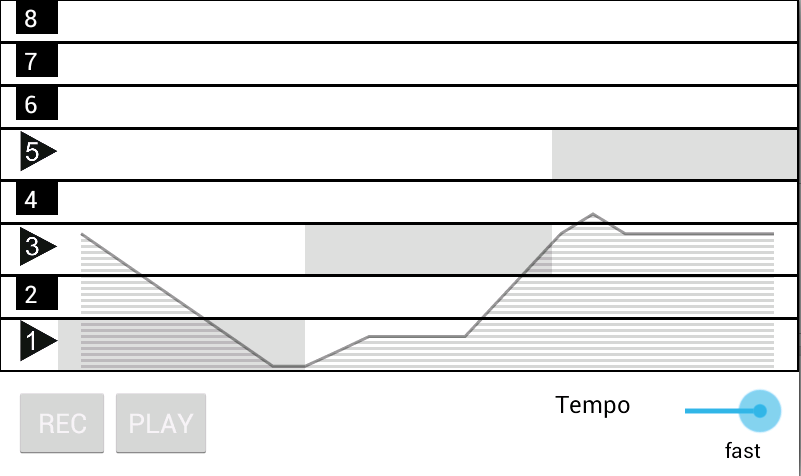
 TarsosDSP is a real-time audio processing library written in Java. Since version 2.0 it is compatible with Android. Judging by the number of forks of the [TarsosDSP GitHub repository](https://github.com/JorenSix/TarsosDSP) Android compatibility increased the popularity of the library. Now the first Android application which uses TarsosDSP has found its way to the Google Play store. Download and play with [SINGmaster](https://play.google.com/store/apps/details?id=bg.singmaster.gui) to see an application of the pitch tracking capabilities within TarsosDSP. The SINGmaster description:
> *"SING master is a smart phone app that helps you to learn how to sing. SING master presents a collection of practical exercises (on the most important building blocks of melodies). Colours and sounds guide you in the exercise. After recording, SING master gives visual feedback : you can see and hear your voice. This is important so that you can identify where your mistakes are."*
Another application in the Play Store that uses TarsosDSP is [CuePitcher](https://play.google.com/store/apps/details?id=io.github.mindosoft.cuepitcher).
- [singmaster\_logo.png](https://0110.be/files/attachments/431/singmaster_logo.png)
---
## [TarsosDSP PureData or MAX MSP external](https://0110.be/posts/TarsosDSP_PureData_or_MAX_MSP_external.md)
- Published: 2014-09-05T00:00:00Z
- Updated: 2025-11-29T22:18:15Z
- Author: Joren
- ID: 423
- Canonical: https://0110.be/posts/TarsosDSP_PureData_or_MAX_MSP_external
- Tags: [TarsosDSP](https://0110.be/tags/TarsosDSP.md), [UGent](https://0110.be/tags/UGent.md)
TarsosDSP is a real-time audio processing library written in Java. Since version 2.0 it is compatible with Android. Judging by the number of forks of the [TarsosDSP GitHub repository](https://github.com/JorenSix/TarsosDSP) Android compatibility increased the popularity of the library. Now the first Android application which uses TarsosDSP has found its way to the Google Play store. Download and play with [SINGmaster](https://play.google.com/store/apps/details?id=bg.singmaster.gui) to see an application of the pitch tracking capabilities within TarsosDSP. The SINGmaster description:
> *"SING master is a smart phone app that helps you to learn how to sing. SING master presents a collection of practical exercises (on the most important building blocks of melodies). Colours and sounds guide you in the exercise. After recording, SING master gives visual feedback : you can see and hear your voice. This is important so that you can identify where your mistakes are."*
Another application in the Play Store that uses TarsosDSP is [CuePitcher](https://play.google.com/store/apps/details?id=io.github.mindosoft.cuepitcher).


- [singmaster\_logo.png](https://0110.be/files/attachments/431/singmaster_logo.png)
---
## [TarsosDSP PureData or MAX MSP external](https://0110.be/posts/TarsosDSP_PureData_or_MAX_MSP_external.md)
- Published: 2014-09-05T00:00:00Z
- Updated: 2025-11-29T22:18:15Z
- Author: Joren
- ID: 423
- Canonical: https://0110.be/posts/TarsosDSP_PureData_or_MAX_MSP_external
- Tags: [TarsosDSP](https://0110.be/tags/TarsosDSP.md), [UGent](https://0110.be/tags/UGent.md)
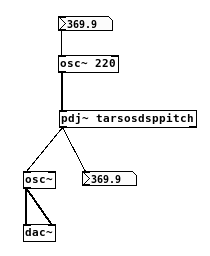 It makes sense to connect TarsosDSP, a real-time audio processing library written in Java, with patcher environments such as Pure Data and Max/MSP. Both Pure Data and Max/MSP offer the capability to code object, or externals using Java. In Pure Data this is done using the `pdj~` object, which should be compatible with the Max/MSP implementation. This post demonstrates a patch that connects an oscillator with a pitch tracking algorithm implemented in TarsosDSP.
To the left you can see the finished patch. When it is working an audio stream is generated using an oscillator. The frequency of the oscillator can be controlled. Subsequently the stream is send to the Java environment with the `pdj` bridge. The Java environment receives an array of floats, representing the audio. A pitch estimation algorithm tries to find the pitch of the audio represented by the buffer. The detected pitch is returned to the pd environment by means of outlet. In pd, the detected pitch is shown and used for auditory feedback.
````java
PitchDetectionResult result = yin.getPitch(audioBuffer);
pitch = result.getPitch();
outlet(0, Atom.newAtom(pitch));
````
Please note that the pitch detection algorithm can handle any audio stream, not only pure sines. The example here demonstrates the most straightforward case. Using this method all algorithms implemented in TarsosDSP can be used in Pure Data. These range from onset detection to filtering, from audio effects to wavelet compression. For a list of features, please see the [TarsosDSP github page](https://github.com/JorenSix/TarsosDSP). Here, the source for this patch [implementing pitch tracking in pd](https://0110.be/files/attachments/423/tarsosdsp_pd_external.zip) can be downloaded. To run it, extract it to a directory and simply run the `pitch.pd` patch. Pure Data should load `pdj~` automatically together with the classes present in the `classes` directory.
- [tarsosdsp\_pd\_external.zip](https://0110.be/files/attachments/423/tarsosdsp_pd_external.zip)
- [pd\_tarsosdsp.png](https://0110.be/files/attachments/423/pd_tarsosdsp.png)
---
## [TarsosDSP on Android - Audio Processing in Java on Android](https://0110.be/posts/TarsosDSP_on_Android_-_Audio_Processing_in_Java_on_Android.md)
- Published: 2014-08-14T00:00:00Z
- Updated: 2025-11-29T22:28:08Z
- Author: Joren
- ID: 420
- Canonical: https://0110.be/posts/TarsosDSP_on_Android_-_Audio_Processing_in_Java_on_Android
- Tags: [TarsosDSP](https://0110.be/tags/TarsosDSP.md), [UGent](https://0110.be/tags/UGent.md)
It makes sense to connect TarsosDSP, a real-time audio processing library written in Java, with patcher environments such as Pure Data and Max/MSP. Both Pure Data and Max/MSP offer the capability to code object, or externals using Java. In Pure Data this is done using the `pdj~` object, which should be compatible with the Max/MSP implementation. This post demonstrates a patch that connects an oscillator with a pitch tracking algorithm implemented in TarsosDSP.
To the left you can see the finished patch. When it is working an audio stream is generated using an oscillator. The frequency of the oscillator can be controlled. Subsequently the stream is send to the Java environment with the `pdj` bridge. The Java environment receives an array of floats, representing the audio. A pitch estimation algorithm tries to find the pitch of the audio represented by the buffer. The detected pitch is returned to the pd environment by means of outlet. In pd, the detected pitch is shown and used for auditory feedback.
````java
PitchDetectionResult result = yin.getPitch(audioBuffer);
pitch = result.getPitch();
outlet(0, Atom.newAtom(pitch));
````
Please note that the pitch detection algorithm can handle any audio stream, not only pure sines. The example here demonstrates the most straightforward case. Using this method all algorithms implemented in TarsosDSP can be used in Pure Data. These range from onset detection to filtering, from audio effects to wavelet compression. For a list of features, please see the [TarsosDSP github page](https://github.com/JorenSix/TarsosDSP). Here, the source for this patch [implementing pitch tracking in pd](https://0110.be/files/attachments/423/tarsosdsp_pd_external.zip) can be downloaded. To run it, extract it to a directory and simply run the `pitch.pd` patch. Pure Data should load `pdj~` automatically together with the classes present in the `classes` directory.
- [tarsosdsp\_pd\_external.zip](https://0110.be/files/attachments/423/tarsosdsp_pd_external.zip)
- [pd\_tarsosdsp.png](https://0110.be/files/attachments/423/pd_tarsosdsp.png)
---
## [TarsosDSP on Android - Audio Processing in Java on Android](https://0110.be/posts/TarsosDSP_on_Android_-_Audio_Processing_in_Java_on_Android.md)
- Published: 2014-08-14T00:00:00Z
- Updated: 2025-11-29T22:28:08Z
- Author: Joren
- ID: 420
- Canonical: https://0110.be/posts/TarsosDSP_on_Android_-_Audio_Processing_in_Java_on_Android
- Tags: [TarsosDSP](https://0110.be/tags/TarsosDSP.md), [UGent](https://0110.be/tags/UGent.md)
 This post explains how to get TarsosDSP running on Android. TarsosDSP is a Java library for audio processing. Its aim is to provide an easy-to-use interface to practical music processing algorithms implemented, as simply as possible, in pure Java and without any other external dependencies.
Since version 2.0 there are no more references to `javax.sound.*` in the TarsosDSP core codebase. This makes it easy to run TarsosDSP on Android. Audio Input/Output operations that depend on either the JVM or Dalvik runtime have been abstracted and removed from the core. For each runtime target a Jar file is provided in the [TarsosDSP release directory](https://0110.be/releases/TarsosDSP).
The source code for the [audio I/O on the JVM](https://github.com/JorenSix/TarsosDSP/tree/master/jvm/be/tarsos/dsp/io/jvm) and the [audio I/O on Android](https://github.com/JorenSix/TarsosDSP/tree/master/android/be/tarsos/dsp/io/android) can be found on GitHub. To get an audio processing algorithm working on Android the only thing that is needed is to place [`TarsosDSP-Android-2.0.jar`](https://0110.be/releases/TarsosDSP/TarsosDSP-2.0/TarsosDSP-Android-2.0.jar) in the `lib` directory of your project.
The following example connects an `AudioDispatcher` to the microphone of an Android device. Subsequently, a real-time pitch detection algorithm is added to the processing chain. The detected pitch in Hertz is printed on a `TextView` element, if no pitch is present in the incoming sound, --1 is printed. To test the application download and install the https://0110.be/files/attachments/420/TarsosDSPAndroid.apk(https://0110.be/files/attachments/420/TarsosDSPAndroid.apk) application on your Android device. The [source code](https://0110.be/files/attachments/420/TarsosDSPAndroid.zip) is available as well.
````java
AudioDispatcher dispatcher = AudioDispatcherFactory.fromDefaultMicrophone(22050, 1024, 0);
PitchDetectionHandler pdh = new PitchDetectionHandler() {
@Override
public void handlePitch(PitchDetectionResult result, AudioEvent e) {
final float pitchInHz = result.getPitch();
runOnUiThread(new Runnable() {
@Override
public void run() {
TextView text = (TextView) findViewById(R.id.textView1);
text.setText("" + pitchInHz);
}
});
}
};
AudioProcessor p = new PitchProcessor(PitchEstimationAlgorithm.FFT_YIN, 22050, 1024, pdh);
dispatcher.addAudioProcessor(p);
new Thread(dispatcher, "Audio Dispatcher").start();
````
Thanks to these changes, the fork of TarsosDSP kindly provided by GitHub user [srubin](https://github.com/srubin/TarsosDSP), created for [a programming assignment at UC Berkley](http://husk.eecs.berkeley.edu/courses/cs160-sp14/index.php/Individual_Programming_Assignment_3), is not needed any more.
Have fun hacking audio on Android!
- [android-audio.jpg](https://0110.be/files/attachments/420/android-audio.jpg)
- [TarsosDSPAndroid.apk](https://0110.be/files/attachments/420/TarsosDSPAndroid.apk)
- [TarsosDSPAndroid.zip](https://0110.be/files/attachments/420/TarsosDSPAndroid.zip)
---
## [Haar Wavlet Transform in TarsosDSP](https://0110.be/posts/Haar_Wavlet_Transform_in_TarsosDSP.md)
- Published: 2014-08-08T00:00:00Z
- Updated: 2014-08-08T13:01:02Z
- Author: Joren
- ID: 422
- Canonical: https://0110.be/posts/Haar_Wavlet_Transform_in_TarsosDSP
- Tags: [TarsosDSP](https://0110.be/tags/TarsosDSP.md), [UGent](https://0110.be/tags/UGent.md)
This post explains how to get TarsosDSP running on Android. TarsosDSP is a Java library for audio processing. Its aim is to provide an easy-to-use interface to practical music processing algorithms implemented, as simply as possible, in pure Java and without any other external dependencies.
Since version 2.0 there are no more references to `javax.sound.*` in the TarsosDSP core codebase. This makes it easy to run TarsosDSP on Android. Audio Input/Output operations that depend on either the JVM or Dalvik runtime have been abstracted and removed from the core. For each runtime target a Jar file is provided in the [TarsosDSP release directory](https://0110.be/releases/TarsosDSP).
The source code for the [audio I/O on the JVM](https://github.com/JorenSix/TarsosDSP/tree/master/jvm/be/tarsos/dsp/io/jvm) and the [audio I/O on Android](https://github.com/JorenSix/TarsosDSP/tree/master/android/be/tarsos/dsp/io/android) can be found on GitHub. To get an audio processing algorithm working on Android the only thing that is needed is to place [`TarsosDSP-Android-2.0.jar`](https://0110.be/releases/TarsosDSP/TarsosDSP-2.0/TarsosDSP-Android-2.0.jar) in the `lib` directory of your project.
The following example connects an `AudioDispatcher` to the microphone of an Android device. Subsequently, a real-time pitch detection algorithm is added to the processing chain. The detected pitch in Hertz is printed on a `TextView` element, if no pitch is present in the incoming sound, --1 is printed. To test the application download and install the https://0110.be/files/attachments/420/TarsosDSPAndroid.apk(https://0110.be/files/attachments/420/TarsosDSPAndroid.apk) application on your Android device. The [source code](https://0110.be/files/attachments/420/TarsosDSPAndroid.zip) is available as well.
````java
AudioDispatcher dispatcher = AudioDispatcherFactory.fromDefaultMicrophone(22050, 1024, 0);
PitchDetectionHandler pdh = new PitchDetectionHandler() {
@Override
public void handlePitch(PitchDetectionResult result, AudioEvent e) {
final float pitchInHz = result.getPitch();
runOnUiThread(new Runnable() {
@Override
public void run() {
TextView text = (TextView) findViewById(R.id.textView1);
text.setText("" + pitchInHz);
}
});
}
};
AudioProcessor p = new PitchProcessor(PitchEstimationAlgorithm.FFT_YIN, 22050, 1024, pdh);
dispatcher.addAudioProcessor(p);
new Thread(dispatcher, "Audio Dispatcher").start();
````
Thanks to these changes, the fork of TarsosDSP kindly provided by GitHub user [srubin](https://github.com/srubin/TarsosDSP), created for [a programming assignment at UC Berkley](http://husk.eecs.berkeley.edu/courses/cs160-sp14/index.php/Individual_Programming_Assignment_3), is not needed any more.
Have fun hacking audio on Android!
- [android-audio.jpg](https://0110.be/files/attachments/420/android-audio.jpg)
- [TarsosDSPAndroid.apk](https://0110.be/files/attachments/420/TarsosDSPAndroid.apk)
- [TarsosDSPAndroid.zip](https://0110.be/files/attachments/420/TarsosDSPAndroid.zip)
---
## [Haar Wavlet Transform in TarsosDSP](https://0110.be/posts/Haar_Wavlet_Transform_in_TarsosDSP.md)
- Published: 2014-08-08T00:00:00Z
- Updated: 2014-08-08T13:01:02Z
- Author: Joren
- ID: 422
- Canonical: https://0110.be/posts/Haar_Wavlet_Transform_in_TarsosDSP
- Tags: [TarsosDSP](https://0110.be/tags/TarsosDSP.md), [UGent](https://0110.be/tags/UGent.md)
 The TarsosDSP Java library for audio processing now contains an implementation of the [Haar Wavelet](https://en.wikipedia.org/wiki/Haar_wavelet) Transform. A discrete wavelet transform based on the Haar wavelet (depicted at the right). This reversible transform has some interesting properties and is practical in signal compression and for analyzing sudden transitions in a file. It can e.g. be used to detect edges in an image.
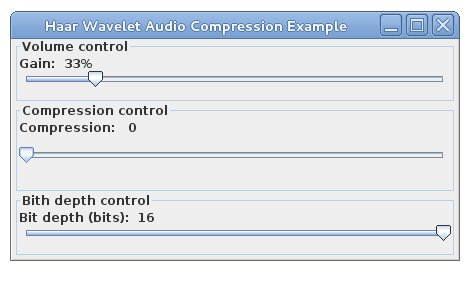
As an example use case of the Haar transform, a simple lossy audio compression algorithm is implemented in TarsosDSP. It compresses audio by dividing audio into bloks of 32 samples, transforming them using the Haar wavelet Transform and subsequently removing samples with the least difference between them. The last step is to reverse the transform and play the audio. The amount of compressed samples can be chosen between 0 (no compression) and 31 (no signal left). This crude lossy audio compression technique can save at least a tenth of samples without any noticeable effect. A way to store the audio and read it from disk is included as well.
The algorithm works in real time and an example application has been implemented which operates on an mp3 stream. To make this work immediately, the `avconv` tool needs to be on your system's path. Also implemented is a bit depth compressor, which shows the effect of (extreme) bit depth compression.
The example is available at the [TarsosDSP release directory](https://0110.be/releases/TarsosDSP), the code can be found on the [TarsosDSP github page](https://github.com/JorenSix/TarsosDSP).
---
## [TarsosDSP Spectral Peak extraction](https://0110.be/posts/TarsosDSP_Spectral_Peak_extraction.md)
- Published: 2014-04-10T00:00:00Z
- Updated: 2014-05-07T13:45:08Z
- Author: Joren
- ID: 421
- Canonical: https://0110.be/posts/TarsosDSP_Spectral_Peak_extraction
- Tags: [TarsosDSP](https://0110.be/tags/TarsosDSP.md), [UGent](https://0110.be/tags/UGent.md)
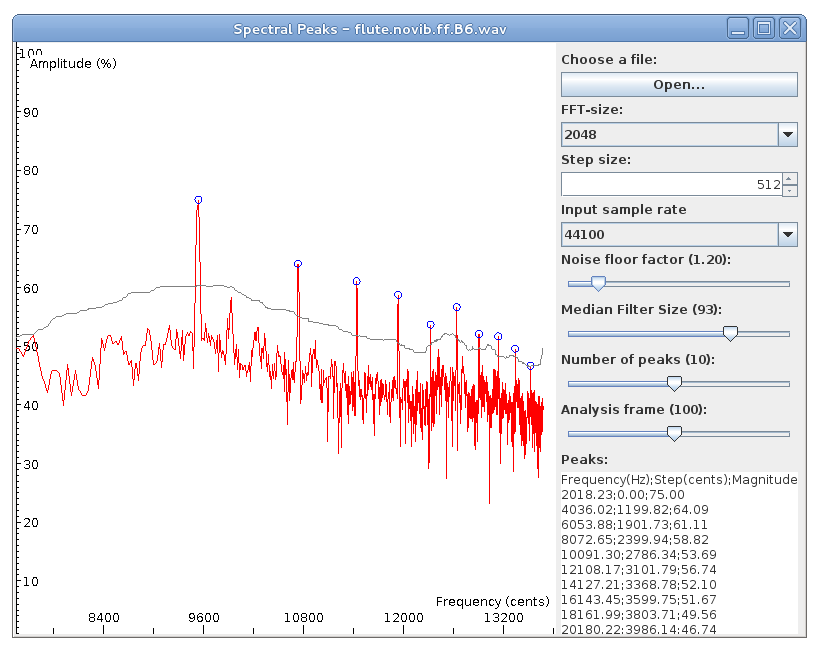
The TarsosDSP Java library for audio processing now contains a module for spectral peak extraction. It calculates a short time Fourier transform and subsequently finds the frequency bins with most energy present using a median filter. The frequency estimation for each identified bin is significantly improved by taking phase information into account. A method described in "Sethares et al. 2009 - Spectral Tools for Dynamic Tonality and Audio Morphing".
The noise floor, determined by the median filter, the spectral information itself and the estimated peak locations are returned for each FFT-frame. Below a visualization of a flute can be found. As expected, the peaks are harmonically spread over the complete spectrum up until the Nyquist frequency.
---
## [TarsosDSP Paper and Presentation at AES 53rd International conference on Semantic Audio](https://0110.be/posts/TarsosDSP_Paper_and_Presentation_at_AES_53rd_International_conference_on_Semantic_Audio.md)
- Published: 2013-12-24T00:00:00Z
- Updated: 2014-01-16T13:25:46Z
- Author: Joren
- ID: 411
- Canonical: https://0110.be/posts/TarsosDSP_Paper_and_Presentation_at_AES_53rd_International_conference_on_Semantic_Audio
- Tags: [Presentation](https://0110.be/tags/Presentation.md), [Research papers](https://0110.be/tags/Research%20papers.md), [TarsosDSP](https://0110.be/tags/TarsosDSP.md), [UGent](https://0110.be/tags/UGent.md)
TarsosDSP will be presented at the [AES 53rd International conference on Semantic Audio](http://www.aes.org/conferences/53/) in London . During the conference both a presentation and demonstration of the paper "*TarsosDSP, a Real-Time Audio Processing Framework in Java*":\[aes53_tarsos_dsp.pdf\], by Joren Six, Olmo Cornelis and Marc Leman, in *Proceedings of the 53rd AES Conference (AES 53rd)*, 2014. From their website:
> *Semantic Audio is concerned with content-based management of digital audio recordings. The rapid evolution of digital audio technologies, e.g. audio data compression and streaming, the availability of large audio libraries online and offline, and recent developments in content-based audio retrieval have significantly changed the way digital audio is created, processed, and consumed. New audio content can be produced at lower cost, while also large audio archives at libraries or record labels are opening to the public. Thus the sheer amount of available audio data grows more and more each day. Semantic analysis of audio resulting in high-level metadata descriptors such as musical chords and tempo, or the identification of speakers facilitate content-based management of audio recordings. Aside from audio retrieval and recommendation technologies, the semantics of audio signals are also becoming increasingly important, for instance, in object-based audio coding, as well as intelligent audio editing, and processing. Recent product releases already demonstrate this to a great extent, however, more innovative functionalities relying on semantic audio analysis and management are imminent. These functionalities may utilise, for instance, (informed) audio source separation, speaker segmentation and identification, structural music segmentation, or social and Semantic Web technologies, including ontologies and linked open data.*
> *This conference will give a broad overview of the state of the art and address many of the new scientific disciplines involved in this still-emerging field. Our purpose is to continue fostering this line of interdisciplinary research. This is reflected by the wide variety of invited speakers presenting at the conference.*
The paper presents TarsosDSP, a framework for real-time audio analysis and processing. Most libraries and frameworks offer either audio analysis and feature extraction or audio synthesis and processing. TarsosDSP is one of a only a few frameworks that offers both analysis, processing and feature extraction in real-time, a unique feature in the Java ecosystem. The framework contains practical audio processing algorithms, it can be extended easily, and has no external dependencies. Each algorithm is implemented as simple as possible thanks to a straightforward processing pipeline. TarsosDSP's features include a resampling algorithm, onset detectors, a number of pitch estimation algorithms, a time stretch algorithm, a pitch shifting algorithm, and an algorithm to calculate the Constant-Q. The framework also allows simple audio synthesis, some audio effects, and several filters. The Open Source framework is a valuable contribution to the MIR-Community and ideal fit for interactive MIR-applications on Android. The full paper can be downloaded "*TarsosDSP, a Real-Time Audio Processing Framework in Java*":\[aes53_tarsos_dsp.pdf\]
A BibTeX entry for the paper can be found below.
\`\`\`ruby\
\@inproceedings{six2014tarsosdsp,\
author = {Joren Six and Olmo Cornelis and Marc Leman},\
title = {{TarsosDSP, a Real-Time Audio Processing Framework in Java}},\
booktitle = {{Proceedings of the 53rd AES Conference (AES 53rd)}},\
year = 2014\
}\
\`\`\`

- [aes53\_tarsos\_dsp.pdf](https://0110.be/files/attachments/411/aes53_tarsos_dsp.pdf)
---
## [Constant-Q Transform in Java with TarsosDSP](https://0110.be/posts/Constant-Q_Transform_in_Java_with_TarsosDSP.md)
- Published: 2013-10-09T00:00:00Z
- Updated: 2020-11-17T09:01:43Z
- Author: Joren
- ID: 363
- Canonical: https://0110.be/posts/Constant-Q_Transform_in_Java_with_TarsosDSP
- Tags: [Code](https://0110.be/tags/Code.md), [Computational musicology](https://0110.be/tags/Computational%20musicology.md), [HoGent](https://0110.be/tags/HoGent.md), [Java](https://0110.be/tags/Java.md), [Music Information Retrieval](https://0110.be/tags/Music%20Information%20Retrieval.md), [TarsosDSP](https://0110.be/tags/TarsosDSP.md)
The DSP library for Taros, aptly named TarsosDSP, now includes an implementation of a *Constant-Q Transform* (as of version 1.6). The Constant-Q transform does essentially the same thing as an FFT, but has the advantage that each octave has the same amount of bins. This makes the Constant-Q transform practical for applications processing music. If, for example, 12 bins per octave are chosen, these can correspond with the western musical scale.
Also included in the newest release (version 1.7) is a way to visualize the transform, or other musical features. The visualization implementation is done together with Thomas Stubbe.
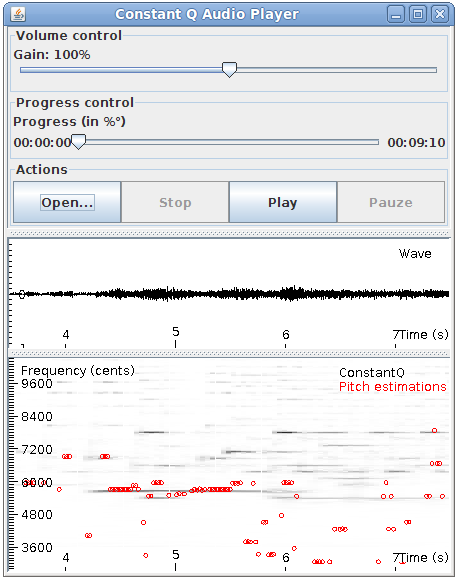
The example application below shows the Constant-Q transform with an overlay of pitch estimations. The corresponding waveform is also shown.
The TarsosDSP Java library for audio processing now contains an implementation of the [Haar Wavelet](https://en.wikipedia.org/wiki/Haar_wavelet) Transform. A discrete wavelet transform based on the Haar wavelet (depicted at the right). This reversible transform has some interesting properties and is practical in signal compression and for analyzing sudden transitions in a file. It can e.g. be used to detect edges in an image.
As an example use case of the Haar transform, a simple lossy audio compression algorithm is implemented in TarsosDSP. It compresses audio by dividing audio into bloks of 32 samples, transforming them using the Haar wavelet Transform and subsequently removing samples with the least difference between them. The last step is to reverse the transform and play the audio. The amount of compressed samples can be chosen between 0 (no compression) and 31 (no signal left). This crude lossy audio compression technique can save at least a tenth of samples without any noticeable effect. A way to store the audio and read it from disk is included as well.
The algorithm works in real time and an example application has been implemented which operates on an mp3 stream. To make this work immediately, the `avconv` tool needs to be on your system's path. Also implemented is a bit depth compressor, which shows the effect of (extreme) bit depth compression.
The example is available at the [TarsosDSP release directory](https://0110.be/releases/TarsosDSP), the code can be found on the [TarsosDSP github page](https://github.com/JorenSix/TarsosDSP).

---
## [TarsosDSP Spectral Peak extraction](https://0110.be/posts/TarsosDSP_Spectral_Peak_extraction.md)
- Published: 2014-04-10T00:00:00Z
- Updated: 2014-05-07T13:45:08Z
- Author: Joren
- ID: 421
- Canonical: https://0110.be/posts/TarsosDSP_Spectral_Peak_extraction
- Tags: [TarsosDSP](https://0110.be/tags/TarsosDSP.md), [UGent](https://0110.be/tags/UGent.md)
The TarsosDSP Java library for audio processing now contains a module for spectral peak extraction. It calculates a short time Fourier transform and subsequently finds the frequency bins with most energy present using a median filter. The frequency estimation for each identified bin is significantly improved by taking phase information into account. A method described in "Sethares et al. 2009 - Spectral Tools for Dynamic Tonality and Audio Morphing".
The noise floor, determined by the median filter, the spectral information itself and the estimated peak locations are returned for each FFT-frame. Below a visualization of a flute can be found. As expected, the peaks are harmonically spread over the complete spectrum up until the Nyquist frequency.

---
## [TarsosDSP Paper and Presentation at AES 53rd International conference on Semantic Audio](https://0110.be/posts/TarsosDSP_Paper_and_Presentation_at_AES_53rd_International_conference_on_Semantic_Audio.md)
- Published: 2013-12-24T00:00:00Z
- Updated: 2014-01-16T13:25:46Z
- Author: Joren
- ID: 411
- Canonical: https://0110.be/posts/TarsosDSP_Paper_and_Presentation_at_AES_53rd_International_conference_on_Semantic_Audio
- Tags: [Presentation](https://0110.be/tags/Presentation.md), [Research papers](https://0110.be/tags/Research%20papers.md), [TarsosDSP](https://0110.be/tags/TarsosDSP.md), [UGent](https://0110.be/tags/UGent.md)
TarsosDSP will be presented at the [AES 53rd International conference on Semantic Audio](http://www.aes.org/conferences/53/) in London . During the conference both a presentation and demonstration of the paper "*TarsosDSP, a Real-Time Audio Processing Framework in Java*":\[aes53_tarsos_dsp.pdf\], by Joren Six, Olmo Cornelis and Marc Leman, in *Proceedings of the 53rd AES Conference (AES 53rd)*, 2014. From their website:
> *Semantic Audio is concerned with content-based management of digital audio recordings. The rapid evolution of digital audio technologies, e.g. audio data compression and streaming, the availability of large audio libraries online and offline, and recent developments in content-based audio retrieval have significantly changed the way digital audio is created, processed, and consumed. New audio content can be produced at lower cost, while also large audio archives at libraries or record labels are opening to the public. Thus the sheer amount of available audio data grows more and more each day. Semantic analysis of audio resulting in high-level metadata descriptors such as musical chords and tempo, or the identification of speakers facilitate content-based management of audio recordings. Aside from audio retrieval and recommendation technologies, the semantics of audio signals are also becoming increasingly important, for instance, in object-based audio coding, as well as intelligent audio editing, and processing. Recent product releases already demonstrate this to a great extent, however, more innovative functionalities relying on semantic audio analysis and management are imminent. These functionalities may utilise, for instance, (informed) audio source separation, speaker segmentation and identification, structural music segmentation, or social and Semantic Web technologies, including ontologies and linked open data.*
> *This conference will give a broad overview of the state of the art and address many of the new scientific disciplines involved in this still-emerging field. Our purpose is to continue fostering this line of interdisciplinary research. This is reflected by the wide variety of invited speakers presenting at the conference.*
The paper presents TarsosDSP, a framework for real-time audio analysis and processing. Most libraries and frameworks offer either audio analysis and feature extraction or audio synthesis and processing. TarsosDSP is one of a only a few frameworks that offers both analysis, processing and feature extraction in real-time, a unique feature in the Java ecosystem. The framework contains practical audio processing algorithms, it can be extended easily, and has no external dependencies. Each algorithm is implemented as simple as possible thanks to a straightforward processing pipeline. TarsosDSP's features include a resampling algorithm, onset detectors, a number of pitch estimation algorithms, a time stretch algorithm, a pitch shifting algorithm, and an algorithm to calculate the Constant-Q. The framework also allows simple audio synthesis, some audio effects, and several filters. The Open Source framework is a valuable contribution to the MIR-Community and ideal fit for interactive MIR-applications on Android. The full paper can be downloaded "*TarsosDSP, a Real-Time Audio Processing Framework in Java*":\[aes53_tarsos_dsp.pdf\]
A BibTeX entry for the paper can be found below.
\`\`\`ruby\
\@inproceedings{six2014tarsosdsp,\
author = {Joren Six and Olmo Cornelis and Marc Leman},\
title = {{TarsosDSP, a Real-Time Audio Processing Framework in Java}},\
booktitle = {{Proceedings of the 53rd AES Conference (AES 53rd)}},\
year = 2014\
}\
\`\`\`





- [aes53\_tarsos\_dsp.pdf](https://0110.be/files/attachments/411/aes53_tarsos_dsp.pdf)
---
## [Constant-Q Transform in Java with TarsosDSP](https://0110.be/posts/Constant-Q_Transform_in_Java_with_TarsosDSP.md)
- Published: 2013-10-09T00:00:00Z
- Updated: 2020-11-17T09:01:43Z
- Author: Joren
- ID: 363
- Canonical: https://0110.be/posts/Constant-Q_Transform_in_Java_with_TarsosDSP
- Tags: [Code](https://0110.be/tags/Code.md), [Computational musicology](https://0110.be/tags/Computational%20musicology.md), [HoGent](https://0110.be/tags/HoGent.md), [Java](https://0110.be/tags/Java.md), [Music Information Retrieval](https://0110.be/tags/Music%20Information%20Retrieval.md), [TarsosDSP](https://0110.be/tags/TarsosDSP.md)
The DSP library for Taros, aptly named TarsosDSP, now includes an implementation of a *Constant-Q Transform* (as of version 1.6). The Constant-Q transform does essentially the same thing as an FFT, but has the advantage that each octave has the same amount of bins. This makes the Constant-Q transform practical for applications processing music. If, for example, 12 bins per octave are chosen, these can correspond with the western musical scale.
Also included in the newest release (version 1.7) is a way to visualize the transform, or other musical features. The visualization implementation is done together with Thomas Stubbe.
The example application below shows the Constant-Q transform with an overlay of pitch estimations. The corresponding waveform is also shown.

\
java -jar Resynthesizer-latest.jar in.wav\
_______ _____ _____ _____
|__ __| | __ \ / ____| __ \
| | __ _ _ __ ___ ___ ___| | | | (___ | |__) |
| |/ _` | '__/ __|/ _ \/ __| | | |\___ \| ___/
| | (_| | | \__ \ (_) \__ \ |__| |____) | |
|_|\__,_|_| |___/\___/|___/_____/|_____/|_|
----------------------------------------------------
Name:
TarsosDSP resynthesizer
----------------------------------------------------
Synopsis:
java -jar CommandLineResynthesizer.jar [--detector DETECTOR] [--output out.wav] [--combined combined.wav] input.wav
----------------------------------------------------
Description:
Extracts pitch and loudnes from audio and resynthesises the audio with that information.
The result is either played back our written in an output file.
There is als an option to combine source and synthezized material
in the left and right channels of a stereo audio file.
input.wav a readable wav file.
--output out.wav a writable file.
--combined combined.wav a writable output file. One channel original, other synthesized.
--detector DETECTOR defaults to FFT_YIN or one of these:
YIN
MPM
FFT_YIN
DYNAMIC_WAVELET
AMDF
The source code of the Java implementation of the synthesizer can be found on the [TarsosDSP github page](https://github.com/JorenSix/TarsosDSP).
- [Pitch\_Estimation\_Synthesizer.png](https://0110.be/files/attachments/359/Pitch_Estimation_Synthesizer.png)
- [flute.wav](https://0110.be/files/attachments/359/flute.wav)
---
## [Phase Vocoding: Time Stretching and Pitch Shifting with TarsosDSP Java](https://0110.be/posts/Phase_Vocoding%3A_Time_Stretching_and_Pitch_Shifting_with_TarsosDSP_Java.md)
- Published: 2012-12-13T00:00:00Z
- Updated: 2020-11-17T09:02:35Z
- Author: Joren
- ID: 355
- Canonical: https://0110.be/posts/Phase_Vocoding%3A_Time_Stretching_and_Pitch_Shifting_with_TarsosDSP_Java
- Tags: [HoGent](https://0110.be/tags/HoGent.md), [TarsosDSP](https://0110.be/tags/TarsosDSP.md), [WSOLA](https://0110.be/tags/WSOLA.md)
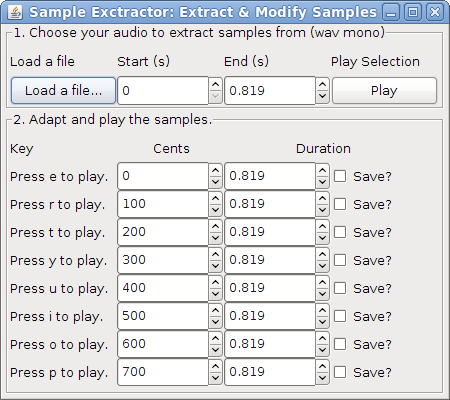
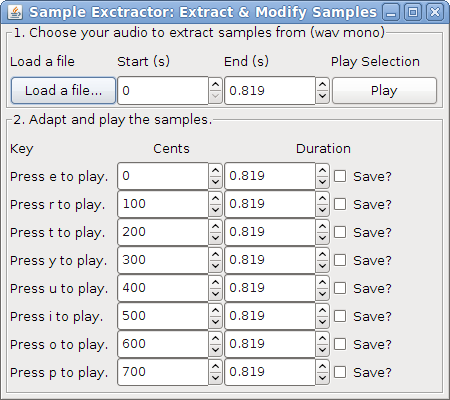
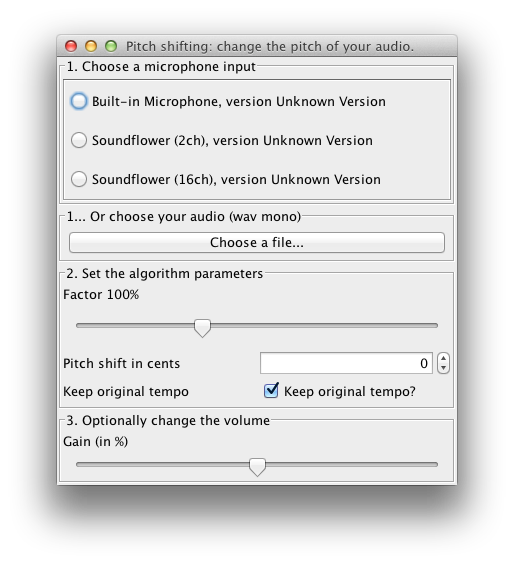
The DSP library for Taros, aptly named TarsosDSP, now includes an implementation of a *pitch shifting algorithm* (as of version 1.4) and a time stretching algorithm. Combined, the two can be used for something like [phase vocoding](http://en.wikipedia.org/wiki/Phase_vocoder). With a phase vocoder you can load an audio snippet, change the pitch and duration and e.g. create a library of snippets. E.g. by recording one piano key stroke, it is possible to generate two octaves of samples of different lengths, and use those in stead of synthesized samples. The following example application shows exactly that, implemented in the java programming language.
The example application below shows how to pitch shift and time stretch a sample to create a sample library with the TarsosDSP library.
TarsosDSP is a collection of classes to do simple audio processing. It features an implementation of a percussion onset detector and two pitch detection algorithms: Yin and the Mcleod Pitch method. Also included is a Goertzel DTMF decoding algorithm and a time stretch algorithm (WSOLA).
Its aim is to provide a simple interface to some audio (signal) processing algorithms implemented in pure JAVA. Some TarsosDSP example applications are available.
The following example filters a band of frequencies of an input file testFile. It keeps the frequencies form startFrequency to stopFrequency.
AudioInputStream inputStream = AudioSystem.getAudioInputStream(testFile);
    AudioDispatcher dispatcher = new AudioDispatcher(inputStream,stepSize,overlap);
    dispatcher.addAudioProcessor(new HighPass(startFrequency, sampleRate, overlap));
    dispatcher.addAudioProcessor(new LowPassFS(stopFrequency, sampleRate, overlap));
    dispatcher.addAudioProcessor(new FloatConverter(format));
    dispatcher.addAudioProcessor(new WaveformWriter(format,stepSize, overlap, "filtered.wav"));
    dispatcher.run();
Head over to the TarsosDSP release repository and download the latest TarsosDSP library. To get up to speed quickly, check the TarsosDSP Example applications for inspiration and consult the API documentation. If you, for some reason, want to build from source, you need Apache Ant and git installed on your system. The following commands fetch the source and build the library and example jars:
git clone https://JorenSix@github.com/JorenSix/TarsosDSP.git
    cd TarsosDSP/build
    ant tarsos_dsp_library #Builds the core TarsosDSP library
    ant build_examples #Builds all the TarsosDSP examples
    ant javadoc #Creates the documentation in TarsosDSP/doc
\
When everything runs correctly you should be able to run all example applications and have the latest version of the TarsosDSP library for inclusion in your projects. Also the Javadoc documentation for the API should be available in TarsosDSP/doc. Drop me a line if you use TarsosDSP in your project. Always nice to hear how this software is used.
The source tree is divided in three directories:
src contains the source files of the core DSP libraries.
test contains unit tests for some of the DSP functionality.
build contains ANT build files. Either to build Java documentation or runnable JAR-files for the example applications.
examples contains a couple of example applications with a Java Swing user interface:
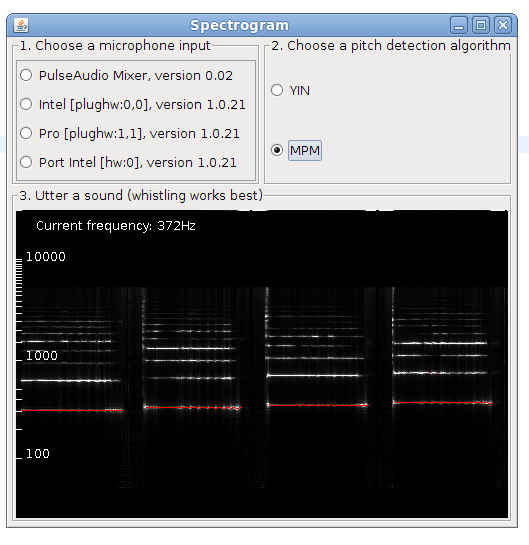
\
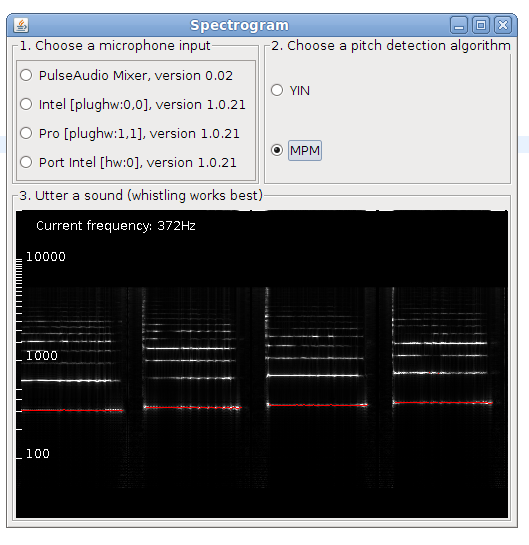
java -jar Spectrogram.jar in.wav\
The source code of the Java implementation can be found on the [TarsosDSP github page](https://github.com/JorenSix/TarsosDSP/).
- [Spectrogram.jar](https://0110.be/files/attachments/384/Spectrogram.jar)
- [spectrogram.png](https://0110.be/files/attachments/384/spectrogram.png)
---
## [Audio Time Stretching - Implementation in Pure Java Using WSOLA](https://0110.be/posts/Audio_Time_Stretching_-_Implementation_in_Pure_Java_Using_WSOLA.md)
- Published: 2012-02-06T14:52:34Z
- Updated: 2013-12-05T18:19:15Z
- Author: Joren
- ID: 372
- Canonical: https://0110.be/posts/Audio_Time_Stretching_-_Implementation_in_Pure_Java_Using_WSOLA
- Tags: [HoGent](https://0110.be/tags/HoGent.md), [Java](https://0110.be/tags/Java.md), [Tarsos](https://0110.be/tags/Tarsos.md), [TarsosDSP](https://0110.be/tags/TarsosDSP.md), [WSOLA](https://0110.be/tags/WSOLA.md)
The DSP library for Taros, aptly named TarsosDSP, now includes an implementation of a time stretching algorithm. The goal of time stretching is to change the duration of a piece of audio without affecting the pitch. The algorithm implemented is described in [An Overlap-add Technique Based On Waveform Similarity (WSOLA) for High Quality Time-Scale Modification of Speech](http://citeseerx.ist.psu.edu/viewdoc/download?doi=10.1.1.202.5460&rep=rep1&type=pdf).

\
java -jar TimeStretch.jar in.wav out.wav 2.0\
_______ _____ _____ _____
|__ __| | __ \ / ____| __ \
| | __ _ _ __ ___ ___ ___| | | | (___ | |__) |
| |/ _` | '__/ __|/ _ \/ __| | | |\___ \| ___/
| | (_| | | \__ \ (_) \__ \ |__| |____) | |
|_|\__,_|_| |___/\___/|___/_____/|_____/|_|
----------------------------------------------------
Name:
TarsosDSP Time stretch utility.
----------------------------------------------------
Synopsis:
java -jar TimeStretch.jar source.wav target.wav factor
----------------------------------------------------
Description:
Change the play back speed of audio without changing the pitch.
source.wav A readable, mono wav file.
target.wav Target location for the time stretched file.
factor Time stretching factor: 2.0 means double the length, 0.5 half. 1.0 is no change.
The source code of the Java implementation of WSOLA can be found on the [TarsosDSP github page](https://github.com/JorenSix/TarsosDSP/blob/master/src/be/hogent/tarsos/dsp/filters/WaveformSimilarityBasedOverlapAdd.java).
- [time\_stretching\_in\_java.png](https://0110.be/files/attachments/372/time_stretching_in_java.png)
- [08.\_Ladrang\_Kandamanyura\_10s-20s.wav](https://0110.be/files/attachments/372/08._Ladrang_Kandamanyura_10s-20s.wav)
- [TimeStretch.jar](https://0110.be/files/attachments/372/TimeStretch.jar)
---
## [TarsosDSP sample application: Utter Asterisk](https://0110.be/posts/TarsosDSP_sample_application%3A_Utter_Asterisk.md)
- Published: 2011-12-15T14:30:42Z
- Updated: 2013-12-05T18:19:15Z
- Author: Joren
- ID: 404
- Canonical: https://0110.be/posts/TarsosDSP_sample_application%3A_Utter_Asterisk
- Tags: [HoGent](https://0110.be/tags/HoGent.md), [TarsosDSP](https://0110.be/tags/TarsosDSP.md)
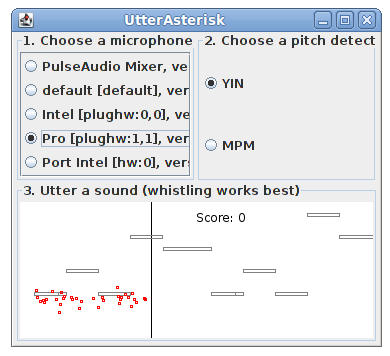 The DSP library of Tarsos, aptly named TarsosDSP, contains an implementation of a game that bares some resemblance to SingStar. It is called UtterAsterisk. It is meant to be a technical demonstration showing real-time pitch detection in pure java using a [YIN](http://recherche.ircam.fr/equipes/pcm/cheveign/ps/2002_JASA_YIN_proof.pdf) -implementation.
"Download Utter Asterisk":\[UtterAsterisk.jar\] and try to sing (utter) as close to the melody as possible. The [souce code for Utter Asterisk](https://github.com/JorenSix/TarsosDSP) is available on github.

- [UtterAsterisk.jar](https://0110.be/files/attachments/404/UtterAsterisk.jar)
---
## [TarsosDSP used in jAM - Java Automatic Music Transcription](https://0110.be/posts/TarsosDSP_used_in_jAM_-_Java_Automatic_Music_Transcription.md)
- Published: 2011-12-12T09:13:14Z
- Updated: 2013-12-05T18:19:15Z
- Author: Joren
- ID: 399
- Canonical: https://0110.be/posts/TarsosDSP_used_in_jAM_-_Java_Automatic_Music_Transcription
- Tags: [HoGent](https://0110.be/tags/HoGent.md), [Java](https://0110.be/tags/Java.md), [TarsosDSP](https://0110.be/tags/TarsosDSP.md)
The DSP library of Tarsos, aptly named TarsosDSP, contains an implementation of a game that bares some resemblance to SingStar. It is called UtterAsterisk. It is meant to be a technical demonstration showing real-time pitch detection in pure java using a [YIN](http://recherche.ircam.fr/equipes/pcm/cheveign/ps/2002_JASA_YIN_proof.pdf) -implementation.
"Download Utter Asterisk":\[UtterAsterisk.jar\] and try to sing (utter) as close to the melody as possible. The [souce code for Utter Asterisk](https://github.com/JorenSix/TarsosDSP) is available on github.

- [UtterAsterisk.jar](https://0110.be/files/attachments/404/UtterAsterisk.jar)
---
## [TarsosDSP used in jAM - Java Automatic Music Transcription](https://0110.be/posts/TarsosDSP_used_in_jAM_-_Java_Automatic_Music_Transcription.md)
- Published: 2011-12-12T09:13:14Z
- Updated: 2013-12-05T18:19:15Z
- Author: Joren
- ID: 399
- Canonical: https://0110.be/posts/TarsosDSP_used_in_jAM_-_Java_Automatic_Music_Transcription
- Tags: [HoGent](https://0110.be/tags/HoGent.md), [Java](https://0110.be/tags/Java.md), [TarsosDSP](https://0110.be/tags/TarsosDSP.md)
 TarsosDSP, a small Java DSP library, has been used in a bachelor thesis: [Entwicklung eines Systems zur automatischen Notentranskription von monophonischem Audiomaterial](http://saeft.com/jAM/assets/Bachelorarbeit.pdf) by Michael Wager.
The goal of the thesis was to develop an automatic transcription system for monophonic music. You can download the latest version of [jAM - Java Automatic Music Transcription](http://saeft.com/jAM/index.php/index/download).
If you want to use TarsosDSP, please consult the [TarsosDSP page on github](https://github.com/JorenSix/TarsosDSP) or read [more about TarsosDSP](https://0110.be/tag/TarsosDSP) here.
---
## [Dual-Tone Multi-Frequency (DTMF) Decoding with the Goertzel Algorithm in Java](https://0110.be/posts/Dual-Tone_Multi-Frequency_%28DTMF%29_Decoding_with_the_Goertzel_Algorithm_in_Java.md)
- Published: 2011-09-27T09:07:26Z
- Updated: 2013-12-05T18:19:15Z
- Author: Joren
- ID: 343
- Canonical: https://0110.be/posts/Dual-Tone_Multi-Frequency_%28DTMF%29_Decoding_with_the_Goertzel_Algorithm_in_Java
- Tags: [Code](https://0110.be/tags/Code.md), [HoGent](https://0110.be/tags/HoGent.md), [Java](https://0110.be/tags/Java.md), [TarsosDSP](https://0110.be/tags/TarsosDSP.md)
TarsosDSP, a small Java DSP library, has been used in a bachelor thesis: [Entwicklung eines Systems zur automatischen Notentranskription von monophonischem Audiomaterial](http://saeft.com/jAM/assets/Bachelorarbeit.pdf) by Michael Wager.
The goal of the thesis was to develop an automatic transcription system for monophonic music. You can download the latest version of [jAM - Java Automatic Music Transcription](http://saeft.com/jAM/index.php/index/download).
If you want to use TarsosDSP, please consult the [TarsosDSP page on github](https://github.com/JorenSix/TarsosDSP) or read [more about TarsosDSP](https://0110.be/tag/TarsosDSP) here.
---
## [Dual-Tone Multi-Frequency (DTMF) Decoding with the Goertzel Algorithm in Java](https://0110.be/posts/Dual-Tone_Multi-Frequency_%28DTMF%29_Decoding_with_the_Goertzel_Algorithm_in_Java.md)
- Published: 2011-09-27T09:07:26Z
- Updated: 2013-12-05T18:19:15Z
- Author: Joren
- ID: 343
- Canonical: https://0110.be/posts/Dual-Tone_Multi-Frequency_%28DTMF%29_Decoding_with_the_Goertzel_Algorithm_in_Java
- Tags: [Code](https://0110.be/tags/Code.md), [HoGent](https://0110.be/tags/HoGent.md), [Java](https://0110.be/tags/Java.md), [TarsosDSP](https://0110.be/tags/TarsosDSP.md)
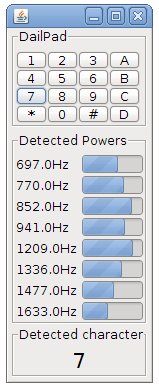 The DSP library of Tarsos, aptly named TarsosDSP, now contains an implementation of the Goertzel Algorithm. It is implemented using pure Java.
The [Goertzel algorithm](http://en.wikipedia.org/wiki/Goertzel_algorithm) can be used to detect if one or more predefined frequencies are present in a signal and it does this very efficiently. One of the classic applications of the Goertzel algorithm is decoding the tones generated on by touch tone telephones. These use [DTMF (Dual tone multi frequency)-signaling](http://en.wikipedia.org/wiki/Dual-tone_multi-frequency_signaling).
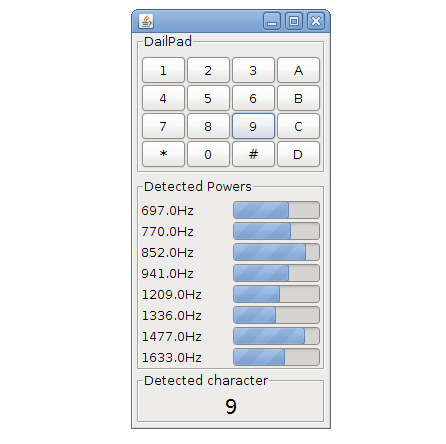
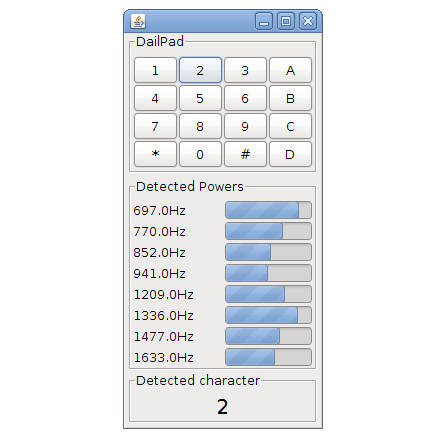
To make the algorithm visually appealing a Java Swing interface has been created(visible right). You can try this application by running the "Goertzel DTMF Jar-file":\[GoertzelDTMF.jar\]. The souce code is included in the jar and is avaliable as a separate "zip file":\[GoertzelDTMF_src.zip\]. The [TarsosDSP github page](https://github.com/JorenSix/TarsosDSP) also contains the source for the [Goertzel algorithm Java implementation](https://github.com/JorenSix/TarsosDSP/blob/master/src/be/hogent/tarsos/dsp/pitch/Goertzel.java).
- [goertzel\_DTMF\_java\_7.png](https://0110.be/files/attachments/343/goertzel_DTMF_java_7.png)
- [GoertzelDTMF.jar](https://0110.be/files/attachments/343/GoertzelDTMF.jar)
- [GoertzelDTMF\_src.zip](https://0110.be/files/attachments/343/GoertzelDTMF_src.zip)
---
## [TarsosDSP: a small JAVA audio processing library](https://0110.be/posts/TarsosDSP%3A_a_small_JAVA_audio_processing_library.md)
- Published: 2011-03-25T15:58:59Z
- Updated: 2013-12-05T18:19:15Z
- Author: Joren
- ID: 392
- Canonical: https://0110.be/posts/TarsosDSP%3A_a_small_JAVA_audio_processing_library
- Tags: [Code](https://0110.be/tags/Code.md), [HoGent](https://0110.be/tags/HoGent.md), [Java](https://0110.be/tags/Java.md), [Tarsos](https://0110.be/tags/Tarsos.md), [TarsosDSP](https://0110.be/tags/TarsosDSP.md), [featured](https://0110.be/tags/featured.md)
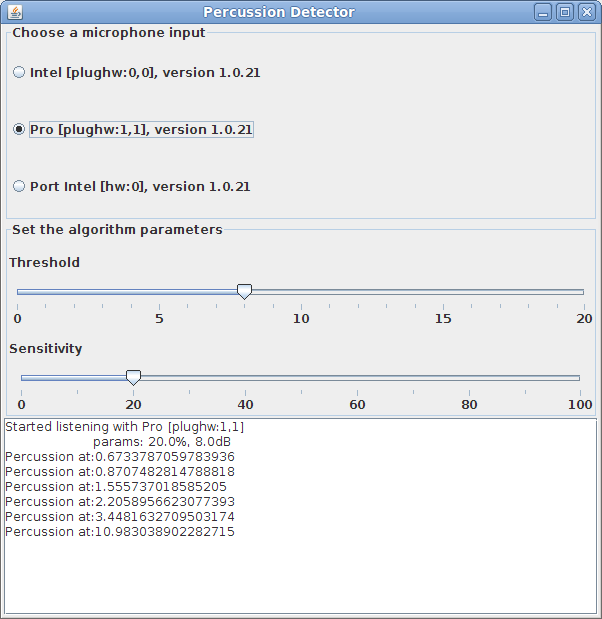
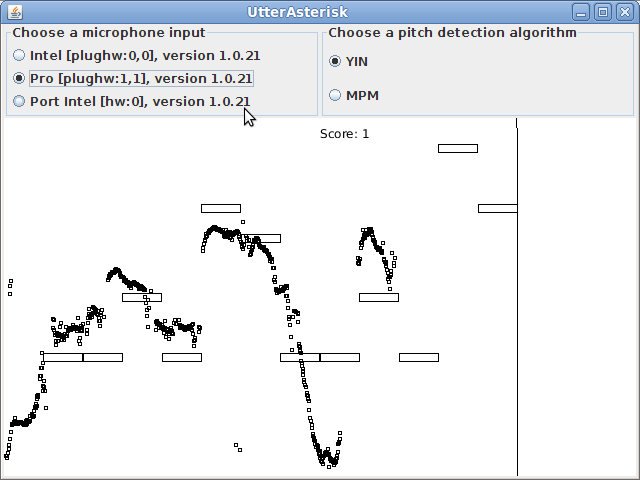
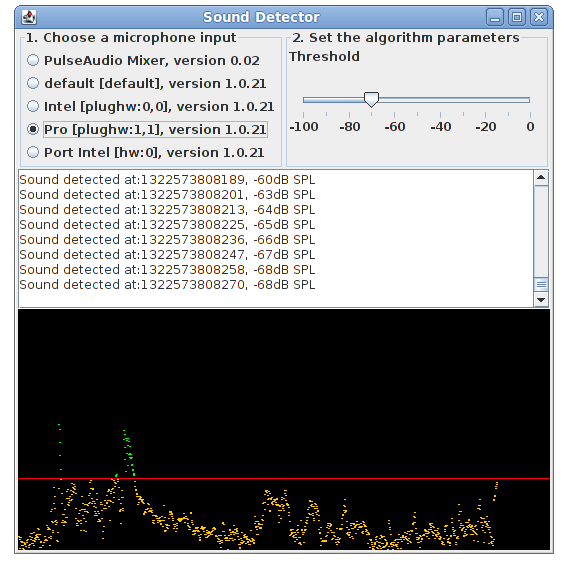
TarsosDSP is a collection of classes to do simple audio processing. It features an implementation of a percussion onset detector and two pitch detection algorithms: Yin and the Mcleod Pitch method.
Its aim is to provide a simple interface to some audio (signal) processing algorithms implemented in JAVA.
To make some of the possibilities clear I coded some examples.
- "TarsosDSP UtterAsterisk":\[UtterAsterisk.jar\] a game that shows real-time pitch detection with YIN.
- "TarsosDSP Sound Detector":\[SoundDetector.jar\] is simply to show how to react when (loud) sound is available.
- "TarsosDSP Percussion Detector":\[PercussionDetector.jar\] is capable of detecting percussion onsets using the method described [here](http://arrow.dit.ie/cgi/viewcontent.cgi?article=1018&context=argcon). It plays a sound from [freesound.org](http://freesound.org) when percussion is detected.
The [source code of TarsosDSP](https://github.com/JorenSix/TarsosDSP) is available on github.
### Presentation at Newline
Saturday the 25th of March TarsosDSP was presented at [Newline](http://0x20.be/Newline/Schedule), a small conference organized by [whitespace](http://0x20.be). Here you can download "the slides I used to present TarsosDSP":\[tarsosDSP_presentation.pdf\], I also created "an introductory text on sound and Java":\[sound_and_java.pdf\].
- [PitchDetector.jar](https://0110.be/files/attachments/392/PitchDetector.jar)
- [PercussionDetector.jar](https://0110.be/files/attachments/392/PercussionDetector.jar)
- [tarsosDSP\_presentation.pdf](https://0110.be/files/attachments/392/tarsosDSP_presentation.pdf)
- [sound\_and\_java.pdf](https://0110.be/files/attachments/392/sound_and_java.pdf)
- [UtterAsterisk.jar](https://0110.be/files/attachments/392/UtterAsterisk.jar)
- [SoundDetector.jar](https://0110.be/files/attachments/392/SoundDetector.jar)
---
The DSP library of Tarsos, aptly named TarsosDSP, now contains an implementation of the Goertzel Algorithm. It is implemented using pure Java.
The [Goertzel algorithm](http://en.wikipedia.org/wiki/Goertzel_algorithm) can be used to detect if one or more predefined frequencies are present in a signal and it does this very efficiently. One of the classic applications of the Goertzel algorithm is decoding the tones generated on by touch tone telephones. These use [DTMF (Dual tone multi frequency)-signaling](http://en.wikipedia.org/wiki/Dual-tone_multi-frequency_signaling).
To make the algorithm visually appealing a Java Swing interface has been created(visible right). You can try this application by running the "Goertzel DTMF Jar-file":\[GoertzelDTMF.jar\]. The souce code is included in the jar and is avaliable as a separate "zip file":\[GoertzelDTMF_src.zip\]. The [TarsosDSP github page](https://github.com/JorenSix/TarsosDSP) also contains the source for the [Goertzel algorithm Java implementation](https://github.com/JorenSix/TarsosDSP/blob/master/src/be/hogent/tarsos/dsp/pitch/Goertzel.java).


- [goertzel\_DTMF\_java\_7.png](https://0110.be/files/attachments/343/goertzel_DTMF_java_7.png)
- [GoertzelDTMF.jar](https://0110.be/files/attachments/343/GoertzelDTMF.jar)
- [GoertzelDTMF\_src.zip](https://0110.be/files/attachments/343/GoertzelDTMF_src.zip)
---
## [TarsosDSP: a small JAVA audio processing library](https://0110.be/posts/TarsosDSP%3A_a_small_JAVA_audio_processing_library.md)
- Published: 2011-03-25T15:58:59Z
- Updated: 2013-12-05T18:19:15Z
- Author: Joren
- ID: 392
- Canonical: https://0110.be/posts/TarsosDSP%3A_a_small_JAVA_audio_processing_library
- Tags: [Code](https://0110.be/tags/Code.md), [HoGent](https://0110.be/tags/HoGent.md), [Java](https://0110.be/tags/Java.md), [Tarsos](https://0110.be/tags/Tarsos.md), [TarsosDSP](https://0110.be/tags/TarsosDSP.md), [featured](https://0110.be/tags/featured.md)
TarsosDSP is a collection of classes to do simple audio processing. It features an implementation of a percussion onset detector and two pitch detection algorithms: Yin and the Mcleod Pitch method.
Its aim is to provide a simple interface to some audio (signal) processing algorithms implemented in JAVA.
To make some of the possibilities clear I coded some examples.
- "TarsosDSP UtterAsterisk":\[UtterAsterisk.jar\] a game that shows real-time pitch detection with YIN.
- "TarsosDSP Sound Detector":\[SoundDetector.jar\] is simply to show how to react when (loud) sound is available.
- "TarsosDSP Percussion Detector":\[PercussionDetector.jar\] is capable of detecting percussion onsets using the method described [here](http://arrow.dit.ie/cgi/viewcontent.cgi?article=1018&context=argcon). It plays a sound from [freesound.org](http://freesound.org) when percussion is detected.
The [source code of TarsosDSP](https://github.com/JorenSix/TarsosDSP) is available on github.
### Presentation at Newline
Saturday the 25th of March TarsosDSP was presented at [Newline](http://0x20.be/Newline/Schedule), a small conference organized by [whitespace](http://0x20.be). Here you can download "the slides I used to present TarsosDSP":\[tarsosDSP_presentation.pdf\], I also created "an introductory text on sound and Java":\[sound_and_java.pdf\].



- [PitchDetector.jar](https://0110.be/files/attachments/392/PitchDetector.jar)
- [PercussionDetector.jar](https://0110.be/files/attachments/392/PercussionDetector.jar)
- [tarsosDSP\_presentation.pdf](https://0110.be/files/attachments/392/tarsosDSP_presentation.pdf)
- [sound\_and\_java.pdf](https://0110.be/files/attachments/392/sound_and_java.pdf)
- [UtterAsterisk.jar](https://0110.be/files/attachments/392/UtterAsterisk.jar)
- [SoundDetector.jar](https://0110.be/files/attachments/392/SoundDetector.jar)
---