Fig: Click the screenshot to go to the 'Introduction to Music Information Retrieval' slides.
 Fig: Some AI imagining audio search.
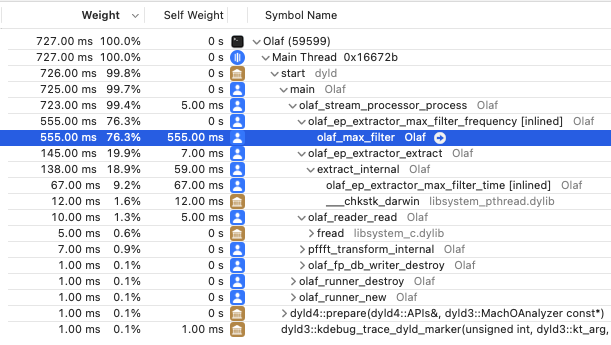 \
Fig: The results of profiling Olaf in XCode's time profiler. Almost all time is spend in a single function which is the prime target for optimization.
\
Fig: The results of profiling Olaf in XCode's time profiler. Almost all time is spend in a single function which is the prime target for optimization.


bash
#wget https://aka.ms/download-jdk/microsoft-jdk-17.0.5-windows-x64.zip
#unzip microsoft-jdk-17.0.5-windows-x64.zip
#export JAVA_HOME=`pwd`/jdk-17.0.5+8/
git clone --depth 1 https://github.com/JorenSix/JGaborator
cd JGaborator/gaborator
echo $JAVA_HOME
JNI_INCLUDES=-I"$JAVA_HOME/include"\ -I"$JAVA_HOME/include/win32"
zig cc  -target x86_64-windows-gnu -c -O3 -ffast-math -fPIC pffft/pffft.c -o pffft/pffft.o
zig cc  -target x86_64-windows-gnu -c -O3 -ffast-math -fPIC -DFFTPACK_DOUBLE_PRECISION pffft/fftpack.c -o pffft/fftpack.o
zig c++ -target x86_64-windows-gnu -I"pffft" -I"gaborator-1.7"  $JNI_INCLUDES -O3\
        -ffast-math -DGABORATOR_USE_PFFFT  -o jgaborator.dll jgaborator.cc pffft/pffft.o pffft/fftpack.o
file jgaborator.dll
# jgaborator.dll: PE32+ executable (console) x86-64, for MS Windows
```
Note that, when cross-compiling from macOS, *to target Windows a Windows JDK is needed*. The windows JDK has other header files like `jni.h`. Some commands to download and use the JDK are commented out in the example above. Also note that targeting Linux from macOS seems to work with the standard macOS JDK. This is probably due to shared conventions regarding compilation of libraries.
To target other platforms, e.g. ARM Linux, there are *only two things that need to be changed*: the `-target` switch should be changed to `aarch64-linux-gnu` and the name of the output library should be (by Linux convention) changed to `libjgaborator.so`. During the build step of JGaborator a list of target platforms it iterated and a total of 9 builds are packaged into a single Jar file. There is also a bit of supporting code to load the correct version of the library.
Using a GitHub action or similar CI tools this cross compilation with zig can be automated to run on a software release. For Github the [Setup Zig](https://github.com/marketplace/actions/setup-zig) action is practical.
#### Loading the correct library
In a first attempt I tried to detect the operating system and architecture of the environment to then load the library but eventually decided against this approach. Mainly because you then need to keep an exhaustive list of supporting platforms and this is *difficult, error prone and decidedly not future-proof*.
In my second attempt I simply *try to load each precompiled library* limited to the sensible ones - only dll's on windows - until a matching one is loaded. The rationale here is that the system itself knows best which library works and failing to load a library is computationally cheap. There is [some code to iterate all precompiled libraries in a JAR-file](https://github.com/JorenSix/JGaborator/blob/master/src/main/java/be/ugent/jgaborator/util/ZigNativeUtils.java#L106) so supporting an additional platform amounts to adding a [precompiled library in the JAR folder](https://github.com/JorenSix/JGaborator/tree/master/src/main/resources/jni): there is no need to be explicit in the Java code about architectures or OSes.
Trying multiple libraries has an additional advantage: this allows to ship multiple versions targeting the same architecture: e.g. one with additional acceleration libraries enabled and one without. By sorting the libraries alphabetically the first, then, should be the one with acceleration and the fallback without. In the case of JGaborator for mac aarch64 there is one compiled with `-framework Accelerate` and one compiled by the Zig cross-compiler without.
#### Takehome messages
- If you find yourself cross-compiling C or C for many platforms, **consider the Zig cross-compiler**. Even when you have no intention to write a single line of Zig code.
- For JNI and Java the [JGaborator source code](https://github.com/JorenSix/JGaborator) might offer some **inspiration to pre-compile and load libraries** for many platforms with little effort.
- CI tools can help to verify builds and **automate Zig cross-compilation**.
- If you build for Windows make sure to include windows header-files even when there are no compilation errors using UNIX-header files.
If you find this valuable [consider sponsoring the work on Zig](https://github.com/sponsors/ziglang)
---
## [DiscStitch & BAF - Contributions to ISMIR 2022](https://0110.be/posts/DiscStitch_%26_BAF_-_Contributions_to_ISMIR_2022.md)
- Published: 2022-12-04T00:00:00Z
- Updated: 2022-12-15T14:10:38Z
- Author: Joren
- ID: 497
- Canonical: https://0110.be/posts/DiscStitch_%26_BAF_-_Contributions_to_ISMIR_2022
- Tags: [ISMIR](https://0110.be/tags/ISMIR.md), [Music Information Retrieval](https://0110.be/tags/Music%20Information%20Retrieval.md), [UGent](https://0110.be/tags/UGent.md)

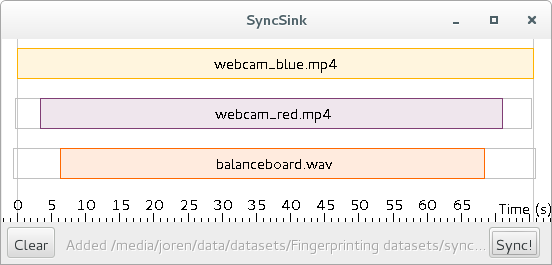
SyncSink is a tool to synchronize media files with shared audio. SyncSink matches and aligns shared audio and determines offsets in seconds. With these precise offsets it becomes trivial to sync files. SyncSink is, for example, used to synchronize video files: when you have many video captures of the same event, the audio attached to these video captures is used to align and sync multiple (independently operated) cameras. Evidently, SyncSink can also synchronize audio captured from many (independent) microphones if some environmental sound is shared (leaked in) the each recording.- [SyncSink-synchronizing\_audio.gif](https://0110.be/files/attachments/483/SyncSink-synchronizing_audio.gif) - [syncsink-1.0.jar](https://0110.be/files/attachments/483/syncsink-1.0.jar) --- ## [AAWM/FMA 2019 - Birmingham ](https://0110.be/posts/AAWM%2FFMA_2019_-_Birmingham_.md) - Published: 2019-07-02T00:00:00Z - Updated: 2025-11-29T14:37:46Z - Author: Joren - ID: 471 - Canonical: https://0110.be/posts/AAWM%2FFMA_2019_-_Birmingham_ - Tags: [Folk Music Analysis (FMA) conference](https://0110.be/tags/Folk%20Music%20Analysis%20%28FMA%29%20conference.md), [Music Information Retrieval](https://0110.be/tags/Music%20Information%20Retrieval.md), [Presentation](https://0110.be/tags/Presentation.md), [Research papers](https://0110.be/tags/Research%20papers.md), [UGent](https://0110.be/tags/UGent.md) I am currently in Birmingham, UK at the 2019 at the joint [Analytical Approaches to World Music (AAWM) and Folk Music Conference (FMA)](http://fma2019.bcu.ac.uk). The opening concert by the [RBC folk ensemble](https://www.youtube.com/watch?v=TxcMPWTlaaI) already provided the most lively and enthusiastic conference opening probably ever. Especially considering the early morning hour (9.30). At the conference, two studies will be presented on which I collaborated: ### Automatic comparison of human music, speech, and bird song suggests uniqueness of human scales
Fig: SyncSink in action: syncing some audio files
 "Automatic comparison of human music, speech, and bird song suggests uniqueness of human scales":\[FMA2019_paper_12.pdf\] by Jiei Kuroyanagi, Shoichiro Sato, Meng-Jou Ho, Gakuto Chiba, Joren Six, Peter Pfordresher, Adam Tierney, Shinya Fujii and Patrick Savage
> The uniqueness of human music relative to speech and animal song has been extensively debated, but rarely directly measured. We applied an automated scale analysis algorithm to a sample of 86 recordings of human music, human speech, and bird songs from around the world. We found that human music throughout the world uniquely emphasized scales with small-integer frequency ratios, particularly a perfect 5th (3:2 ratio), while human speech and bird song showed no clear evidence of consistent scale-like tunings. We speculate that the uniquely human tendency toward scales with small-integer ratios may relate to the evolution of synchronized group performance among humans.
### Automatic comparison of global children's and adult songs
"Automatic comparison of human music, speech, and bird song suggests uniqueness of human scales":\[FMA2019_paper_12.pdf\] by Jiei Kuroyanagi, Shoichiro Sato, Meng-Jou Ho, Gakuto Chiba, Joren Six, Peter Pfordresher, Adam Tierney, Shinya Fujii and Patrick Savage
> The uniqueness of human music relative to speech and animal song has been extensively debated, but rarely directly measured. We applied an automated scale analysis algorithm to a sample of 86 recordings of human music, human speech, and bird songs from around the world. We found that human music throughout the world uniquely emphasized scales with small-integer frequency ratios, particularly a perfect 5th (3:2 ratio), while human speech and bird song showed no clear evidence of consistent scale-like tunings. We speculate that the uniquely human tendency toward scales with small-integer ratios may relate to the evolution of synchronized group performance among humans.
### Automatic comparison of global children's and adult songs
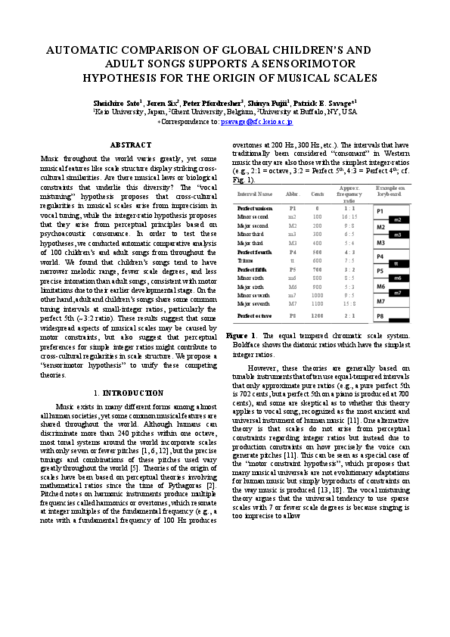 "Automatic comparison of global children's and adult songs":\[FMA2019_paper_13.pdf\] by Shoichiro Sato, Joren Six, Peter Pfordresher, Shinya Fujii and Patrick Savage
> Music throughout the world varies greatly, yet some musical features like scale structure display striking crosscultural similarities. Are there musical laws or biological constraints that underlie this diversity? The "vocal mistuning" hypothesis proposes that cross-cultural regularities in musical scales arise from imprecision in vocal tuning, while the integer-ratio hypothesis proposes that they arise from perceptual principles based on psychoacoustic consonance. In order to test these hypotheses, we conducted automatic comparative analysis of 100 children's and adult songs from throughout the world. We found that children's songs tend to have narrower melodic range, fewer scale degrees, and less precise intonation than adult songs, consistent with motor limitations due to their earlier developmental stage. On the other hand, adult and children's songs share some common tuning intervals at small-integer ratios, particularly the perfect 5th (\~3:2 ratio). These results suggest that some widespread aspects of musical scales may be caused by motor constraints, but also suggest that perceptual preferences for simple integer ratios might contribute to cross-cultural regularities in scale structure. We propose a "sensorimotor hypothesis" to unify these competing theories.
---
## [ISMIR 2018 Conference - Automatic Analysis Of Global Music Recordings suggests Scale Tuning Universals](https://0110.be/posts/ISMIR_2018_Conference_-_Automatic_Analysis_Of_Global_Music_Recordings__suggests_Scale_Tuning_Universals.md)
- Published: 2018-09-24T00:00:00Z
- Updated: 2019-07-03T13:46:15Z
- Author: Joren
- ID: 462
- Canonical: https://0110.be/posts/ISMIR_2018_Conference_-_Automatic_Analysis_Of_Global_Music_Recordings__suggests_Scale_Tuning_Universals
- Tags: [IPEM](https://0110.be/tags/IPEM.md), [ISMIR](https://0110.be/tags/ISMIR.md), [Music Information Retrieval](https://0110.be/tags/Music%20Information%20Retrieval.md), [Presentation](https://0110.be/tags/Presentation.md), [Research papers](https://0110.be/tags/Research%20papers.md), [UGent](https://0110.be/tags/UGent.md)
"Automatic comparison of global children's and adult songs":\[FMA2019_paper_13.pdf\] by Shoichiro Sato, Joren Six, Peter Pfordresher, Shinya Fujii and Patrick Savage
> Music throughout the world varies greatly, yet some musical features like scale structure display striking crosscultural similarities. Are there musical laws or biological constraints that underlie this diversity? The "vocal mistuning" hypothesis proposes that cross-cultural regularities in musical scales arise from imprecision in vocal tuning, while the integer-ratio hypothesis proposes that they arise from perceptual principles based on psychoacoustic consonance. In order to test these hypotheses, we conducted automatic comparative analysis of 100 children's and adult songs from throughout the world. We found that children's songs tend to have narrower melodic range, fewer scale degrees, and less precise intonation than adult songs, consistent with motor limitations due to their earlier developmental stage. On the other hand, adult and children's songs share some common tuning intervals at small-integer ratios, particularly the perfect 5th (\~3:2 ratio). These results suggest that some widespread aspects of musical scales may be caused by motor constraints, but also suggest that perceptual preferences for simple integer ratios might contribute to cross-cultural regularities in scale structure. We propose a "sensorimotor hypothesis" to unify these competing theories.
---
## [ISMIR 2018 Conference - Automatic Analysis Of Global Music Recordings suggests Scale Tuning Universals](https://0110.be/posts/ISMIR_2018_Conference_-_Automatic_Analysis_Of_Global_Music_Recordings__suggests_Scale_Tuning_Universals.md)
- Published: 2018-09-24T00:00:00Z
- Updated: 2019-07-03T13:46:15Z
- Author: Joren
- ID: 462
- Canonical: https://0110.be/posts/ISMIR_2018_Conference_-_Automatic_Analysis_Of_Global_Music_Recordings__suggests_Scale_Tuning_Universals
- Tags: [IPEM](https://0110.be/tags/IPEM.md), [ISMIR](https://0110.be/tags/ISMIR.md), [Music Information Retrieval](https://0110.be/tags/Music%20Information%20Retrieval.md), [Presentation](https://0110.be/tags/Presentation.md), [Research papers](https://0110.be/tags/Research%20papers.md), [UGent](https://0110.be/tags/UGent.md)
 Thanks to the support of a travel grant by the faculty of Arts and Philosophy of Ghent University I was able to attend the ISMIR 2018 conference. A conference on Music Information Retrieval. I am co author on a contribution for the [the Late-Breaking / Demos session](http://ismir2018.ircam.fr/pages/events-lbd.html)
> The structure of musical scales has been proposed to reflect universal acoustic principles based on simple integer ratios. However, some studying tuning in small samples of non-Western cultures have argued that such ratios are not universal but specific to Western music. To address this debate, we applied an algorithm that could automatically analyze and cross-culturally compare scale tunings to a global sample of 50 music recordings, including both instrumental and vocal pieces. Although we found great cross-cultural diversity in most scale degrees, these preliminary results also suggest a strong tendency to include the simplest possible integer ratio within the octave (perfect fifth, 3:2 ratio, \~700 cents) in both Western and non-Western cultures. This suggests that cultural diversity in musical scales is not without limit, but is constrained by universal psycho-acoustic principles that may shed light on the evolution of human music.
- [musical\_scales\_extended\_abstract\_\_0826\_revision\_copy.pdf](https://0110.be/files/attachments/462/musical_scales_extended_abstract__0826_revision_copy.pdf)
- [animated\_logo.gif](https://0110.be/files/attachments/462/animated_logo.gif)
- [ismir\_2018\_logo.jpg](https://0110.be/files/attachments/462/ismir_2018_logo.jpg)
---
## [TISMIR journal article - A Case for Reproducibility in MIR: Replication of ‘A Highly Robust Audio Fingerprinting System’](https://0110.be/posts/TISMIR_journal_article_-_A_Case_for_Reproducibility_in_MIR%3A_Replication_of_%E2%80%98A_Highly_Robust_Audio_Fingerprinting_System%E2%80%99.md)
- Published: 2018-09-12T00:00:00Z
- Updated: 2018-09-26T13:00:47Z
- Author: Joren
- ID: 463
- Canonical: https://0110.be/posts/TISMIR_journal_article_-_A_Case_for_Reproducibility_in_MIR%3A_Replication_of_%E2%80%98A_Highly_Robust_Audio_Fingerprinting_System%E2%80%99
- Tags: [ISMIR](https://0110.be/tags/ISMIR.md), [Music Information Retrieval](https://0110.be/tags/Music%20Information%20Retrieval.md), [Research papers](https://0110.be/tags/Research%20papers.md), [UGent](https://0110.be/tags/UGent.md)
Thanks to the support of a travel grant by the faculty of Arts and Philosophy of Ghent University I was able to attend the ISMIR 2018 conference. A conference on Music Information Retrieval. I am co author on a contribution for the [the Late-Breaking / Demos session](http://ismir2018.ircam.fr/pages/events-lbd.html)
> The structure of musical scales has been proposed to reflect universal acoustic principles based on simple integer ratios. However, some studying tuning in small samples of non-Western cultures have argued that such ratios are not universal but specific to Western music. To address this debate, we applied an algorithm that could automatically analyze and cross-culturally compare scale tunings to a global sample of 50 music recordings, including both instrumental and vocal pieces. Although we found great cross-cultural diversity in most scale degrees, these preliminary results also suggest a strong tendency to include the simplest possible integer ratio within the octave (perfect fifth, 3:2 ratio, \~700 cents) in both Western and non-Western cultures. This suggests that cultural diversity in musical scales is not without limit, but is constrained by universal psycho-acoustic principles that may shed light on the evolution of human music.
- [musical\_scales\_extended\_abstract\_\_0826\_revision\_copy.pdf](https://0110.be/files/attachments/462/musical_scales_extended_abstract__0826_revision_copy.pdf)
- [animated\_logo.gif](https://0110.be/files/attachments/462/animated_logo.gif)
- [ismir\_2018\_logo.jpg](https://0110.be/files/attachments/462/ismir_2018_logo.jpg)
---
## [TISMIR journal article - A Case for Reproducibility in MIR: Replication of ‘A Highly Robust Audio Fingerprinting System’](https://0110.be/posts/TISMIR_journal_article_-_A_Case_for_Reproducibility_in_MIR%3A_Replication_of_%E2%80%98A_Highly_Robust_Audio_Fingerprinting_System%E2%80%99.md)
- Published: 2018-09-12T00:00:00Z
- Updated: 2018-09-26T13:00:47Z
- Author: Joren
- ID: 463
- Canonical: https://0110.be/posts/TISMIR_journal_article_-_A_Case_for_Reproducibility_in_MIR%3A_Replication_of_%E2%80%98A_Highly_Robust_Audio_Fingerprinting_System%E2%80%99
- Tags: [ISMIR](https://0110.be/tags/ISMIR.md), [Music Information Retrieval](https://0110.be/tags/Music%20Information%20Retrieval.md), [Research papers](https://0110.be/tags/Research%20papers.md), [UGent](https://0110.be/tags/UGent.md)
 As an extension of the ISMIR conferences the International Society for Music Information Retrievel started a new journal: TISMIR. The first issue contains an article of mine:\
[A Case for Reproducibility in MIR: Replication of 'A Highly Robust Audio Fingerprinting System'](https://transactions.ismir.net/articles/10.5334/tismir.4/). The abstract can be read here:
> Claims made in many Music Information Retrieval (MIR) publications are hard to verify due to the fact that (i) often only a textual description is made available and code remains unpublished -- leaving many implementation issues uncovered; (ii) copyrights on music limit the sharing of datasets; and (iii) incentives to put effort into reproducible research -- publishing and documenting code and specifics on data -- is lacking. In this article the problems around reproducibility are illustrated by replicating an MIR work. The system and evaluation described in 'A Highly Robust Audio Fingerprinting System' is replicated as closely as possible. The replication is done with several goals in mind: to describe difficulties in replicating the work and subsequently reflect on guidelines around reproducible research. Added contributions are the verification of the reported work, a publicly available implementation and an evaluation method that is reproducible.
---
## [International Symposium on Computational Ethnomusicological Archiving](https://0110.be/posts/International_Symposium_on_Computational_Ethnomusicological_Archiving.md)
- Published: 2017-11-24T00:00:00Z
- Updated: 2017-12-13T09:00:47Z
- Author: Joren
- ID: 457
- Canonical: https://0110.be/posts/International_Symposium_on_Computational_Ethnomusicological_Archiving
- Tags: [Computational ethnomusicology](https://0110.be/tags/Computational%20ethnomusicology.md), [Computational musicology](https://0110.be/tags/Computational%20musicology.md), [Music Information Retrieval](https://0110.be/tags/Music%20Information%20Retrieval.md), [Presentation](https://0110.be/tags/Presentation.md), [UGent](https://0110.be/tags/UGent.md)
This weekend the University Hamburg - Institute for Systematic Musicology and more specifically Christian D. Koehn organized the [International Symposium on Computational Ethnomusicological Archiving](https://www.fbkultur.uni-hamburg.de/sm/iscea.html). The symposium featured a broad selection of research topics (physical modelling of instruments, MIR research, 3D scanning techniques, technology for (re)spacialisation of music, library sciences) which all had a relation with archiving musics of the world:
> *How could existing digital technologies in the field of music information retrieval, artificial intelligence, and data networking be efficiently implemented with regard to digital music archives? How might current and future developments in these fields benefit researchers in ethnomusicology? How can analytical data about musical sound and descriptive data about musical culture be more comprehensively integrated?*
I was able to attend the symposium and contributed with a talk titled "Challenges and opportunities for computational analysis of wax cylinders":\[2017.12.Hamburg-Wax-presentation.pdf\] and by chairing a panel discussion. The symposium was kindly sponsored by the VolkswagenStiftung. The talk had the following abstract:
> *In this presentation we describe our experience of working with computational analysis on digitized wax cylinder recordings. The audio quality of these recordings is limited which poses challenges for standard MIR tools. Unclear recording and playback speeds further hinder some types of audio analysis. Moreover, due to a lack of systematical meta-data notation it is often uncertain where a single recording originates or when exactly it was recorded. However, being the oldest available sound recordings, they are invaluable witnesses of various musical practices and they are opportunities to improve the understanding of these practices. Next to sketching these general concerns, we present results of the analysis of pitch content of 400 wax cylinder recordings from Indiana University (USA) and from the Royal Museum from Central Africa (Belgium). The scales of the 400 recordings are mapped and analyzed as a set. It is found that the fifth is almost always present and that scales with four and five pitch classes are organized similarly and differ from those with six and seven pitch classes, latter center around intervals of 170 cents, and former around 240 cents.*
- [2017.12.Hamburg-Wax-presentation.pdf](https://0110.be/files/attachments/457/2017.12.Hamburg-Wax-presentation.pdf)
- [ISCEA-final-program.pdf](https://0110.be/files/attachments/457/ISCEA-final-program.pdf)
---
## [4th International Digital Libraries for Musicology workshop (DLfM 2017)](https://0110.be/posts/4th_International_Digital_Libraries_for_Musicology_workshop_%28DLfM_2017%29.md)
- Published: 2017-10-28T00:00:00Z
- Updated: 2017-12-05T13:56:47Z
- Author: Joren
- ID: 456
- Canonical: https://0110.be/posts/4th_International_Digital_Libraries_for_Musicology_workshop_%28DLfM_2017%29
- Tags: [Computational musicology](https://0110.be/tags/Computational%20musicology.md), [Music Information Retrieval](https://0110.be/tags/Music%20Information%20Retrieval.md), [Panako](https://0110.be/tags/Panako.md), [Presentation](https://0110.be/tags/Presentation.md), [Research papers](https://0110.be/tags/Research%20papers.md), [UGent](https://0110.be/tags/UGent.md)
As an extension of the ISMIR conferences the International Society for Music Information Retrievel started a new journal: TISMIR. The first issue contains an article of mine:\
[A Case for Reproducibility in MIR: Replication of 'A Highly Robust Audio Fingerprinting System'](https://transactions.ismir.net/articles/10.5334/tismir.4/). The abstract can be read here:
> Claims made in many Music Information Retrieval (MIR) publications are hard to verify due to the fact that (i) often only a textual description is made available and code remains unpublished -- leaving many implementation issues uncovered; (ii) copyrights on music limit the sharing of datasets; and (iii) incentives to put effort into reproducible research -- publishing and documenting code and specifics on data -- is lacking. In this article the problems around reproducibility are illustrated by replicating an MIR work. The system and evaluation described in 'A Highly Robust Audio Fingerprinting System' is replicated as closely as possible. The replication is done with several goals in mind: to describe difficulties in replicating the work and subsequently reflect on guidelines around reproducible research. Added contributions are the verification of the reported work, a publicly available implementation and an evaluation method that is reproducible.
---
## [International Symposium on Computational Ethnomusicological Archiving](https://0110.be/posts/International_Symposium_on_Computational_Ethnomusicological_Archiving.md)
- Published: 2017-11-24T00:00:00Z
- Updated: 2017-12-13T09:00:47Z
- Author: Joren
- ID: 457
- Canonical: https://0110.be/posts/International_Symposium_on_Computational_Ethnomusicological_Archiving
- Tags: [Computational ethnomusicology](https://0110.be/tags/Computational%20ethnomusicology.md), [Computational musicology](https://0110.be/tags/Computational%20musicology.md), [Music Information Retrieval](https://0110.be/tags/Music%20Information%20Retrieval.md), [Presentation](https://0110.be/tags/Presentation.md), [UGent](https://0110.be/tags/UGent.md)
This weekend the University Hamburg - Institute for Systematic Musicology and more specifically Christian D. Koehn organized the [International Symposium on Computational Ethnomusicological Archiving](https://www.fbkultur.uni-hamburg.de/sm/iscea.html). The symposium featured a broad selection of research topics (physical modelling of instruments, MIR research, 3D scanning techniques, technology for (re)spacialisation of music, library sciences) which all had a relation with archiving musics of the world:
> *How could existing digital technologies in the field of music information retrieval, artificial intelligence, and data networking be efficiently implemented with regard to digital music archives? How might current and future developments in these fields benefit researchers in ethnomusicology? How can analytical data about musical sound and descriptive data about musical culture be more comprehensively integrated?*
I was able to attend the symposium and contributed with a talk titled "Challenges and opportunities for computational analysis of wax cylinders":\[2017.12.Hamburg-Wax-presentation.pdf\] and by chairing a panel discussion. The symposium was kindly sponsored by the VolkswagenStiftung. The talk had the following abstract:
> *In this presentation we describe our experience of working with computational analysis on digitized wax cylinder recordings. The audio quality of these recordings is limited which poses challenges for standard MIR tools. Unclear recording and playback speeds further hinder some types of audio analysis. Moreover, due to a lack of systematical meta-data notation it is often uncertain where a single recording originates or when exactly it was recorded. However, being the oldest available sound recordings, they are invaluable witnesses of various musical practices and they are opportunities to improve the understanding of these practices. Next to sketching these general concerns, we present results of the analysis of pitch content of 400 wax cylinder recordings from Indiana University (USA) and from the Royal Museum from Central Africa (Belgium). The scales of the 400 recordings are mapped and analyzed as a set. It is found that the fifth is almost always present and that scales with four and five pitch classes are organized similarly and differ from those with six and seven pitch classes, latter center around intervals of 170 cents, and former around 240 cents.*
- [2017.12.Hamburg-Wax-presentation.pdf](https://0110.be/files/attachments/457/2017.12.Hamburg-Wax-presentation.pdf)
- [ISCEA-final-program.pdf](https://0110.be/files/attachments/457/ISCEA-final-program.pdf)
---
## [4th International Digital Libraries for Musicology workshop (DLfM 2017)](https://0110.be/posts/4th_International_Digital_Libraries_for_Musicology_workshop_%28DLfM_2017%29.md)
- Published: 2017-10-28T00:00:00Z
- Updated: 2017-12-05T13:56:47Z
- Author: Joren
- ID: 456
- Canonical: https://0110.be/posts/4th_International_Digital_Libraries_for_Musicology_workshop_%28DLfM_2017%29
- Tags: [Computational musicology](https://0110.be/tags/Computational%20musicology.md), [Music Information Retrieval](https://0110.be/tags/Music%20Information%20Retrieval.md), [Panako](https://0110.be/tags/Panako.md), [Presentation](https://0110.be/tags/Presentation.md), [Research papers](https://0110.be/tags/Research%20papers.md), [UGent](https://0110.be/tags/UGent.md)
 I have contributed to the 4th International Digital Libraries for Musicology workshop (DLfM 2017) which was organized in Shanghai, China. It was a satellite event of the ISMIR 2017 conference. Unfortunately I did not mange to find funding to attend the workshop, I did however contribute as co-author to two proceeding papers. Both were presented by Reinier de Valk (thanks again).
### [MIRchiving: Challenges and opportunities of connecting MIR research and digital music archives](https://dl.acm.org/citation.cfm?id=3144755)
By Reinier de Valk (DANS), Anja Volk (Utrecht University), Andre Holzapfel (KTH Royal Institute of Technology) , Aggelos Pikrakis (University of Piraeus), Nadine Kroher (University of Seville - IMUS) and Joren Six (Ghent University - IPEM). Next to the [version of record](https://dl.acm.org/citation.cfm?id=3144755) there is also an author version available of the contribution titled "MIRchiving: Challenges and opportunities of connecting MIR research and digital music archives":\[2017.DLfM.MIRchiving-author.pdf\].
> This study is a call for action for the music information retrieval (MIR) community to pay more attention to collaboration with digital music archives. The study, which resulted from an interdisciplinary workshop and subsequent discussion, matches the demand for MIR technologies from various archives with what is already supplied by the MIR community. We conclude that the expressed demands can only be served sustainably through closer collaborations. Whereas MIR systems are described in scientific publications, usable implementations are often absent. If there is a runnable system, user documentation is often sparse----posing a huge hurdle for archivists to employ it. This study sheds light on the current limitations and opportunities of MIR research in the context of music archives by means of examples, and highlights available tools. As a basic guideline for collaboration, we propose to interpret MIR research as part of a value chain. We identify the following benefits of collaboration between MIR researchers and music archives: new perspectives for content access in archives, more diverse evaluation data and methods, and a more application-oriented MIR research workflow.
### [Applications of duplicate detection: linking meta-data and merging music archives: The experience of the IPEM historical archive of electronic music](https://dl.acm.org/citation.cfm?id=3144759)
By Federica Bressan, Joren Six and Marc Leman (Ghent University - IPEM). Next to the [version of record](https://dl.acm.org/citation.cfm?id=3144759) there is also an author version available of the contribution titled "Applications of duplicate detection: linking meta-data and merging music archives: The experience of the IPEM historical archive of electronic music":\[2017.dlfm_duplicates-author.pdf\].
> This work focuses on applications of duplicate detection for managing digital music archives. It aims to make this mature music information retrieval (MIR) technology better known to archivists and provide clear suggestions on how this technology can be used in practice. More specifically applications are discussed to complement meta-data, to link or merge digital music archives, to improve listening experiences and to re-use segmentation data. The IPEM archive, a digitized music archive containing early electronic music, provides a case study.
The [full DLfM 2017 proceedings](https://dl.acm.org/citation.cfm?id=3144749) are published by ACM.
- [2017.DLfM.MIRchiving-author.pdf](https://0110.be/files/attachments/456/2017.DLfM.MIRchiving-author.pdf)
- [2017.dlfm\_duplicates-author.pdf](https://0110.be/files/attachments/456/2017.dlfm_duplicates-author.pdf)
- [dlfm.png](https://0110.be/files/attachments/456/dlfm.png)
---
## [AES 2017 - A framework to provide fine-grained time-dependent context for active listening experiences](https://0110.be/posts/AES_2017_-_A_framework_to_provide_fine-grained_time-dependent_context_for_active_listening_experiences.md)
- Published: 2017-06-16T00:00:00Z
- Updated: 2017-07-10T11:16:36Z
- Author: Joren
- ID: 454
- Canonical: https://0110.be/posts/AES_2017_-_A_framework_to_provide_fine-grained_time-dependent_context_for_active_listening_experiences
- Tags: [Code](https://0110.be/tags/Code.md), [Music Information Retrieval](https://0110.be/tags/Music%20Information%20Retrieval.md), [UGent](https://0110.be/tags/UGent.md)
The [2017 AES international conference on semantic audio](http://www.aes.org/conferences/2017/semantic/) was organized at ISS Fraunhofer, Erlangen, Germany. As the birthplace of the MP3 codec, it is holy ground, a stop that can not be skipped on the itinerary of an audio engineers pilgrimage of life. At the conference I presented " A framework to provide fine-grained time-dependent context for active listening experiences":\[2017.author.aes.pdf\] with a poster ("pdf":\[aes_2017_poster.pdf\], "inkscape svg":\[aes_2017_poster_2.svg\]).
I have contributed to the 4th International Digital Libraries for Musicology workshop (DLfM 2017) which was organized in Shanghai, China. It was a satellite event of the ISMIR 2017 conference. Unfortunately I did not mange to find funding to attend the workshop, I did however contribute as co-author to two proceeding papers. Both were presented by Reinier de Valk (thanks again).
### [MIRchiving: Challenges and opportunities of connecting MIR research and digital music archives](https://dl.acm.org/citation.cfm?id=3144755)
By Reinier de Valk (DANS), Anja Volk (Utrecht University), Andre Holzapfel (KTH Royal Institute of Technology) , Aggelos Pikrakis (University of Piraeus), Nadine Kroher (University of Seville - IMUS) and Joren Six (Ghent University - IPEM). Next to the [version of record](https://dl.acm.org/citation.cfm?id=3144755) there is also an author version available of the contribution titled "MIRchiving: Challenges and opportunities of connecting MIR research and digital music archives":\[2017.DLfM.MIRchiving-author.pdf\].
> This study is a call for action for the music information retrieval (MIR) community to pay more attention to collaboration with digital music archives. The study, which resulted from an interdisciplinary workshop and subsequent discussion, matches the demand for MIR technologies from various archives with what is already supplied by the MIR community. We conclude that the expressed demands can only be served sustainably through closer collaborations. Whereas MIR systems are described in scientific publications, usable implementations are often absent. If there is a runnable system, user documentation is often sparse----posing a huge hurdle for archivists to employ it. This study sheds light on the current limitations and opportunities of MIR research in the context of music archives by means of examples, and highlights available tools. As a basic guideline for collaboration, we propose to interpret MIR research as part of a value chain. We identify the following benefits of collaboration between MIR researchers and music archives: new perspectives for content access in archives, more diverse evaluation data and methods, and a more application-oriented MIR research workflow.
### [Applications of duplicate detection: linking meta-data and merging music archives: The experience of the IPEM historical archive of electronic music](https://dl.acm.org/citation.cfm?id=3144759)
By Federica Bressan, Joren Six and Marc Leman (Ghent University - IPEM). Next to the [version of record](https://dl.acm.org/citation.cfm?id=3144759) there is also an author version available of the contribution titled "Applications of duplicate detection: linking meta-data and merging music archives: The experience of the IPEM historical archive of electronic music":\[2017.dlfm_duplicates-author.pdf\].
> This work focuses on applications of duplicate detection for managing digital music archives. It aims to make this mature music information retrieval (MIR) technology better known to archivists and provide clear suggestions on how this technology can be used in practice. More specifically applications are discussed to complement meta-data, to link or merge digital music archives, to improve listening experiences and to re-use segmentation data. The IPEM archive, a digitized music archive containing early electronic music, provides a case study.
The [full DLfM 2017 proceedings](https://dl.acm.org/citation.cfm?id=3144749) are published by ACM.
- [2017.DLfM.MIRchiving-author.pdf](https://0110.be/files/attachments/456/2017.DLfM.MIRchiving-author.pdf)
- [2017.dlfm\_duplicates-author.pdf](https://0110.be/files/attachments/456/2017.dlfm_duplicates-author.pdf)
- [dlfm.png](https://0110.be/files/attachments/456/dlfm.png)
---
## [AES 2017 - A framework to provide fine-grained time-dependent context for active listening experiences](https://0110.be/posts/AES_2017_-_A_framework_to_provide_fine-grained_time-dependent_context_for_active_listening_experiences.md)
- Published: 2017-06-16T00:00:00Z
- Updated: 2017-07-10T11:16:36Z
- Author: Joren
- ID: 454
- Canonical: https://0110.be/posts/AES_2017_-_A_framework_to_provide_fine-grained_time-dependent_context_for_active_listening_experiences
- Tags: [Code](https://0110.be/tags/Code.md), [Music Information Retrieval](https://0110.be/tags/Music%20Information%20Retrieval.md), [UGent](https://0110.be/tags/UGent.md)
The [2017 AES international conference on semantic audio](http://www.aes.org/conferences/2017/semantic/) was organized at ISS Fraunhofer, Erlangen, Germany. As the birthplace of the MP3 codec, it is holy ground, a stop that can not be skipped on the itinerary of an audio engineers pilgrimage of life. At the conference I presented " A framework to provide fine-grained time-dependent context for active listening experiences":\[2017.author.aes.pdf\] with a poster ("pdf":\[aes_2017_poster.pdf\], "inkscape svg":\[aes_2017_poster_2.svg\]).
@article{six2015multimodal,
      author      = {Joren Six and Marc Leman},
      title       = {{Synchronizing Multimodal Recordings Using Audio-To-Audio Alignment}},
      issn        = {1783-7677},
      volume      = {9},
      number      = {3},
      pages       = {223-229},
      doi         = {10.1007/s12193-015-0196-1},
      journal     = {{Journal of Multimodal User Interfaces}},
      publisher   = {Springer Berlin Heidelberg},
      year        = 2015
 }
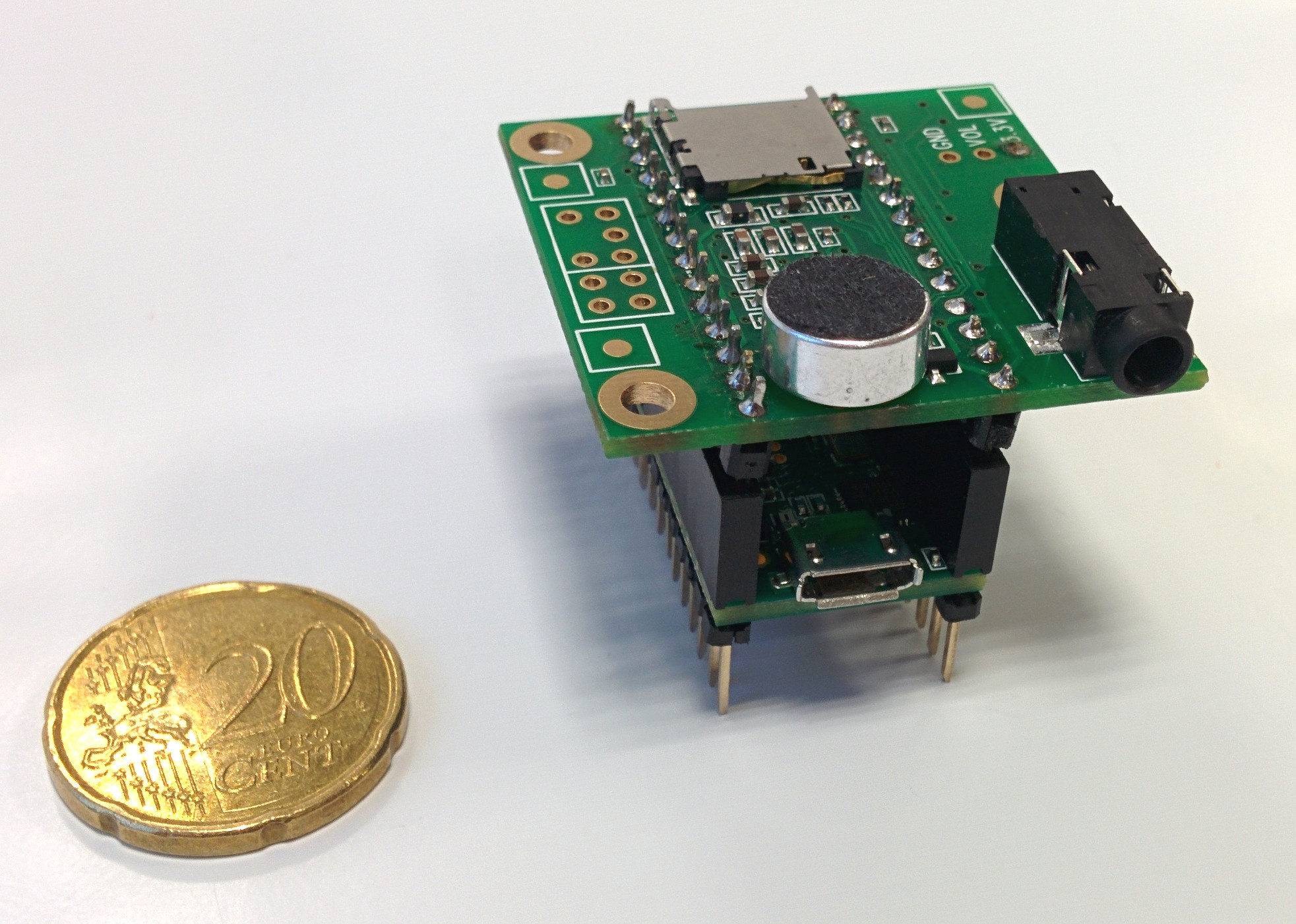
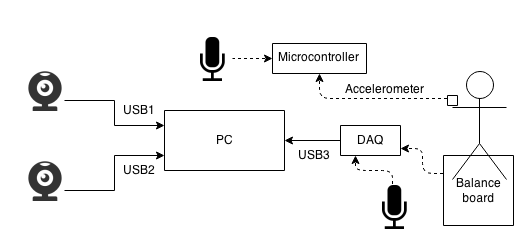
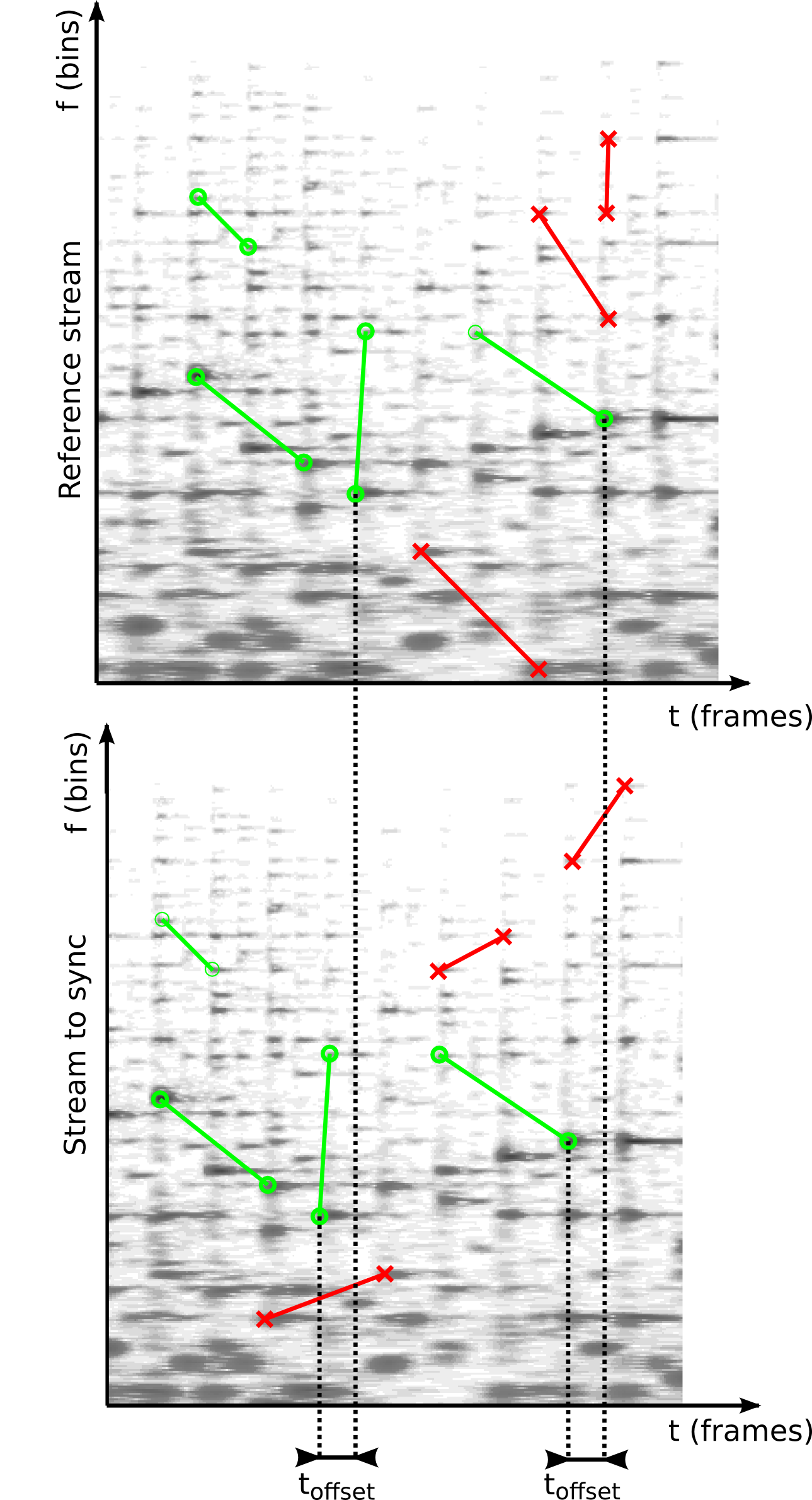
- [2015.synchronized-recording.pdf](https://0110.be/files/attachments/434/2015.synchronized-recording.pdf)
- [SyncDataset.zip](https://0110.be/files/attachments/434/SyncDataset.zip)
- [SyncSink-1.4.jar](https://0110.be/files/attachments/434/SyncSink-1.4.jar)
---
## [Audio Fingerprinting - Opportunities for digital musicology](https://0110.be/posts/Audio_Fingerprinting_-_Opportunities_for_digital_musicology.md)
- Published: 2014-11-25T00:00:00Z
- Updated: 2025-11-29T22:11:24Z
- Author: Joren
- ID: 425
- Canonical: https://0110.be/posts/Audio_Fingerprinting_-_Opportunities_for_digital_musicology
- Tags: [Computational musicology](https://0110.be/tags/Computational%20musicology.md), [IPEM](https://0110.be/tags/IPEM.md), [Music Information Retrieval](https://0110.be/tags/Music%20Information%20Retrieval.md), [Panako](https://0110.be/tags/Panako.md), [Presentation](https://0110.be/tags/Presentation.md), [UGent](https://0110.be/tags/UGent.md)
The 27th of November, 2014 a lecture on audio fingerprinting and its applications for digital musicology will be given at [IPEM](http://www.ipem.ugent.be/). The lecture introduces audio fingerprinting, explains an audio fingerprinting technique and then goes on to explain how such algorithm offers opportunities for large scale digital musicological applications. Here you can download the slides about [audio fingerprinting and its opportunities for digital musicology](https://0110.be/files/attachments/425/2014.11.27.aucoustic_fingerprinting.pdf).
With the explained audio fingerprinting technique a specific form of very reliable musical structure analysis can be done. Below, in the figure section, an example of repetitive structure in the song [Ribs Out](https://www.youtube.com/watch?v=WI7MonB-hig) is shown. Another example is comparing edits or versions of songs. Below, also in the figure section, the radio edit of Daft Punk's Get Lucky is compared with the original version. Audio synchronization using fingerprinting is another application that is actively used in the field of digital musicology to [align audio with extracted features](http://acousticbrainz.org/).
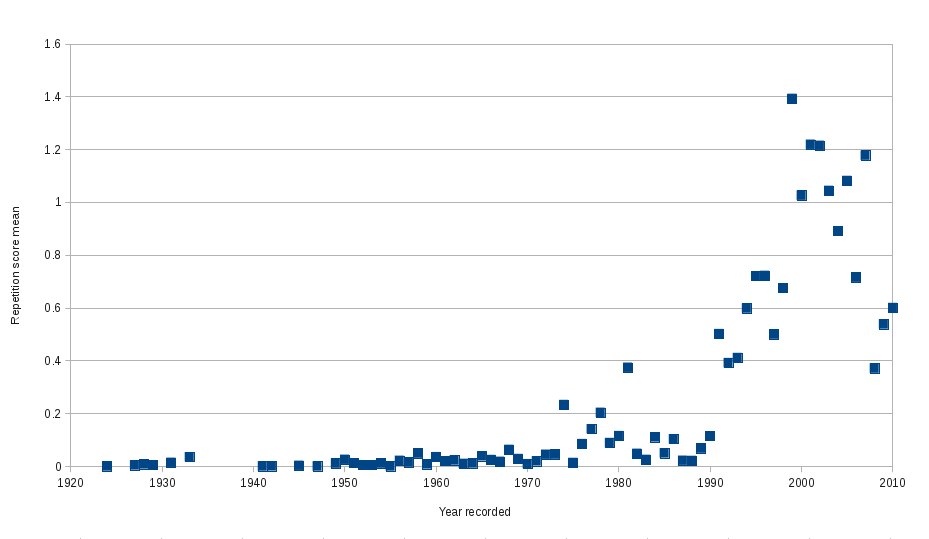
Since acoustic fingerprinting makes structure analysis very efficiently it can be applied on a large scale (20k songs). The figure below shows that identical repetition is something that has been used more and more since the mid 1970's. The trend probably aligns with the amount of technical knowledge needed to 'copy and paste' a snippet of music.
 \
\
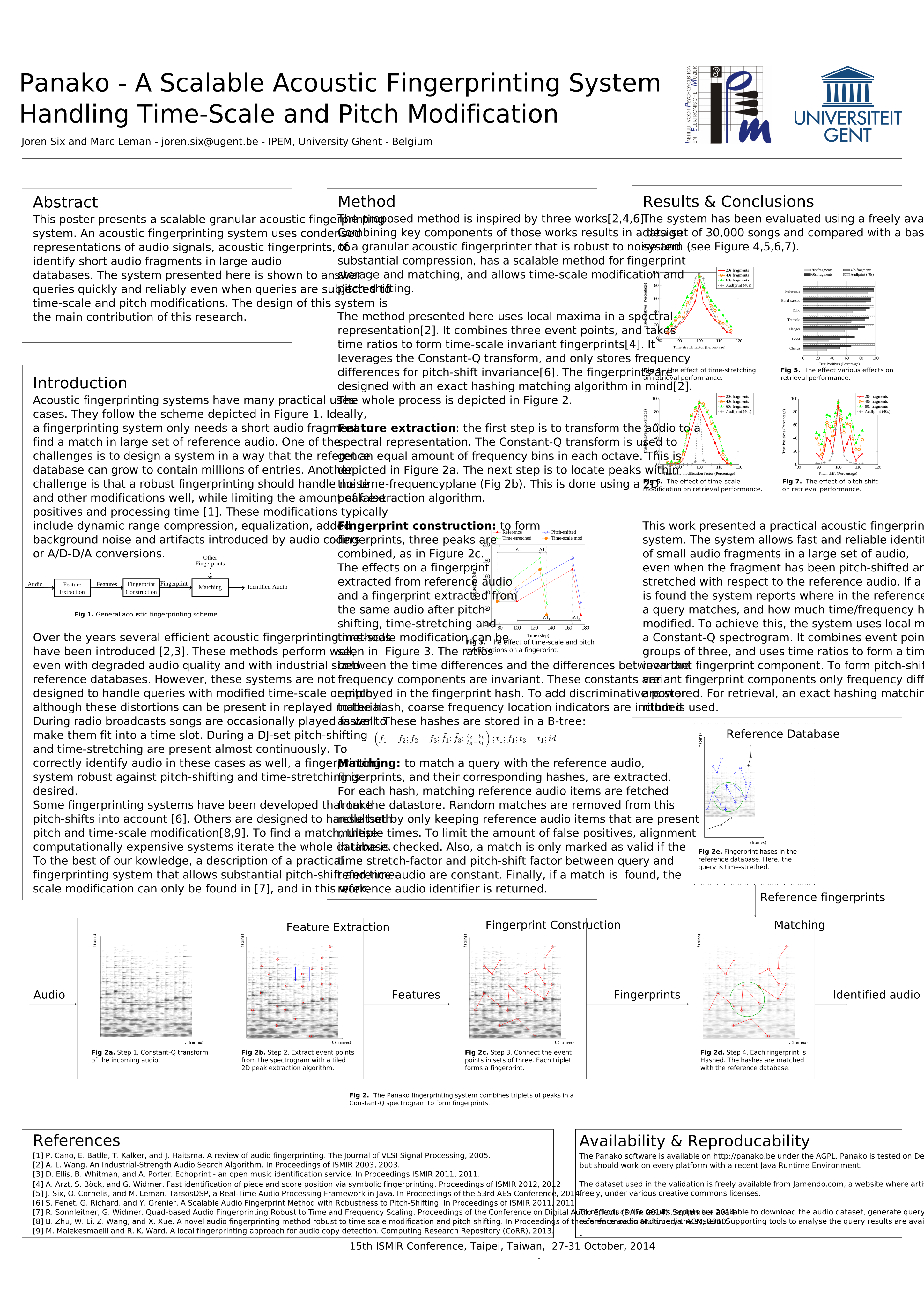 At [ISMIR 2014](http://www.terasoft.com.tw/conf/ismir2014) i will present a paper on a fingerprinting system. ISMIR is the annual conference of the International Society for Music Information Retrieval is the world's leading interdisciplinary forum on accessing, analyzing, and organizing digital music of all sorts. This years instalment takes place in Taipei, Taiwan. My contribution is a paper titled [Panako - A Scalable Acoustic Fingerprinting System Handling Time-Scale and Pitch Modification](http://www.terasoft.com.tw/conf/ismir2014/proceedings/T048_122_Paper.pdf), it will be presented during a poster session the 27th of October.
> *This paper presents a scalable granular acoustic fingerprinting system. An acoustic fingerprinting system uses condensed representation of audio signals, acoustic fingerprints, to identify short audio fragments in large audio databases. A robust fingerprinting system generates similar fingerprints for perceptually similar audio signals. The system presented here is designed to handle time-scale and pitch modifications. The open source implementation of the system is called Panako and is evaluated on commodity hardware using a freely available reference database with fingerprints of over 30,000 songs. The results show that the system responds quickly and reliably on queries, while handling time-scale and pitch modifications of up to ten percent.*
> *The system is also shown to handle GSM-compression, several audio effects and band-pass filtering. After a query, the system returns the start time in the reference audio and how much the query has been pitch-shifted or time-stretched with respect to the reference audio. The design of the system that offers this combination of features is the main contribution of this paper.*
The system is available, together with documentation and information on how to reproduce the results from the ISMIR paper, on the Panako website. Also available for download is the [Panako poster (pdf)](https://0110.be/files/attachments/424/panako_poster.pdf), [Panako ISMIR paper](https://0110.be/files/attachments/424/ismir_2014_panako_fingerprinter.pdf) and the [Panako poster (inkscape SVG)](https://0110.be/files/attachments/424/panako_poster_portrait.svg).
At [ISMIR 2014](http://www.terasoft.com.tw/conf/ismir2014) i will present a paper on a fingerprinting system. ISMIR is the annual conference of the International Society for Music Information Retrieval is the world's leading interdisciplinary forum on accessing, analyzing, and organizing digital music of all sorts. This years instalment takes place in Taipei, Taiwan. My contribution is a paper titled [Panako - A Scalable Acoustic Fingerprinting System Handling Time-Scale and Pitch Modification](http://www.terasoft.com.tw/conf/ismir2014/proceedings/T048_122_Paper.pdf), it will be presented during a poster session the 27th of October.
> *This paper presents a scalable granular acoustic fingerprinting system. An acoustic fingerprinting system uses condensed representation of audio signals, acoustic fingerprints, to identify short audio fragments in large audio databases. A robust fingerprinting system generates similar fingerprints for perceptually similar audio signals. The system presented here is designed to handle time-scale and pitch modifications. The open source implementation of the system is called Panako and is evaluated on commodity hardware using a freely available reference database with fingerprints of over 30,000 songs. The results show that the system responds quickly and reliably on queries, while handling time-scale and pitch modifications of up to ten percent.*
> *The system is also shown to handle GSM-compression, several audio effects and band-pass filtering. After a query, the system returns the start time in the reference audio and how much the query has been pitch-shifted or time-stretched with respect to the reference audio. The design of the system that offers this combination of features is the main contribution of this paper.*
The system is available, together with documentation and information on how to reproduce the results from the ISMIR paper, on the Panako website. Also available for download is the [Panako poster (pdf)](https://0110.be/files/attachments/424/panako_poster.pdf), [Panako ISMIR paper](https://0110.be/files/attachments/424/ismir_2014_panako_fingerprinter.pdf) and the [Panako poster (inkscape SVG)](https://0110.be/files/attachments/424/panako_poster_portrait.svg).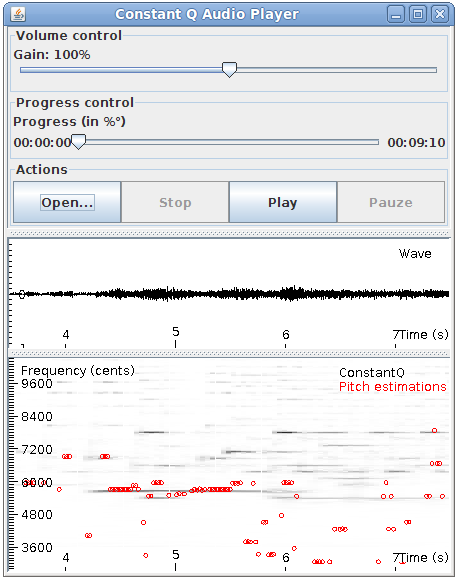
 The journal paper *Tarsos, a Modular Platform for Precise Pitch Analysis of Western and Non-Western Music* by Six, Cornelis, and Leman was published in a special issue about Computational Ethnomusicology of [the Journal of New Music Research (JNMR)](http://www.tandfonline.com/toc/nnmr20/current) on the 20th of august 2013. Below you can find the abstract for the article, and pointers to audio examples, the Tarsos software, and the author version of the article itself.
> **Abstract:** This paper presents Tarsos, a modular software platform used to extract and analyze pitch organization in music. With Tarsos pitch estimations are generated from an audio signal and those estimations are processed in order to form musicologically meaningful representations. Tarsos aims to offer a flexible system for pitch analysis through the combination of an interactive user interface, several pitch estimation algorithms, filtering options, immediate auditory feedback and data output modalities for every step. To study the most frequently used pitches, a fine-grained histogram that allows up to 1200 values per octave is constructed. This allows Tarsos to analyze deviations in Western music, or to analyze specific tone scales that differ from the 12 tone equal temperament, common in many non-Western musics. Tarsos has a graphical user interface or can be launched using an API - as a batch script. Therefore, it is fit for both the analysis of individual songs and the analysis of large music corpora. The interface allows several visual representations, and can indicate the scale of the piece under analysis. The extracted scale can be used immediately to tune a MIDI keyboard that can be played in the discovered scale. These features make Tarsos an interesting tool that can be used for musicological analysis, teaching and even artistic productions.
To read the full text you can either download "Tarsos, a Modular Platform for Precise Pitch Analysis of Western and Non-Western Music, Author version":\[2013.08.20.tarsos_jnmr_author_version.pdf\]. Or obtain the published version of [Tarsos, a Modular Platform for Precise Pitch Analysis of Western and Non-Western Music, published version](http://www.tandfonline.com/doi/full/10.1080/09298215.2013.797999)
Ladrang Kandamanyura (slendro pathet manyura), is the name of the piece used in the article throughout section 2. The album on which the piece can be found is available at [wergo](http://www.wergo.de/shop/en_UK/Audio_CDs/1000088/show,223736,n.html). Below a thirty second fragment is embedded. You can also "download":\[08.\_Ladrang_Kandamanyura_10s-20s_up.wav\] the thirty second fragment to analyse it yourself.
Below the BibTex entry for the article is embedded.
\`\`\`ruby\
\@article{six2013tarsos_jnmr,\
author = {Six, Joren and Cornelis, Olmo and Leman, Marc},\
title = {Tarsos, a Modular Platform for Precise Pitch Analysis\
of Western and Non-Western Music},\
journal = {Journal of New Music Research},\
volume = {42},\
number = {2},\
pages = {113-129},\
year = {2013},\
doi = {10.1080/09298215.2013.797999},\
URL = {http://www.tandfonline.com/doi/abs/10.1080/09298215.2013.797999}\
}\
\`\`\`
- [jnmr.cover.jpg](https://0110.be/files/attachments/331/jnmr.cover.jpg)
- [08.\_Ladrang\_Kandamanyura\_10s-20s\_up.wav](https://0110.be/files/attachments/331/08._Ladrang_Kandamanyura_10s-20s_up.wav)
- [2013.08.20.tarsos\_jnmr\_author\_version.pdf](https://0110.be/files/attachments/331/2013.08.20.tarsos_jnmr_author_version.pdf)
---
## [Tarsos 1.0: Transcription Features](https://0110.be/posts/Tarsos_1.0%3A_Transcription_Features.md)
- Published: 2012-12-05T00:00:00Z
- Updated: 2020-11-17T09:00:24Z
- Author: Joren
- ID: 335
- Canonical: https://0110.be/posts/Tarsos_1.0%3A_Transcription_Features
- Tags: [Computational ethnomusicology](https://0110.be/tags/Computational%20ethnomusicology.md), [Computational musicology](https://0110.be/tags/Computational%20musicology.md), [HoGent](https://0110.be/tags/HoGent.md), [Java](https://0110.be/tags/Java.md), [Music Information Retrieval](https://0110.be/tags/Music%20Information%20Retrieval.md), [Tarsos](https://0110.be/tags/Tarsos.md), [WSOLA](https://0110.be/tags/WSOLA.md), [featured](https://0110.be/tags/featured.md)
Today marks the reslease of Tarsos 1.0 . The new Tarsos release contains practical transcription features. As can be seen in the screenshot below, a time stretching feature makes it easy to loop a certain audio fragment while it is playing in a slow tempo. The next loop can be played with by pressing the `n` key, the one before by pressing `b`.
Since the pitch classes can be found in a song, and there is a feature that lets you play a `MIDI` keyboard in the tone scale of the song under analysis, transcription of ethnic music is made a lot easier.
The new release of Tarsos can be found in the [Tarsos release repository](http://0110.be/releases/Tarsos/). From now on, nightly releases are uploaded there automatically.
---
## [ISMIR 2012 - Highlights](https://0110.be/posts/ISMIR_2012_-_Highlights.md)
- Published: 2012-10-08T11:47:22Z
- Updated: 2013-12-05T18:19:15Z
- Author: Joren
- ID: 388
- Canonical: https://0110.be/posts/ISMIR_2012_-_Highlights
- Tags: [Computational ethnomusicology](https://0110.be/tags/Computational%20ethnomusicology.md), [HoGent](https://0110.be/tags/HoGent.md), [ISMIR](https://0110.be/tags/ISMIR.md), [Music Information Retrieval](https://0110.be/tags/Music%20Information%20Retrieval.md)
The journal paper *Tarsos, a Modular Platform for Precise Pitch Analysis of Western and Non-Western Music* by Six, Cornelis, and Leman was published in a special issue about Computational Ethnomusicology of [the Journal of New Music Research (JNMR)](http://www.tandfonline.com/toc/nnmr20/current) on the 20th of august 2013. Below you can find the abstract for the article, and pointers to audio examples, the Tarsos software, and the author version of the article itself.
> **Abstract:** This paper presents Tarsos, a modular software platform used to extract and analyze pitch organization in music. With Tarsos pitch estimations are generated from an audio signal and those estimations are processed in order to form musicologically meaningful representations. Tarsos aims to offer a flexible system for pitch analysis through the combination of an interactive user interface, several pitch estimation algorithms, filtering options, immediate auditory feedback and data output modalities for every step. To study the most frequently used pitches, a fine-grained histogram that allows up to 1200 values per octave is constructed. This allows Tarsos to analyze deviations in Western music, or to analyze specific tone scales that differ from the 12 tone equal temperament, common in many non-Western musics. Tarsos has a graphical user interface or can be launched using an API - as a batch script. Therefore, it is fit for both the analysis of individual songs and the analysis of large music corpora. The interface allows several visual representations, and can indicate the scale of the piece under analysis. The extracted scale can be used immediately to tune a MIDI keyboard that can be played in the discovered scale. These features make Tarsos an interesting tool that can be used for musicological analysis, teaching and even artistic productions.
To read the full text you can either download "Tarsos, a Modular Platform for Precise Pitch Analysis of Western and Non-Western Music, Author version":\[2013.08.20.tarsos_jnmr_author_version.pdf\]. Or obtain the published version of [Tarsos, a Modular Platform for Precise Pitch Analysis of Western and Non-Western Music, published version](http://www.tandfonline.com/doi/full/10.1080/09298215.2013.797999)
Ladrang Kandamanyura (slendro pathet manyura), is the name of the piece used in the article throughout section 2. The album on which the piece can be found is available at [wergo](http://www.wergo.de/shop/en_UK/Audio_CDs/1000088/show,223736,n.html). Below a thirty second fragment is embedded. You can also "download":\[08.\_Ladrang_Kandamanyura_10s-20s_up.wav\] the thirty second fragment to analyse it yourself.
Below the BibTex entry for the article is embedded.
\`\`\`ruby\
\@article{six2013tarsos_jnmr,\
author = {Six, Joren and Cornelis, Olmo and Leman, Marc},\
title = {Tarsos, a Modular Platform for Precise Pitch Analysis\
of Western and Non-Western Music},\
journal = {Journal of New Music Research},\
volume = {42},\
number = {2},\
pages = {113-129},\
year = {2013},\
doi = {10.1080/09298215.2013.797999},\
URL = {http://www.tandfonline.com/doi/abs/10.1080/09298215.2013.797999}\
}\
\`\`\`
- [jnmr.cover.jpg](https://0110.be/files/attachments/331/jnmr.cover.jpg)
- [08.\_Ladrang\_Kandamanyura\_10s-20s\_up.wav](https://0110.be/files/attachments/331/08._Ladrang_Kandamanyura_10s-20s_up.wav)
- [2013.08.20.tarsos\_jnmr\_author\_version.pdf](https://0110.be/files/attachments/331/2013.08.20.tarsos_jnmr_author_version.pdf)
---
## [Tarsos 1.0: Transcription Features](https://0110.be/posts/Tarsos_1.0%3A_Transcription_Features.md)
- Published: 2012-12-05T00:00:00Z
- Updated: 2020-11-17T09:00:24Z
- Author: Joren
- ID: 335
- Canonical: https://0110.be/posts/Tarsos_1.0%3A_Transcription_Features
- Tags: [Computational ethnomusicology](https://0110.be/tags/Computational%20ethnomusicology.md), [Computational musicology](https://0110.be/tags/Computational%20musicology.md), [HoGent](https://0110.be/tags/HoGent.md), [Java](https://0110.be/tags/Java.md), [Music Information Retrieval](https://0110.be/tags/Music%20Information%20Retrieval.md), [Tarsos](https://0110.be/tags/Tarsos.md), [WSOLA](https://0110.be/tags/WSOLA.md), [featured](https://0110.be/tags/featured.md)
Today marks the reslease of Tarsos 1.0 . The new Tarsos release contains practical transcription features. As can be seen in the screenshot below, a time stretching feature makes it easy to loop a certain audio fragment while it is playing in a slow tempo. The next loop can be played with by pressing the `n` key, the one before by pressing `b`.
Since the pitch classes can be found in a song, and there is a feature that lets you play a `MIDI` keyboard in the tone scale of the song under analysis, transcription of ethnic music is made a lot easier.
The new release of Tarsos can be found in the [Tarsos release repository](http://0110.be/releases/Tarsos/). From now on, nightly releases are uploaded there automatically.
---
## [ISMIR 2012 - Highlights](https://0110.be/posts/ISMIR_2012_-_Highlights.md)
- Published: 2012-10-08T11:47:22Z
- Updated: 2013-12-05T18:19:15Z
- Author: Joren
- ID: 388
- Canonical: https://0110.be/posts/ISMIR_2012_-_Highlights
- Tags: [Computational ethnomusicology](https://0110.be/tags/Computational%20ethnomusicology.md), [HoGent](https://0110.be/tags/HoGent.md), [ISMIR](https://0110.be/tags/ISMIR.md), [Music Information Retrieval](https://0110.be/tags/Music%20Information%20Retrieval.md)
 The 13th International Society for Music Information Retrieval Conference took place in Porto, Portugal, October 8th-12th, 2012. This text contains links to some papers, toolkits, software presented there which are interesting for my research. Basically it contains my personal highlights of the conference. The [ISMIR 2012](http://ismir2012.ismir.net/) is described as follows:
> The annual Conference of the International Society for Music Information Retrieval (ISMIR) is the world's leading research forum on processing, searching, organizing and accessing music-related data. The revolution in music distribution and storage brought about by digital technology has fueled tremendous research activities and interests in academia as well as in industry. The ISMIR Conference reflects this rapid development by providing a meeting place for the discussion of MIR-related research, developments, methods, tools and experimental results. Its main goal is to foster multidisciplinary exchange by bringing together researchers and developers, educators and librarians, as well as students and professional users.
### Tutorials
I saw an interesting tutorial on Jazz music and a tutorial on source separation. After an introduction, which detailed the experimental basis of the system, a source separator was introduced. The [REPET source separator](http://music.cs.northwestern.edu/research.php) is a relatively simple system that yields reasonable results to split accompaniment from foreground melody.
### Posters & Talks
The approach and the dataset used in [N-gram Based Statistical Makam Detection on Makam Music in Turkey Using Symbolic Data](http://ismir2012.ismir.net/event/papers/043-ismir-2012.pdf) is very interesting. More than 800 pieces of makam music where transcribed manually and analysed. Details about the dataset are available in the following paper: [A Turkish Makam Music Symbolic Database for Music Information Retrieval: SymbTr](http://ismir2012.ismir.net/event/papers/223-ismir-2012.pdf).
[Assigning a Confidence Threshold on Automatic Beat Annotation in Large Datasets](http://ismir2012.ismir.net/event/papers/157-ismir-2012.pdf) by Zapata et al. shows a very interesting way to do exactly what the title says. Descriptive titles are descriptive.
A very practical tool to do melody extraction was presented by Justin Salamon. He created a Vamp Plugin with the name [Melodia](http://mtg.upf.edu/technologies/melodia). Unfortunately the plugin is currently only available for windows, but Linux and OS X versions are in the pipeline. More about the algorithm implemented and background information can be found in the paper Justin presented: [Statistical Characterisation of Melodic Pitch Contours and its Application for Melody Extraction](http://ismir2012.ismir.net/event/papers/187-ismir-2012.pdf). Another Vamp Plugin for melody visualization was also presented: [Pitch Content Visualization Tools for Music Performance Analysis](http://ismir2012.ismir.net/event/papers/493-ismir-2012.pdf).
The ongoing work by Ceril Bohak and Matija Marolt on segmentation of folk music could be very useful to apply on Afican musics. The paper is called [Finding Repeating Stanzas in Folk Songs](http://ismir2012.ismir.net/event/papers/451-ismir-2012.pdf).
- [ismir\_2012.jpg](https://0110.be/files/attachments/388/ismir_2012.jpg)
---
## [CIM 2012 - Revealing and Listening to Scales From the Past; Tone Scale Analysis of Archived Central-African Music Using Computational Means](https://0110.be/posts/CIM_2012_-_Revealing_and_Listening_to_Scales_From_the_Past%3B_Tone_Scale_Analysis_of_Archived_Central-African_Music_Using_Computational_Means.md)
- Published: 2012-08-31T00:00:00Z
- Updated: 2014-02-13T10:58:38Z
- Author: Joren
- ID: 351
- Canonical: https://0110.be/posts/CIM_2012_-_Revealing_and_Listening_to_Scales_From_the_Past%3B_Tone_Scale_Analysis_of_Archived_Central-African_Music_Using_Computational_Means
- Tags: [Computational musicology](https://0110.be/tags/Computational%20musicology.md), [HoGent](https://0110.be/tags/HoGent.md), [Music Information Retrieval](https://0110.be/tags/Music%20Information%20Retrieval.md), [Presentation](https://0110.be/tags/Presentation.md), [Research papers](https://0110.be/tags/Research%20papers.md), [Tarsos](https://0110.be/tags/Tarsos.md), [featured](https://0110.be/tags/featured.md)
The 13th International Society for Music Information Retrieval Conference took place in Porto, Portugal, October 8th-12th, 2012. This text contains links to some papers, toolkits, software presented there which are interesting for my research. Basically it contains my personal highlights of the conference. The [ISMIR 2012](http://ismir2012.ismir.net/) is described as follows:
> The annual Conference of the International Society for Music Information Retrieval (ISMIR) is the world's leading research forum on processing, searching, organizing and accessing music-related data. The revolution in music distribution and storage brought about by digital technology has fueled tremendous research activities and interests in academia as well as in industry. The ISMIR Conference reflects this rapid development by providing a meeting place for the discussion of MIR-related research, developments, methods, tools and experimental results. Its main goal is to foster multidisciplinary exchange by bringing together researchers and developers, educators and librarians, as well as students and professional users.
### Tutorials
I saw an interesting tutorial on Jazz music and a tutorial on source separation. After an introduction, which detailed the experimental basis of the system, a source separator was introduced. The [REPET source separator](http://music.cs.northwestern.edu/research.php) is a relatively simple system that yields reasonable results to split accompaniment from foreground melody.
### Posters & Talks
The approach and the dataset used in [N-gram Based Statistical Makam Detection on Makam Music in Turkey Using Symbolic Data](http://ismir2012.ismir.net/event/papers/043-ismir-2012.pdf) is very interesting. More than 800 pieces of makam music where transcribed manually and analysed. Details about the dataset are available in the following paper: [A Turkish Makam Music Symbolic Database for Music Information Retrieval: SymbTr](http://ismir2012.ismir.net/event/papers/223-ismir-2012.pdf).
[Assigning a Confidence Threshold on Automatic Beat Annotation in Large Datasets](http://ismir2012.ismir.net/event/papers/157-ismir-2012.pdf) by Zapata et al. shows a very interesting way to do exactly what the title says. Descriptive titles are descriptive.
A very practical tool to do melody extraction was presented by Justin Salamon. He created a Vamp Plugin with the name [Melodia](http://mtg.upf.edu/technologies/melodia). Unfortunately the plugin is currently only available for windows, but Linux and OS X versions are in the pipeline. More about the algorithm implemented and background information can be found in the paper Justin presented: [Statistical Characterisation of Melodic Pitch Contours and its Application for Melody Extraction](http://ismir2012.ismir.net/event/papers/187-ismir-2012.pdf). Another Vamp Plugin for melody visualization was also presented: [Pitch Content Visualization Tools for Music Performance Analysis](http://ismir2012.ismir.net/event/papers/493-ismir-2012.pdf).
The ongoing work by Ceril Bohak and Matija Marolt on segmentation of folk music could be very useful to apply on Afican musics. The paper is called [Finding Repeating Stanzas in Folk Songs](http://ismir2012.ismir.net/event/papers/451-ismir-2012.pdf).
- [ismir\_2012.jpg](https://0110.be/files/attachments/388/ismir_2012.jpg)
---
## [CIM 2012 - Revealing and Listening to Scales From the Past; Tone Scale Analysis of Archived Central-African Music Using Computational Means](https://0110.be/posts/CIM_2012_-_Revealing_and_Listening_to_Scales_From_the_Past%3B_Tone_Scale_Analysis_of_Archived_Central-African_Music_Using_Computational_Means.md)
- Published: 2012-08-31T00:00:00Z
- Updated: 2014-02-13T10:58:38Z
- Author: Joren
- ID: 351
- Canonical: https://0110.be/posts/CIM_2012_-_Revealing_and_Listening_to_Scales_From_the_Past%3B_Tone_Scale_Analysis_of_Archived_Central-African_Music_Using_Computational_Means
- Tags: [Computational musicology](https://0110.be/tags/Computational%20musicology.md), [HoGent](https://0110.be/tags/HoGent.md), [Music Information Retrieval](https://0110.be/tags/Music%20Information%20Retrieval.md), [Presentation](https://0110.be/tags/Presentation.md), [Research papers](https://0110.be/tags/Research%20papers.md), [Tarsos](https://0110.be/tags/Tarsos.md), [featured](https://0110.be/tags/featured.md)
 What follows is about the [Conference on Interdisciplinary Musicology (CIM2012)](http://gfm2012.uni-goettingen.de/cim12/CIM12/Home.html) and the [15th international Conference of the Gesellschaft fur Musikfoschung](http://gfm2012.uni-goettingen.de/GfM2012/Home.html). First this text will give information about our contribution to CIM2012: *Revealing and Listening to Scales From the Past; Tone Scale Analysis of Archived Central-African Music Using Computational Means* and then a number of highlights of the conference follow. The joint conference took place from the 4th to the 8th of september 2012.
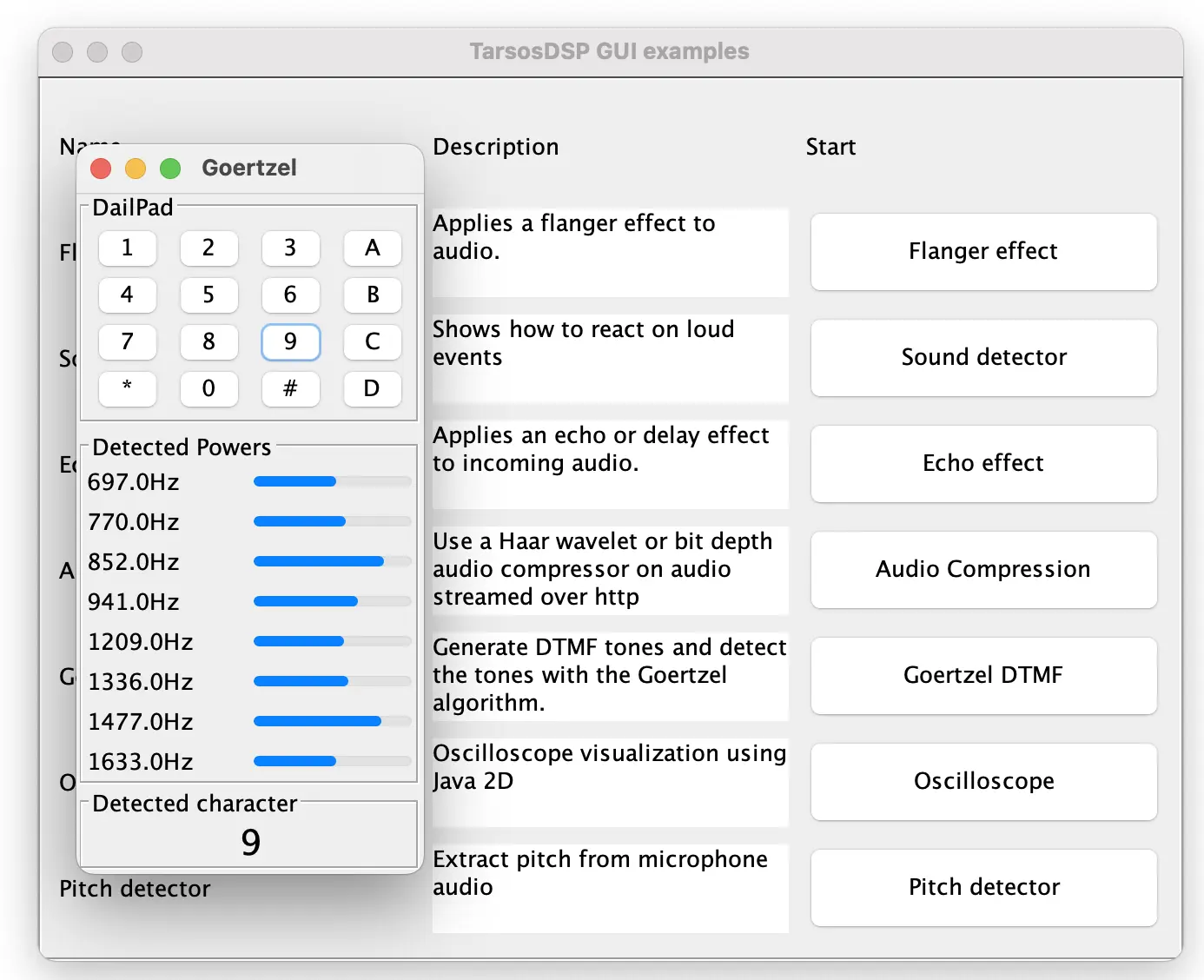
In 2012, CIM will tackle the subject of History. Hosted by the University of Göttingen, whose one time music director Johann Nikolaus Forkel is widely regarded as one of the founders of modern music historiography, CIM12 aims to promote collaborations that provoke and explore new methods and methodologies for establishing, evaluating, preserving and communicating knowledge of music and musical practices of past societies and the factors implicated in both the preservation and transformation of such practices over time.### Revealing and Listening to Scales From the Past; Tone Scale Analysis of Archived Central-African Music Using Computational Means Our contribution ton CIM 2012 is titled "Revealing and Listening to Scales From the Past; Tone Scale Analysis of Archived Central-African Music Using Computational Means":\[CIM12_Submission.pdf\]. The aim was to show how tone scales of the past, e.g. organ tuning, can be extracted and sonified. During the demo special attention was given to historic Central African tuning systems. The presentation I gave is included below and or available for "download":\[2012.09.05-Revealing_and_listening_to_scales_from_the_past\_\_tone_scale_analysis_of_archived_Central-African_music_using_computational_means..ppt\] ### Highlights What follows are some personal highlights for the [Conference on Interdisciplinary Musicology (CIM2012)](http://gfm2012.uni-goettingen.de/cim12/CIM12/Home.html) and the [15th international Conference of the Gesellschaft fur Musikfoschung](http://gfm2012.uni-goettingen.de/GfM2012/Home.html). The joint conference took place from the 4th to the 8th of september 2012. The work presented by Rytis Ambrazevicius et al. *Modal changes in traditional Lithuanian singing: Diachronic aspect* has a lot in common with our research, it was interesting to see their approach. Another highlight of the conference was the whole session organized by Klaus-Peter Brenner around Mbira music. Rainer Polak gave a talk titled *'Swing, Groove and Metre. Asymmetric Feels, Metric Ambiguity and Metric Transformation in African Musics'*. He showed how research about rhythm in jazz research, music theory and empirical musicology ( amongst others) could be bridged and applied to ethnic music. The overview Eleanore Selfridge-Field gave during her talk *Between an Analogue Past and a Digital Future: The Evolving Digital Present* was refreshing. She had a really clear view on all the different ways musicology and digital media can benifit from each-other. From the concert programme I found two especially interesting: the lecture-performance by Margarete Maierhofer-Lischka and Frauke Aulbert of [*Lotofagos*](http://www.youtube.com/watch?v=tYD30v0PgoI), a piece by Beat Furrer and *Burdocks* composed and performed by Christian Wolff and a bunch of enthusiastic students. - [Forkeljpg.jpg](https://0110.be/files/attachments/351/Forkeljpg.jpg) - [CIM12\_Submission.pdf](https://0110.be/files/attachments/351/CIM12_Submission.pdf) - [2012.09.05-Revealing\_and\_listening\_to\_scales\_from\_the\_past\_\_tone\_scale\_analysis\_of\_archived\_Central-African\_music\_using\_computational\_means..ppt](https://0110.be/files/attachments/351/2012.09.05-Revealing_and_listening_to_scales_from_the_past__tone_scale_analysis_of_archived_Central-African_music_using_computational_means..ppt) --- ## [TarsosDSP Release 1.0](https://0110.be/posts/TarsosDSP_Release_1.0.md) - Published: 2012-04-24T14:25:32Z - Updated: 2013-12-05T18:19:15Z - Author: Joren - ID: 352 - Canonical: https://0110.be/posts/TarsosDSP_Release_1.0 - Tags: [Code](https://0110.be/tags/Code.md), [Command Line Application](https://0110.be/tags/Command%20Line%20Application.md), [HoGent](https://0110.be/tags/HoGent.md), [Java](https://0110.be/tags/Java.md), [Music Information Retrieval](https://0110.be/tags/Music%20Information%20Retrieval.md), [TarsosDSP](https://0110.be/tags/TarsosDSP.md), [WSOLA](https://0110.be/tags/WSOLA.md), [featured](https://0110.be/tags/featured.md) After about a year of development and several revisions TarsosDSP has enough features and is stable enough to slap the 1.0 tag onto it. A 'read me', manual, API documentation, source and binaries can be found on the [TarsosDSP release directory](http://tarsos.0110.be/releases/TarsosDSP/). The source is present in the\ What follows below is the information that can be found in the read me file:
TarsosDSP is a collection of classes to do simple audio processing. It features an implementation of a percussion onset detector and two pitch detection algorithms: Yin and the Mcleod Pitch method. Also included is a Goertzel DTMF decoding algorithm and a time stretch algorithm (WSOLA).
Its aim is to provide a simple interface to some audio (signal) processing algorithms implemented in pure JAVA. Some TarsosDSP example applications are available.
The following example filters a band of frequencies of an input file testFile. It keeps the frequencies form startFrequency to stopFrequency.
AudioInputStream inputStream = AudioSystem.getAudioInputStream(testFile);
    AudioDispatcher dispatcher = new AudioDispatcher(inputStream,stepSize,overlap);
    dispatcher.addAudioProcessor(new HighPass(startFrequency, sampleRate, overlap));
    dispatcher.addAudioProcessor(new LowPassFS(stopFrequency, sampleRate, overlap));
    dispatcher.addAudioProcessor(new FloatConverter(format));
    dispatcher.addAudioProcessor(new WaveformWriter(format,stepSize, overlap, "filtered.wav"));
    dispatcher.run();
Head over to the TarsosDSP release repository and download the latest TarsosDSP library. To get up to speed quickly, check the TarsosDSP Example applications for inspiration and consult the API documentation. If you, for some reason, want to build from source, you need Apache Ant and git installed on your system. The following commands fetch the source and build the library and example jars:
git clone https://JorenSix@github.com/JorenSix/TarsosDSP.git
    cd TarsosDSP/build
    ant tarsos_dsp_library #Builds the core TarsosDSP library
    ant build_examples #Builds all the TarsosDSP examples
    ant javadoc #Creates the documentation in TarsosDSP/doc
\
When everything runs correctly you should be able to run all example applications and have the latest version of the TarsosDSP library for inclusion in your projects. Also the Javadoc documentation for the API should be available in TarsosDSP/doc. Drop me a line if you use TarsosDSP in your project. Always nice to hear how this software is used.
The source tree is divided in three directories:
src contains the source files of the core DSP libraries.
test contains unit tests for some of the DSP functionality.
build contains ANT build files. Either to build Java documentation or runnable JAR-files for the example applications.
examples contains a couple of example applications with a Java Swing user interface:
 Tarsos contains a couple of useful command line applications. They can be used to execute common tasks on lots of files. [Dowload Tarsos](http://tarsos.0110.be/attachment/tarsos.jar) and call the applications using the following format:
`java -jar tarsos.jar command [argument...] [--option [value]...]`
The first part `java -jar tarsos.jar` tells the Java Runtime to start the correct application. The first argument for Tarsos defines the command line application to execute. Depending on the command, required arguments and options can follow.
`java -jar tarsos.jar detect_pitch in.wav --detector TARSOS_YIN`
To get a list of available commands, type `java -jar tarsos.jar -h`. If you want more information about a command type `java -jar tarsos.jar command -h`
## Detect Pitch
Detects pitch for one or more input audio files using a pitch detector. If a directory is given it traverses the directory *recursively*. It writes CSV data to standard out with five columns. The first is the start of the analyzed window (seconds), the second the estimated pitch, the third the saillence of the pitch. The name of the algorithm follows and the last column shows the original filename.
Synopsis
--------
java -jar tarsos.jar detect_pitch [option] input_file...
Option Description
------ -----------
-?, -h, --help Show help
--detector
Tarsos contains a couple of useful command line applications. They can be used to execute common tasks on lots of files. [Dowload Tarsos](http://tarsos.0110.be/attachment/tarsos.jar) and call the applications using the following format:
`java -jar tarsos.jar command [argument...] [--option [value]...]`
The first part `java -jar tarsos.jar` tells the Java Runtime to start the correct application. The first argument for Tarsos defines the command line application to execute. Depending on the command, required arguments and options can follow.
`java -jar tarsos.jar detect_pitch in.wav --detector TARSOS_YIN`
To get a list of available commands, type `java -jar tarsos.jar -h`. If you want more information about a command type `java -jar tarsos.jar command -h`
## Detect Pitch
Detects pitch for one or more input audio files using a pitch detector. If a directory is given it traverses the directory *recursively*. It writes CSV data to standard out with five columns. The first is the start of the analyzed window (seconds), the second the estimated pitch, the third the saillence of the pitch. The name of the algorithm follows and the last column shows the original filename.
Synopsis
--------
java -jar tarsos.jar detect_pitch [option] input_file...
Option Description
------ -----------
-?, -h, --help Show help
--detector 
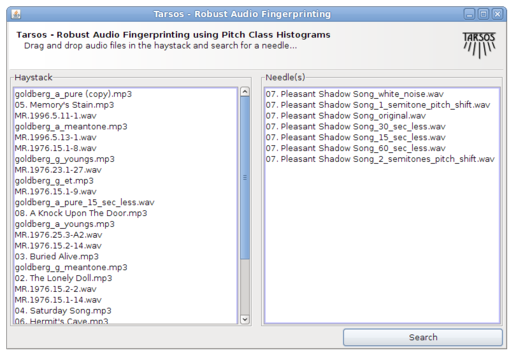 Olmo Cornelis and myself just gave a presentation about Tarsos at the at the [12th International Society for Music Information Retrieval Conference](http://ismir2011.ismir.net/) which is held at Miami.
The live demo we gave went well and we got a lot of positive, interesting feedback. The [presentation about Tarsos](https://0110.be/25.10.2011.ismir_tarsos.pdf) is available here.
It was the first time in the history of ISMIR that there was a session with oral [presentations about Non-Western Music](http://ismir2011.ismir.net/program.html#OS2). We were pleased to be part of this.
The peer reviewed paper about our work: [Tarsos - a Platform to Explore Pitch Scales in Non-Western and Western Music](http://ismir2011.ismir.net/program.html#OS2) is available from the ISMIR website and embedded below:
- [2011.10.25.ismir\_tarsos.pdf](https://0110.be/files/attachments/368/2011.10.25.ismir_tarsos.pdf)
---
[Older posts](https://0110.be/tags/Music%20Information%20Retrieval.md?page=1)
Olmo Cornelis and myself just gave a presentation about Tarsos at the at the [12th International Society for Music Information Retrieval Conference](http://ismir2011.ismir.net/) which is held at Miami.
The live demo we gave went well and we got a lot of positive, interesting feedback. The [presentation about Tarsos](https://0110.be/25.10.2011.ismir_tarsos.pdf) is available here.
It was the first time in the history of ISMIR that there was a session with oral [presentations about Non-Western Music](http://ismir2011.ismir.net/program.html#OS2). We were pleased to be part of this.
The peer reviewed paper about our work: [Tarsos - a Platform to Explore Pitch Scales in Non-Western and Western Music](http://ismir2011.ismir.net/program.html#OS2) is available from the ISMIR website and embedded below:
- [2011.10.25.ismir\_tarsos.pdf](https://0110.be/files/attachments/368/2011.10.25.ismir_tarsos.pdf)
---
[Older posts](https://0110.be/tags/Music%20Information%20Retrieval.md?page=1)

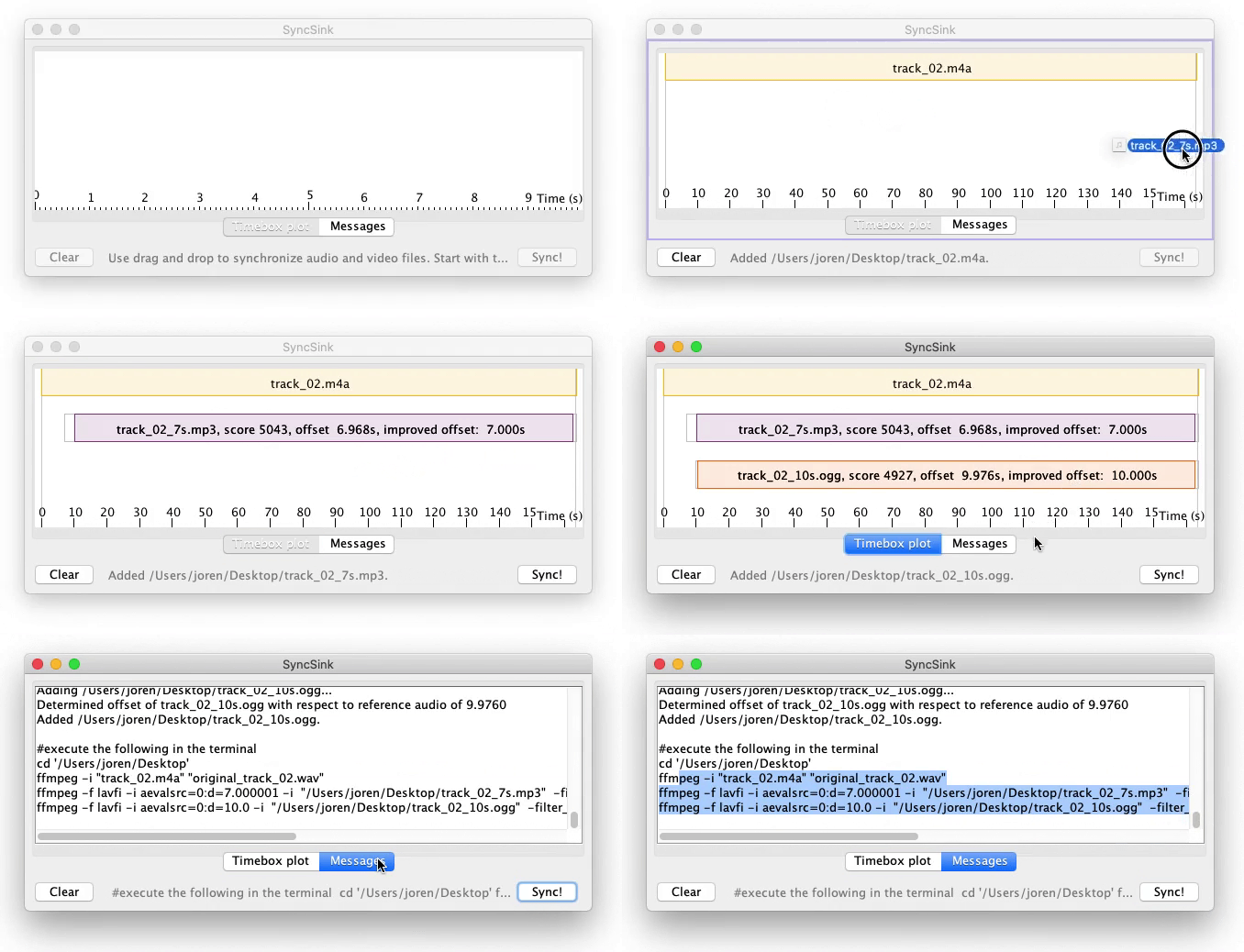
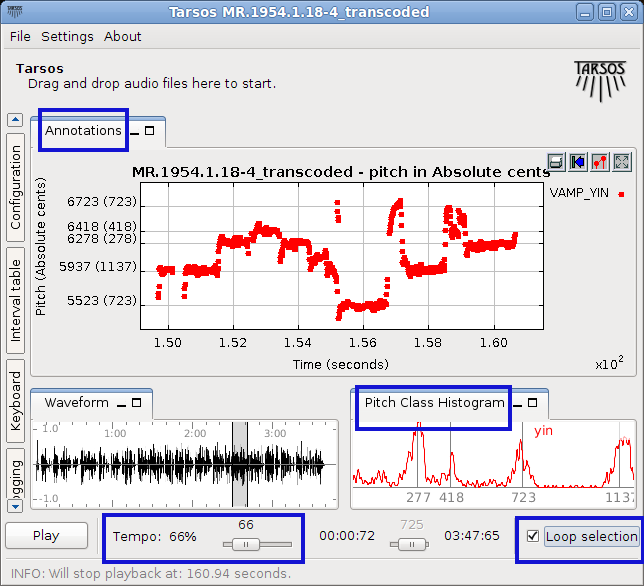 \
\