Hi, I'm Joren. Welcome to my website. I'm a research software engineer in the field of Music Informatics and Digital Humanities. Here you can find a record of my research and projects I have been working on. Learn more »
I just finished creating a first release of Tarsos. The release contains several demo applications, some more usefull than other. Tarsos is a work in progress: not all functionality is exposed with the CLI (Command Line Interface) demo applications. The demos should however give a taste of the possibilities. All demo applications follow this pattern:
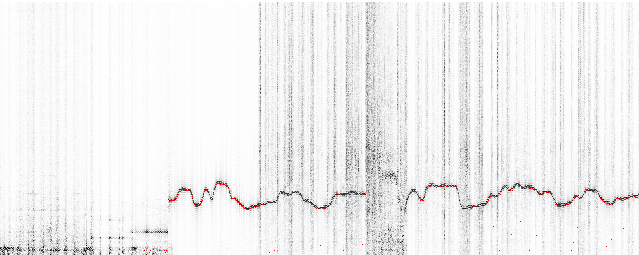
Today I created a spectrogram application using Tarsos. The application listens to an audio input, computes an FFT and at the same time calculates pitch. The expected pitch is overlaid on the spectrogram. All this happens real-time and is implemented using JAVA.
The JAVA software program we are developing is called Tarsos and can now be found on GitHub. GitHub is a web-based hosting service for projects that use the Git version control system.
Currently Tarsos is a collection of Java classes to create, compare and process pitch-frequency data using histograms. In it’s current state it is not usable for end-users.
The dataset we use is the sound archive of the department of Ethnomusicology of the Royal Museum for Central Africa at Tervuren, Belgium. The archive was digitized during the DEKKMMA (Digitization of the Ethnomusicological Sound Archive of the Royal Museum for Central Africa - it works better in Dutch) project. More information about the dataset can be foun on the website of the DEKKMMA project:
The archive is a collection of sound recordings of traditional music from Central Africa, with a particular focus on Congo and Rwanda. The sound archive contains about 3,000 hours of music recordings, the oldest of which date from 1910: Edison cylinders recorded by Hutereau in the Uele-province in Congo.
The archive contains several sound carriers (Edison cylinders, Sonofil wire, magnetic tapes, audiocassettes, disks, CD's ...) with associated metadata (paper files) and contextual data (photographs, films, video's, books, documents of all kind).
The collection was created during and after the colonial era of the Belgian Kingdom in Central Africa. The RMCA collection forms for an important part the musical memory of Central Africa and in terms of size, documentation and musical quality, it is -- without any doubt -- the world's most important sound archive for this region.
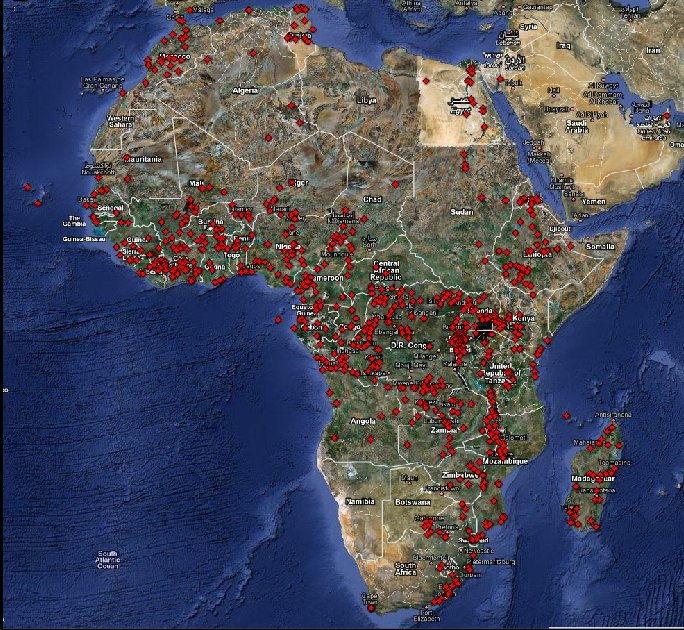
Using the meta data we did a rough geocoding of each recording to create an “interactive map of the dataset”:[dataset_geocodes.html].
The aim of this research project is to gain novel musicological insights into a large dataset of music from Central Africa. While practising ethnomusicological research on this dataset, we to develop and publish useful software and methodologies for the (ethno)musicological research community.
From November 2009 until November 2013 this research project was organised at the School of Arts, University College Ghent, under supervision by Olmo Cornelis. Later, from November 2013 onwards, the project turned into a 2 year doctoral research project hosted at IPEM, University Ghent under the supervision of Marc Leman.
Partners
University Ghent, IPEM: The Institute for Psychoacoustics and Electronic Music is part of the Music department at the Faculty of Arts and Philosophy, at Ghent University.

 Music Information Retrieval, Java, Tarsos, and HoGent
 tarsos.jar, flute.novib.mf.C5B5.wav, satie_gymno1.mid, and 120.scl.txt