» By Joren on Friday 13 November 2026
The IPEM sound archive has a new website. The archive holds the tapes of IPEM, the electronic music production studio founded in Ghent in 1963 as a joint venture between the Belgian national broadcaster and Ghent University. Between 1963 and 1987 about 500 works were produced there, which made IPEM one of the most productive electronic music studios in Europe at the time. I have been maintaining the archive for around a decade and now found the time to give it some needed attention.
The tapes were first digitised around 2000 during a project led by Marc Leman, Jelle Dierickx and Gaëtan Martens. The 2001 paper in the Journal of New Music Research describes the history of the studio, the contents of the archive and the database design. Much of that design still holds up. A second digitization happened later at around 2014, by meemoo. The website bundles results form the first digitisation - CDs - and second digitisation - tapes - and now lists 1,060 tapes, 348 CDs, 3,335 works and 1,036 notebooks, with waveforms, automatic transcriptions, segment timelines and scans of the tape boxes.
With Olaf - a lightweight acoustic fingerprinting solution - the audio from CDs and tapes are linked. This allows to verify meta-data and segmentation of tapes, as described in Applications of duplicate detection: linking meta-data and merging music archives – The experience of the IPEM historical archive of electronic music.
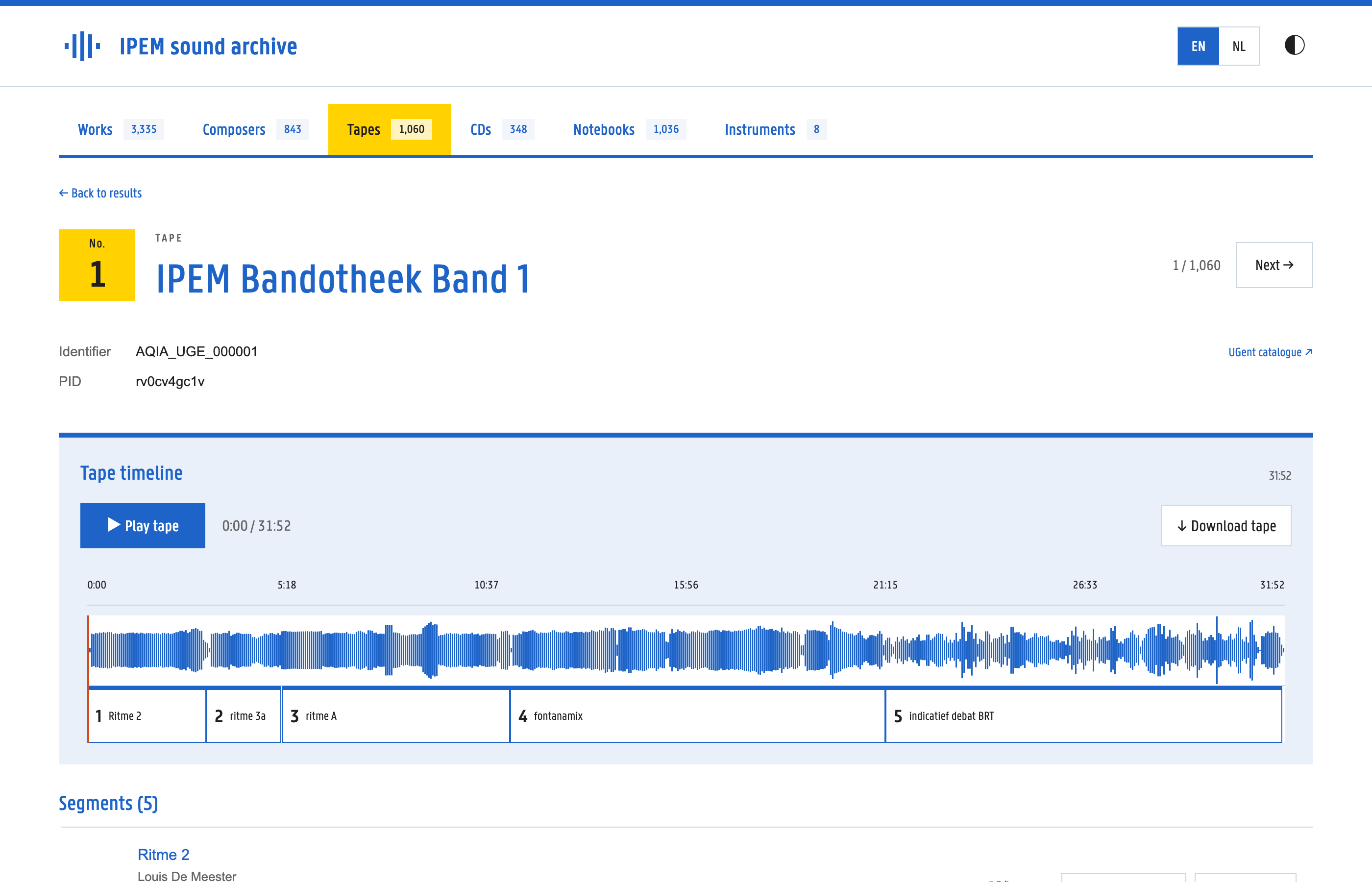
Fig: Tape 1 in the IPEM sound archive, with works by Louis De Meester, Lucien Goethals and much more.
The previous version of the website was a Ruby on Rails application. It worked, but a Rails application needs constant care: Ruby upgrades, gem updates, security patches, a running server and a database. That is a lot of maintenance for a website that rarely changes. It has also become a risk. As I wrote earlier, the age of AI exploits is here, and a server-side application with sub-par maintenance is exactly the kind of thing that gets exploited.
The new version runs on Pihka, a small data publication platform we are developing at GhentCDH. Pihka publishes an SQLite database as a searchable website, with faceted and full-text search, and has no back-end: the browser downloads the database and queries it locally. What remains is a folder of static files that any web server can host, with SQLite as an archival format. The design of the archive should stand the test of time, at least that is the idea.
Anyhow, go have a look at the IPEM sound archive. There are plenty of curious tapes from the Belgian electronic music avant-garde to discover.
 UGent, IPEM, Code, Music Information Retrieval, Computational musicology, and Projecten
» By Joren on Wednesday 11 November 2026
On 14 November, the Industriemuseum in Ghent opens Computer says hello, a temporary exhibition on computer history. It covers seventy years of computers and their influence on our lives and work, with particular attention to Belgian companies and stories. Expect machines, software, games and sounds, from early computers to the smartphone.
I served on the advisory board for the exhibition. It was interesting to see how an exhibition takes shape and to follow the process from the other side. My fellow board members and I suggested plenty of ideas, most of which promptly ended up on the pile marked “interesting, but…”. My main interest is computing for music, so I nudged things a little in that direction. Surprisingly, the idea survived the idea bloodbath, and some music computing hardware found its way into the exhibition.
The NeXTcube I restored at IPEM is part of the exhibition, together with the Ariel ISPW soundcard. This combination was one of the first commercially available systems capable of generating and processing CD-quality sound in real time. Developed at IRCAM, the hardware and an early version of MAX, a graphical programming environment for music, formed the IRCAM Musical Workstation. It allowed musicians to build interactive instruments in software, with sound responding as they played.
The exhibition also features an influential early digital synthesizer: the Yamaha DX7 from IPEM’s collection of electronic music instruments. It is nice to see these instruments become part of a wider story about computing.

Fig: Computer says hello. Campaign image by Victor Verhelst and Corbin Mahieu.
Anyhow, the exhibition runs until 26 September 2027. If you are in Ghent, go have a look! See the exhibition page for practical information and tickets.
UGent, Presentation, Harde waren, and GhentCDH
» By Joren on Wednesday 04 November 2026
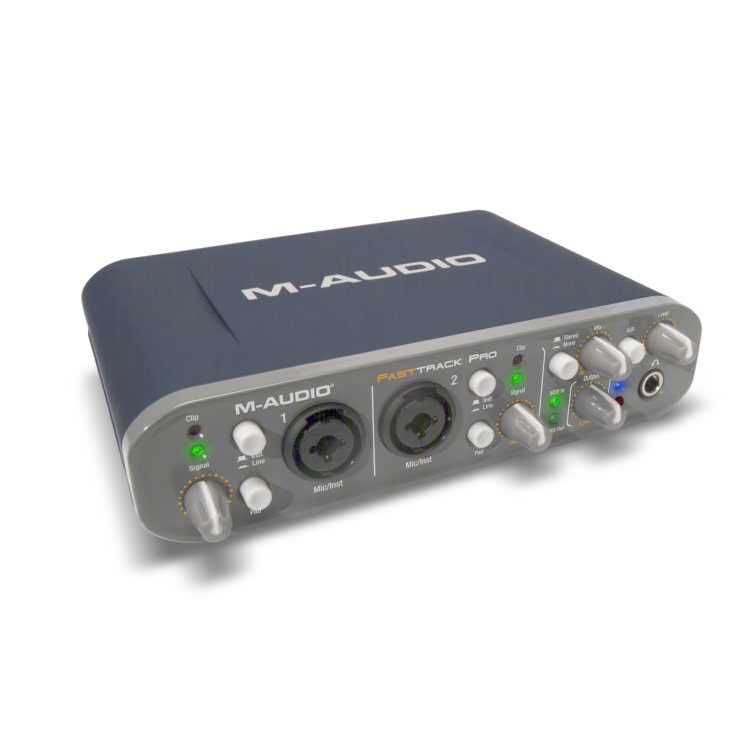 The M-Audio FastTrack Pro is an old but good USB audio interface. On macOS it works out of the box, but only in a reduced mode: Apple’s built-in USB audio driver limits it to 16-bit audio, plays back only at 44.1 kHz and ignores the S/PDIF input. On Linux, the full device is available. To keep the interface useful on a Mac, I instructed Claude to write a user-space macOS driver for the FastTrack Pro. Compared with Apple’s driver, it offers:
- 24-bit audio instead of 16-bit.
- 44.1, 48, 88.2 and 96 kHz sample rates, instead of only 44.1 kHz.
- 4 outputs, 2 of them at 88.2/96 kHz.
- Analog or S/PDIF input, selectable, at 44.1/48 kHz.
- Software volume and mute that work with the volume keys.
- MIDI input and output.
Installation requires macOS 15 and the Xcode Command Line Tools:
1
2
3
|
make # build
make install # install and start
make uninstall # remove, the device goes back to Apple's driver |
This effort fits a recent trend of custom drivers and firmware for audio gear. Now that coding is more accessible, vendors see more value in making their gear hackable instead of locking it down. Allowing custom firmware was, of course, always a good idea, but now a much larger group of enthusiasts can actually write it. For example, Akai is opening up the MPC Sample for custom firmware, and Behringer has published the source code of its upcoming KICK sampler and IGNITE sequencer on GitHub. I see this as a good side effect of LLMs: custom drivers extend the life of existing hardware, and because writing firmware is now within reach of many more people, vendors are pushed towards hackable gear.
Check out the FastTrack Pro driver on GitHub. Feedback, bug reports, and pull requests are very welcome.
UGent, Code, Projecten, and Mac OS X