
~ A new website for the IPEM sound archive, built on Pihka
» By Joren on Friday 13 November 2026The IPEM sound archive has a new website. The archive holds the tapes of IPEM, the electronic music production studio founded in Ghent in 1963 as a joint venture between the Belgian national broadcaster and Ghent University. Between 1963 and 1987 about 500 works were produced there, which made IPEM one of the most productive electronic music studios in Europe at the time. I have been maintaining the archive for around a decade and now found the time to give it some needed attention.
The tapes were first digitised around 2000 during a project led by Marc Leman, Jelle Dierickx and Gaëtan Martens. The 2001 paper in the Journal of New Music Research describes the history of the studio, the contents of the archive and the database design. Much of that design still holds up. A second digitization happened later at around 2014, by meemoo. The website bundles results form the first digitisation - CDs - and second digitisation - tapes - and now lists 1,060 tapes, 348 CDs, 3,335 works and 1,036 notebooks, with waveforms, automatic transcriptions, segment timelines and scans of the tape boxes.
With Olaf - a lightweight acoustic fingerprinting solution - the audio from CDs and tapes are linked. This allows to verify meta-data and segmentation of tapes, as described in Applications of duplicate detection: linking meta-data and merging music archives – The experience of the IPEM historical archive of electronic music.
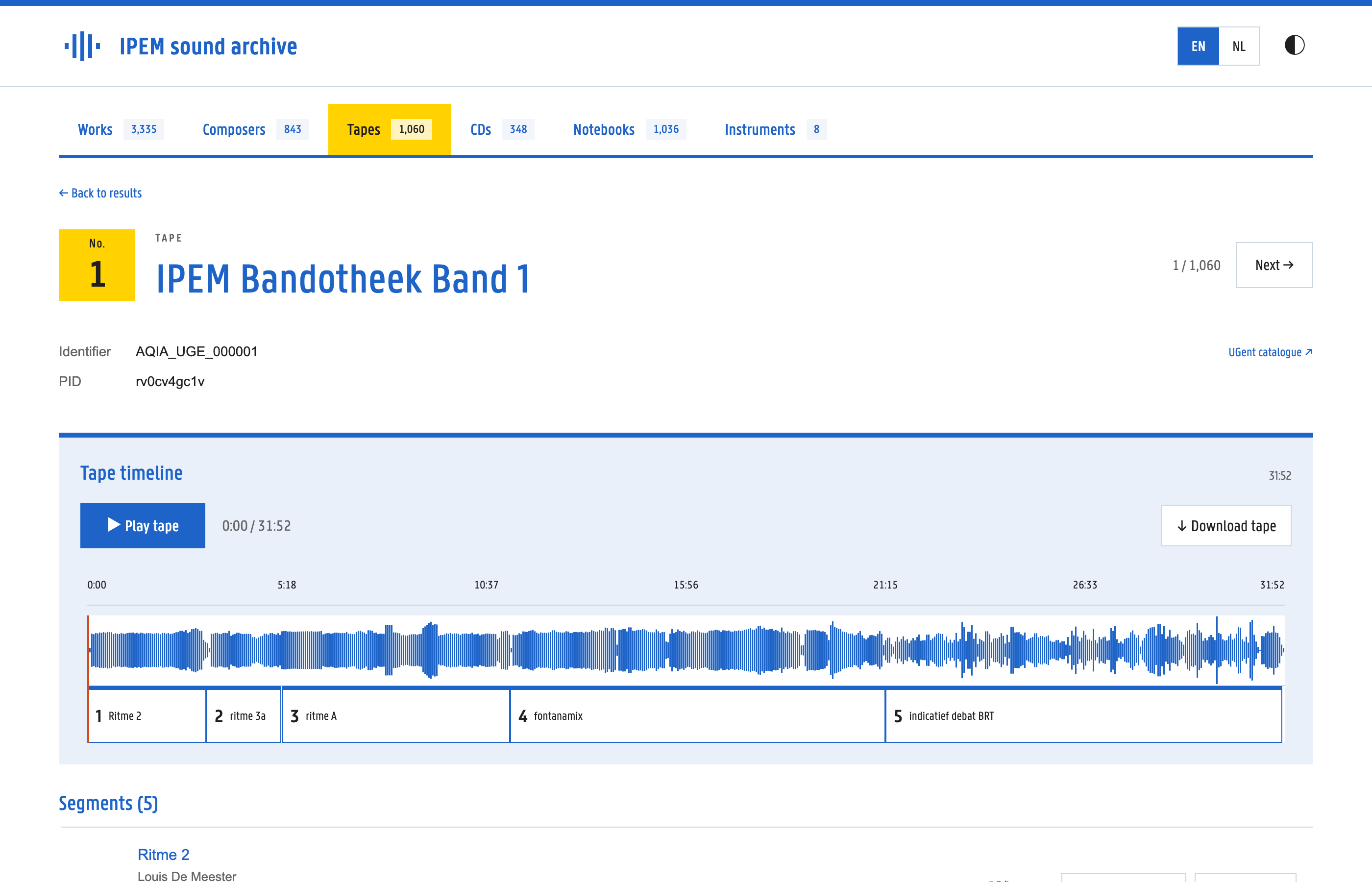
Fig: Tape 1 in the IPEM sound archive, with works by Louis De Meester, Lucien Goethals and much more.
The previous version of the website was a Ruby on Rails application. It worked, but a Rails application needs constant care: Ruby upgrades, gem updates, security patches, a running server and a database. That is a lot of maintenance for a website that rarely changes. It has also become a risk. As I wrote earlier, the age of AI exploits is here, and a server-side application with sub-par maintenance is exactly the kind of thing that gets exploited.
The new version runs on Pihka, a small data publication platform we are developing at GhentCDH. Pihka publishes an SQLite database as a searchable website, with faceted and full-text search, and has no back-end: the browser downloads the database and queries it locally. What remains is a folder of static files that any web server can host, with SQLite as an archival format. The design of the archive should stand the test of time, at least that is the idea.
Anyhow, go have a look at the IPEM sound archive. There are plenty of curious tapes from the Belgian electronic music avant-garde to discover.
 UGent, IPEM, Code, Music Information Retrieval, Computational musicology, and Projecten