Over the last few weeks I have been improving Olaf. Olaf is an audio fingerprinting system with its core algorithm written in C. I have been focusing on ergonomics that make the C core easy to use: bindings, sensible CLI interfaces, and a REST interface. The updates:
A clean WASM build and demo via Zig and a simple JavaScript wrapper, removing the Emscripten dependency.
A REST API to allow remote query and store functionality.
A REST load balancer to shard API requests over multiple REST back-ends.
A web UI to show and listen to matches in a database.
Minimal changes to the C core, with thread and memory safety as the goal.
Improvements to the CLI, with quality-of-life improvements like JSON output and streamlined argument handling across the various subcommands.
Python bindings are in decent shape again.
A more exhaustive test suite.
Some CI/CD improvements.
The updates were an ideal fit for the recent Astra and Opus 5.5 AI models: fingerprinting is a very testable workload, and the already established context makes tasks clear to LLMs. The tech stack also helps: Zig interfacing with a C core have often clear errors during compilation. The risk of things going wrong is also small, since the main functionality in the core is essentially untouched.
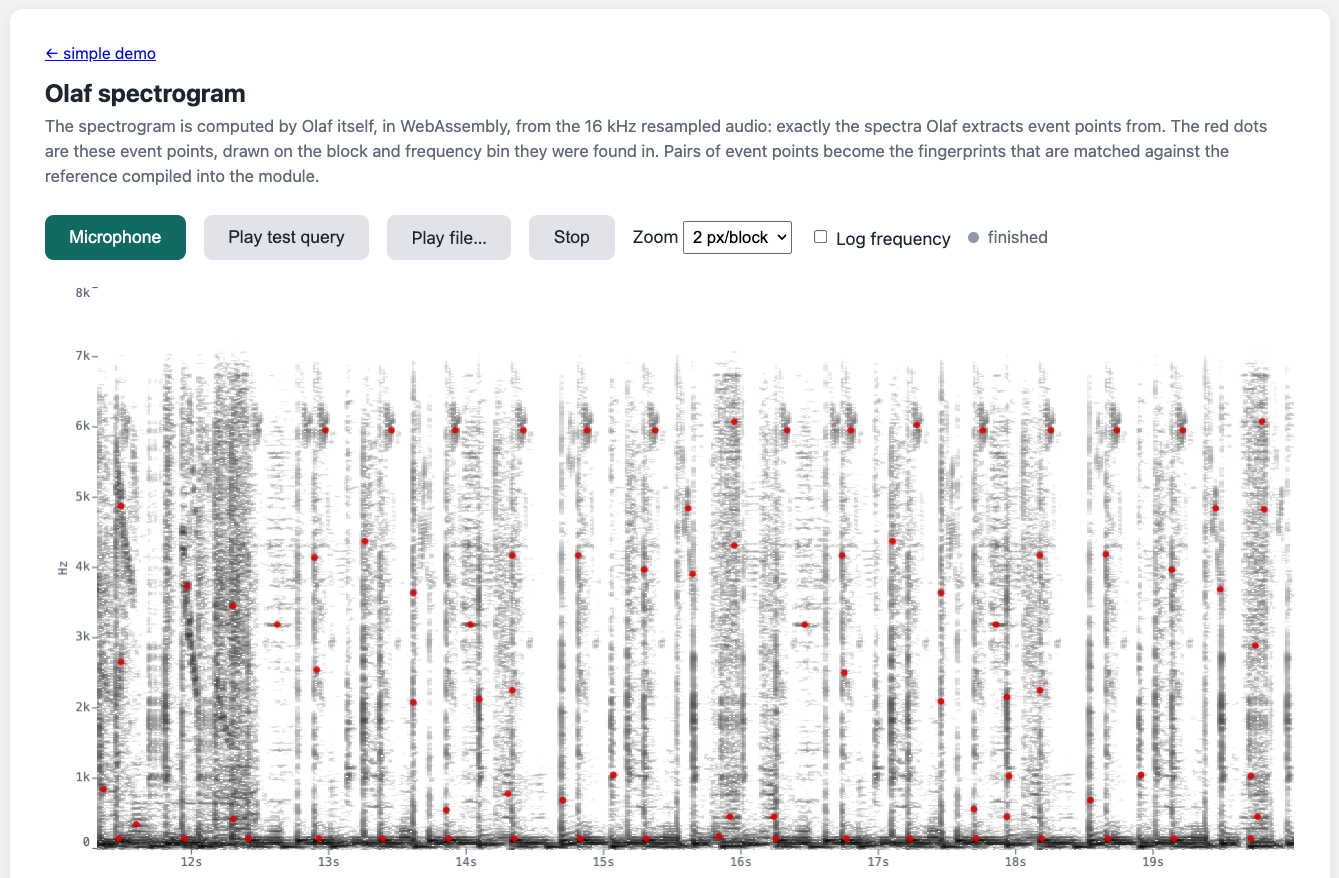
Fig: Web-based spectrogram demo via the WASM version of OLAF. Click the image above to try it out.
Check out the OLAF repository on GitHub to explore the code, try the new CLI, REST API, and Python bindings, or run the WASM demo here. Feedback, bug reports, and pull requests are very welcome.
The SEMANTiCS conference took place in Ghent from 15 to 17 September 2026. Our contribution was a collaboration between GhentCDH and the Semantic Computing Research Group at Aalto University on publishing humanities data with Sampo-UI and Ontop.
At GhentCDH, we often publish research datasets in the digital humanities. Several projects need similar search filters, map visualizations and data exports. Sampo-UI makes it possible to reuse these components when the data is available as Linked Data. In collaboration with the original Sampo-UI team, we worked on modernizing the framework. Our first contribution separates the shared core from project-specific configuration, making updates and reuse more manageable. The second uses Ontop to expose existing relational databases through a SPARQL endpoint. This lets us use Sampo-UI while keeping the database infrastructure and tooling we already have. Having one fewer database system to maintain is welcome.
Abstract: The Sampo model and its Sampo-UI framework have become an established approach for publishing Cultural Heritage and Digital Humanities data on the Semantic Web. Sampo-UI enables exploration of data originating from SPARQL endpoints through faceted search across multiple views with seamlessly integrated visualization and data analytic tools. Here, we present two contributions to the Sampo-UI ecosystem: (i) a separation of Sampo-UI core from application-specific configuration; decoupling core and application simplifies updates and facilitates reuse of efforts, and (ii) the use of Ontop — a virtual knowledge graph system — to expose relational databases through a SPARQL endpoint and Sampo-UI. The use of relational databases and reuse of tooling and expertise around relational databases lower the operational burden of publishing small-to-medium-sized datasets typical of digital humanities projects. These contributions originated outside the original Sampo-UI team but were developed in collaboration with it, and are being prepared for upstream integration. We illustrate the approach with two projects at Ghent University: one on Roman coin finds in Belgium (NuMAD) and one on historic Belgian company data (BelHisFirm). Both portals run the same Sampo-UI core with a different configuration, and operate on existing institutional relational database infrastructure without a dedicated graph database.
The demo below shows the NuMAD portal for exploring Roman coin finds in Belgium through the modernized Sampo-UI. Another demo presents historical records of Belgian companies through the BelHisFirm portal. Both portals run the same Sampo-UI core with different configurations, demonstrating the flexibility of the system.
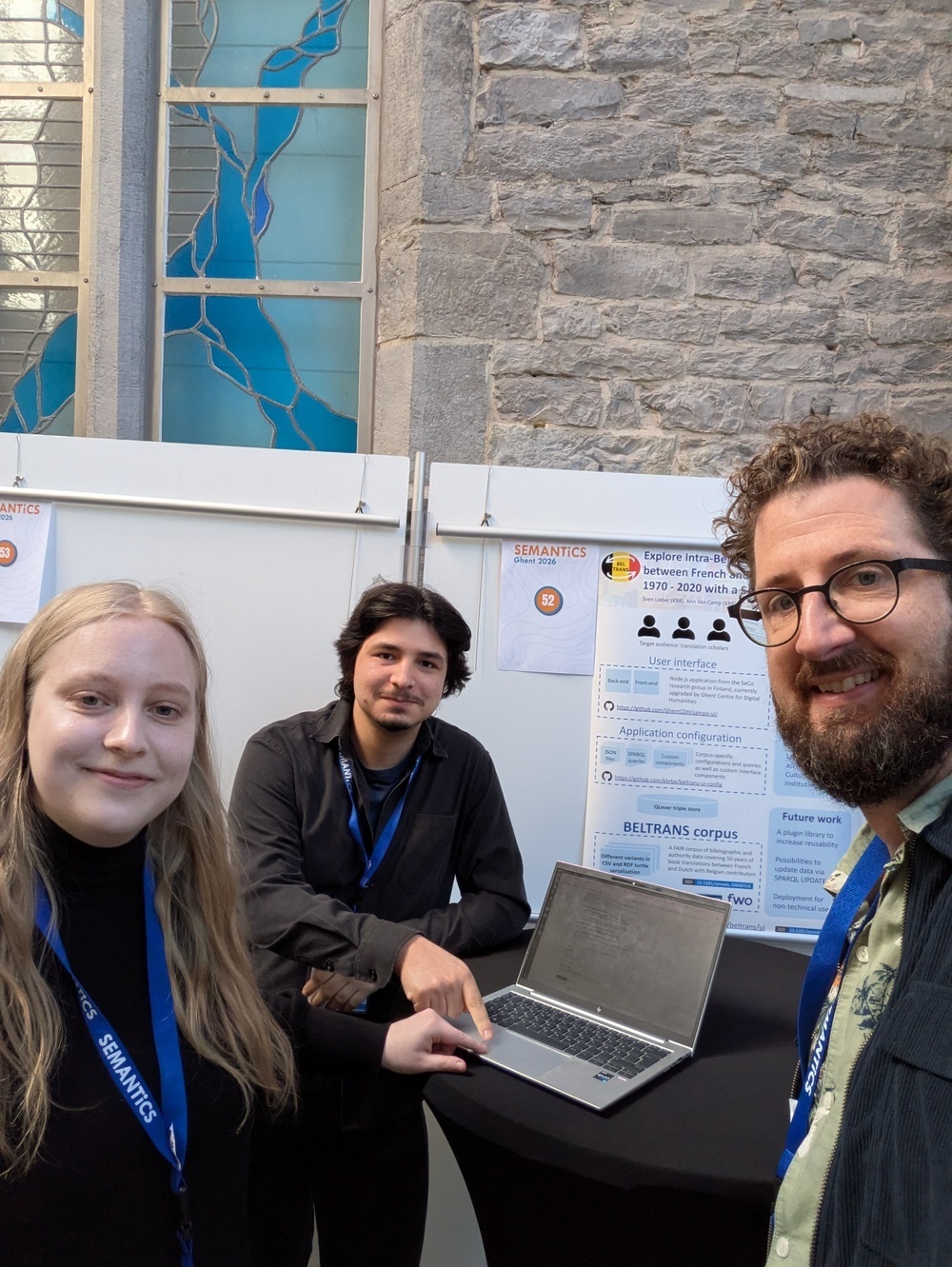
Another contribution presented at the SEMANTiCS conference in Ghent was a Sampo-UI portal for the BELTRANS project. I made a small contribution to the software and the paper, working with colleagues at KBR, the Royal Library of Belgium.
The BELTRANS project studied book translations between Dutch and French from 1970 to 2020, involving at least one Belgian author, scenarist, illustrator or editor. The resulting dataset brings together publication metadata from different libraries. Making these data available is one thing; making them easy to explore is another.
The BELTRANS portal uses Sampo-UI to let researchers filter publications, browse authors and publishers, explore maps and download selected data as CSV. It uses the modernized Sampo-UI core described in my Sampo-UI Meets Ontop post. Here, the data are served by QLever, a graph database with a SPARQL endpoint. The same interface components find another use, this time for translation history.
Abstract: In the field of Big Translation History, (historical) book translation flows are studied based on publication metadata. This research data is often kept internally or only provided as domain-specific MARC21 records, a standard library format. Within the recently completed BELTRANS project, we created a large integrated data corpus of worldwide translations between Dutch and French between 1970 and 2020, where at least one Belgian was involved as author, scenarist, illustrator or editor, to study intra-belgian book translation flows, and published the corpus as FAIR data. In this paper we present the SAMPO-UI-based platform that can be used by non-technical users to explore the underlying BELTRANS Linked Data corpus. The off-the-shelf software SAMPO-UI was configured to build a user interface allowing the exploration of our data related to book publications, authors, publishers and linked temporal and geospatial information. The different search perspectives, filters and visualizations enable researchers to explore the corpus or download self-chosen subsets, without having to process the large underlying data dumps. Both the application and corpus data are opened up in a sustainable way, i.e. besides deposits at research repositories, the application is hosted in the long term at the Royal Library of Belgium (KBR) and the integrated data is equipped with provenance information allowing to click-through to the related metadata records at different national libraries. Future work can extend the application itself with novel visualization techniques or different download formats if necessary. Also, this application can serve as a role model to inspire other researchers to distribute their corpora as Linked Data and via such a SAMPO-UI platform.
Sampo-UI 4 was officially released at the SEMANTiCS conference in Ghent. Together with Jahid Chetti, Heikki, Annastiina Ahola and Frederic Lamsens, we worked on bringing the GhentCDH fork back into the main Sampo-UI repository.
The release includes an updated software stack, a clearer separation between the shared core and project-specific configuration, and a new plug-in system. These changes make it easier to reuse components across projects and keep portals up to date.
The GhentCDH fork has now been merged upstream. Our work continues as part of the shared Sampo-UI project, in collaboration with the original SeCo team.
For more on the changes and their use in our projects, see Sampo-UI Meets Ontop.
```
FedOSC, the Belgian Federal Open Science Cloud, supports open science and research data management at Belgium’s federal scientific institutions. On 8 September 2026, it organised a day on data visualisation and Linked Open Data at KIK-IRPA in Brussels, with talks, demos and a approaches on cultural heritage datasets.
My contribution to the closing talks was an introduction to Sampo-UI, an open-source framework for building search and visualisation interfaces on top of Linked Open Data. I explained why we use it at the Ghent Centre for Digital Humanities: several projects need similar filters, maps and data exports, so it makes sense to reuse a common framework. The presentation covers how Sampo-UI works, our contributions to it, and a practical example with the NuMAD coin database.
 UGent and Code