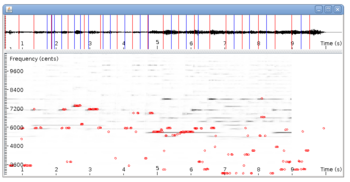
TarsosDSP: a Java Library for Audio Processing
TarsosDSP is a Java library for audio processing. Its aim is to provide an easy-to-use interface to practical music processing algorithms implemented, as simply as possible, in pure...

Below you can find links to the open source software I developed during my research. It is always nice to hear how this software is used, don’t hesitate to drop me a line. Bug reports are welcomed as well.
TarsosDSP is a Java library for audio processing. Its aim is to provide an easy-to-use interface to practical music processing algorithms implemented, as simply as possible, in pure...
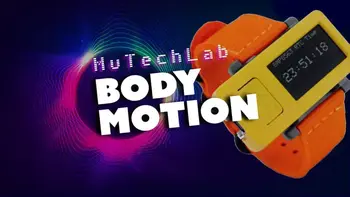
MI-Kit is a low-cost, open-source system for controlling music production software through body movement. Designed for creative music practice and embodied music interaction research. EMI-Kit can be used...
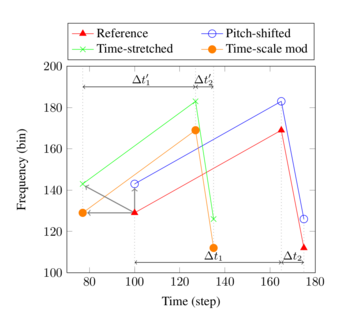
Panako is an extendable acoustic fingerprinting framework. The aim of acoustic fingerprinting is to find small audio fragments in large audio databases. Panako contains several acoustic fingerprinting algorithms...
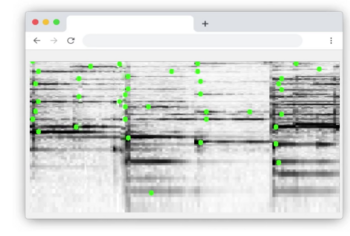
Olaf is a portable, landmark-based, acoustic fingerprinting system released as open source software. Olaf runs on embedded platforms, traditional computers and in the browser. Olaf is able to...
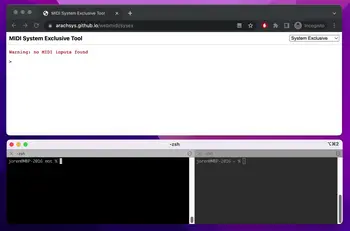
mot consists of several MIDI and OSC command line tools. These are mainly of interest to debug and check OSC messages and MIDI devices. The tools are written...
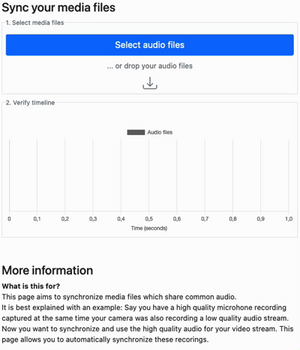
Thanks to WebAssembly it is possible to repurpose software for use on the web, even if it was originally designed with other use in mind. I have developed...
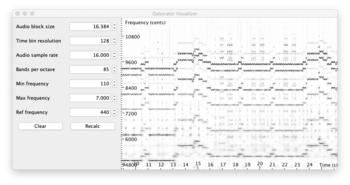
This library calculates fine-grained constant-Q spectral representations of audio signals quickly from Java. The spectral transform can be visualized or further processed in a (Music Information Retrieval) processing...
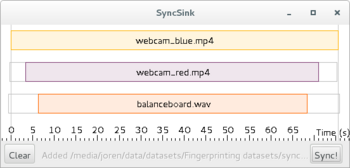
SyncSink is able to synchronize video and audio recordings of the same event. As long as some audio is shared between the multimedia files a reliable synchronization solution...
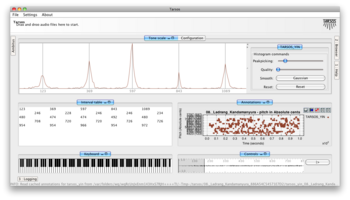
Tarsos is a software tool to analyze and experiment with pitch organization in all kinds of musics. Most of the analysis is done using pitch histograms and octave...

TarsosLSH is a Java library implementing Locality-sensitive Hashing (LSH), a practical nearest neighbor search algorithm for multidimensional vectors that operates in sublinear time. It supports several LSH families:...
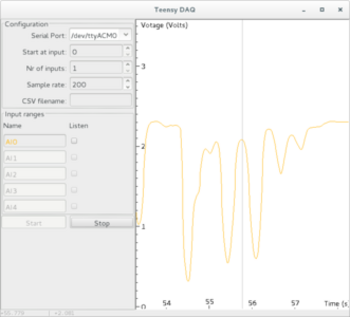
TeensyDAQ is a Java application to quickly visualize and record analog signals with a Teensy micro-controller and some custom software. It is mainly useful to quickly get an...
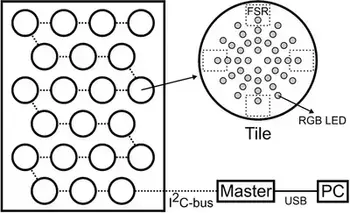
The idea behind AMPEL (by Lousin Moumdjian, Marc Leman, Peter Feys) is to combine both motor and cognitive rehabilitation in a single combined ‘embodied learning’ paradigm. To this...
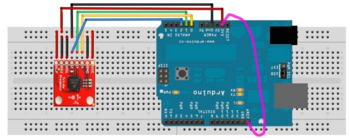
The Pidato experiment demonstrates a rather straightforward method to handle vibrato on a digital piano. It ‘solves’ the age-old problem on what to do with the enigmatic “vibrato”...
The IPEM sound archive has a new website. The archive holds the tapes of IPEM, the electronic music production studio founded in Ghent in 1963 as a joint venture between the Belgian national broadcaster and Ghent University. Between 1963 and 1987 about 500 works were produced there, which made IPEM one of the most productive electronic music studios in Europe at the time. I have been maintaining the archive for around a decade and now found the time to give it some needed attention.
The tapes were first digitised around 2000 during a project led by Marc Leman, Jelle Dierickx and Gaëtan Martens. The 2001 paper in the Journal of New Music Research describes the history of the studio, the contents of the archive and the database design. Much of that design still holds up. A second digitization happened later at around 2014, by meemoo. The website bundles results form the first digitisation - CDs - and second digitisation - tapes - and now lists 1,060 tapes, 348 CDs, 3,335 works and 1,036 notebooks, with waveforms, automatic transcriptions, segment timelines and scans of the tape boxes.
With Olaf - a lightweight acoustic fingerprinting solution - the audio from CDs and tapes are linked. This allows to verify meta-data and segmentation of tapes, as described in Applications of duplicate detection: linking meta-data and merging music archives – The experience of the IPEM historical archive of electronic music.
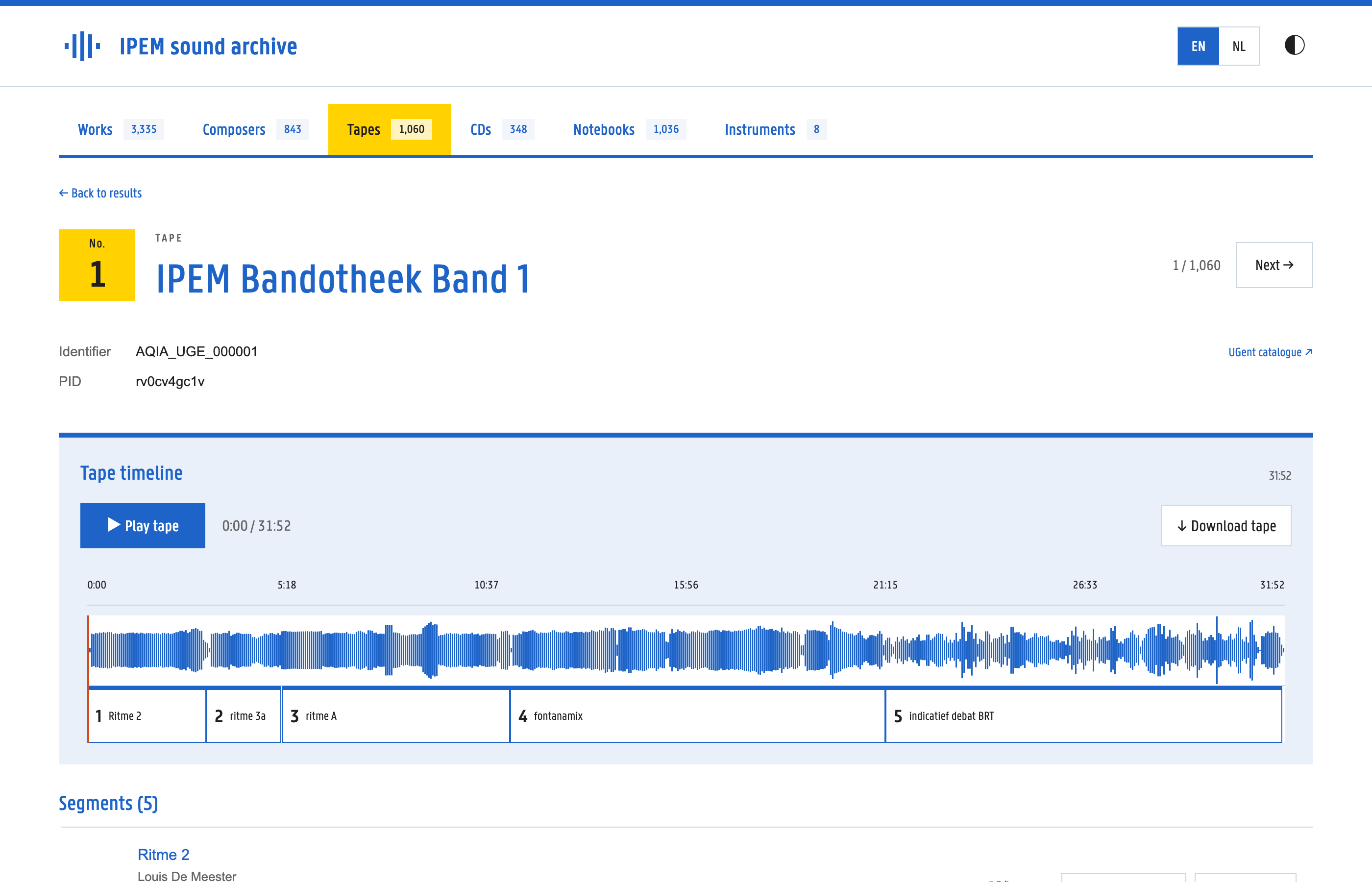
The previous version of the website was a Ruby on Rails application. It worked, but a Rails application needs constant care: Ruby upgrades, gem updates, security patches, a running server and a database. That is a lot of maintenance for a website that rarely changes. It has also become a risk. As I wrote earlier, the age of AI exploits is here, and a server-side application with sub-par maintenance is exactly the kind of thing that gets exploited.
The new version runs on Pihka, a small data publication platform we are developing at GhentCDH. Pihka publishes an SQLite database as a searchable website, with faceted and full-text search, and has no back-end: the browser downloads the database and queries it locally. What remains is a folder of static files that any web server can host, with SQLite as an archival format. The design of the archive should stand the test of time, at least that is the idea.
Anyhow, go have a look at the IPEM sound archive. There are plenty of curious tapes from the Belgian electronic music avant-garde to discover.
 UGent, IPEM, Code, Music Information Retrieval, Computational musicology, and Projecten
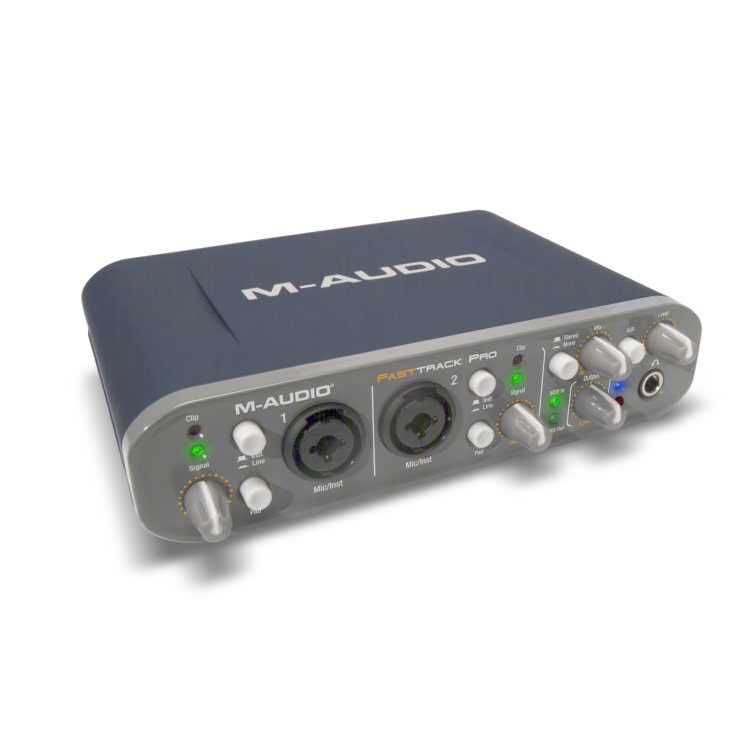 The M-Audio FastTrack Pro is an old but good USB audio interface. On macOS it works out of the box, but only in a reduced mode: Apple’s built-in USB audio driver limits it to 16-bit audio, plays back only at 44.1 kHz and ignores the S/PDIF input. On Linux, the full device is available. To keep the interface useful on a Mac, I instructed Claude to write a user-space macOS driver for the FastTrack Pro. Compared with Apple’s driver, it offers:
Installation requires macOS 15 and the Xcode Command Line Tools:
  1
2
3

  make            # build
make install    # install and start
make uninstall  # remove, the device goes back to Apple's driver
This effort fits a recent trend of custom drivers and firmware for audio gear. Now that coding is more accessible, vendors see more value in making their gear hackable instead of locking it down. Allowing custom firmware was, of course, always a good idea, but now a much larger group of enthusiasts can actually write it. For example, Akai is opening up the MPC Sample for custom firmware, and Behringer has published the source code of its upcoming KICK sampler and IGNITE sequencer on GitHub. I see this as a good side effect of LLMs: custom drivers extend the life of existing hardware, and because writing firmware is now within reach of many more people, vendors are pushed towards hackable gear.
Check out the FastTrack Pro driver on GitHub. Feedback, bug reports, and pull requests are very welcome.
UGent, Code, Projecten, and Mac OS X
Every Halloween I build an interactive installation for trick-or-treaters, like last year’s speaking pumpkin. The lesson from last year: keep thing simple. So this year I tried and failed again. But, I learned a few thing and built some reusable software.
Now that LLMs are more capable, it also changed what you can do in a couple of evenings. Before, I did web-based environments since it allowed quickly prototyping by hand, now native applications are feasible which brings a couple of advantages: lower latency, network integration, driving multiple audio devices,… Additionally, there are now AI-systems which are very good at 3D modeling and rigging 3D models: before I was limited to assets I could find.
Scareflow is a node-based show controller. You wire events (key presses, OSC messages) through delay, random and cooldown blocks to sounds, WLED lights, Tasmota smart plugs or OSC output. Sounds start within milliseconds, so thunder, lightning and visuals can be synchronized.
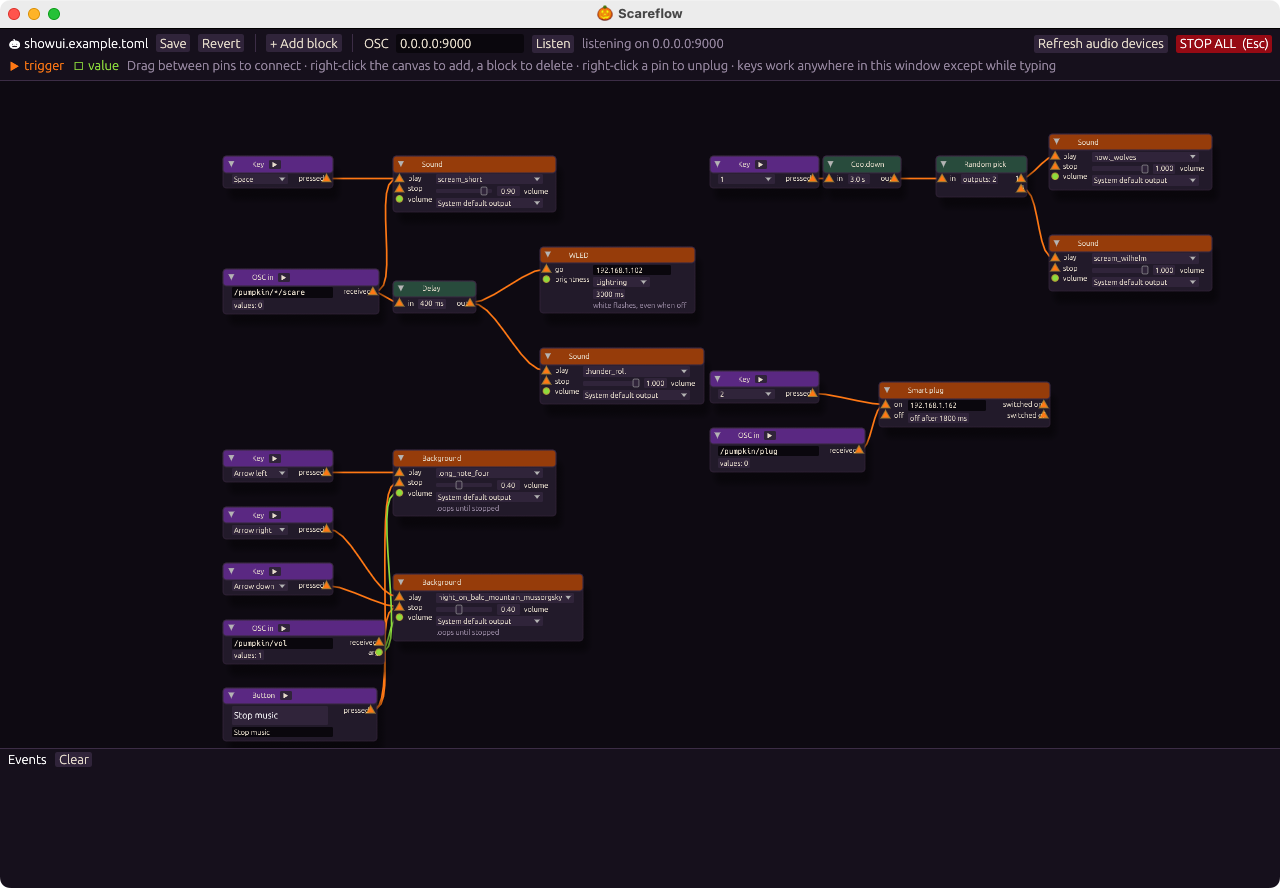
The glue is Open Sound Control (OSC): small UDP messages with an address like /pierke/scare. It works as low-latency inter-process communication on one machine or across the network. Any environment that speaks OSC can be integrated. If you want to build your own event-based show, Scareflow is a good place to start: the editor needs no code, shows are plain TOML-files. Prompt your LLM for extensions and integrations with other event types.
Check out Scareflow on GitHub to build your own show and extend it with your own events.
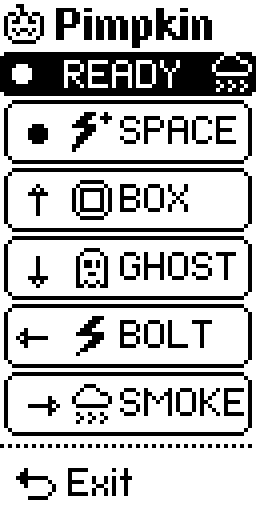
This Halloween I rediscovered my Flipper Zero as a programming platform: it has Bluetooth and a Sub-GHz software defined radio built in. Pimpkin Remote is a small Flipper app with two roles.
It acts as a Bluetooth keyboard whose key presses trigger events in Scareflow, and serves as a remote for a smoke machine. The smoke machine responds to 315MHz messages sent from the Flipper Zero directly. Again thanks to LLMs programming the Flipper Zero became much more accessible.
Hallowierke is a skeleton marionette in the costume of Pierke, the Ghent puppet, projected on a window. It dances, looks around and waves until an OSC message from Scareflow arrives. Then, it is electrocuted by a bolt of lightning. Mwoehahaha.
The player is written in Rust with Bevy. The rigged puppet, 17 bones and nine animations, is generated by a Python script for Blender. Astra by ChatGPT is great at this: it produced a rigged, dressed and animated model, something I would never have attempted by hand. As with Dewey, I now have a moving puppet but learned little about rigging. For a Halloween porch, that is a trade I am willing to make.
For next year, I will keep it simple.
UGent, Code, and Projecten
Recently, researchers released the complete connectome of a male fruit fly: a map of the neural connections in its brain and nerve cord. The accompanying paper describes this work. I have connected a simplified version of part of that connectome to a 3D model of a fly and now have a fly zooming around on my mac. It flies around the desktop, lands on windows, and is scared of the mouse cursor.
I have called it Dewey. That way it should at least like part of its own name: Drosophila means “dew-loving”.
I am not sure what Dewey feels or thinks about being stuck in the matrix. To make it less lonely, I have built in an option to at least add a few friends. There are deeper philosophical questions to raise about simulating neural circuits. Is it purely reflexive? At what point might there be something more? These questions become especially worrying if we start doing this with a social species such as a bee, or eventually animals with more complex nervous systems. Imagining the Umwelt of an animal, is difficult enough in the real world. What an Umwelt would look like in a virtual world breaks my brain.
Seeing Dewey fly around is nice. The process of creating Dewey, much less so. I prompted a recent LLM to connect the brains to a body and essentially guided the process until Dewey appeared. A mere year ago, getting such a result would have taken me days, if not weeks. I would also have had to learn a lot more about neural activation patterns and the intricacies of rendering and animating a 3D fly. Now, I am much less motivated to do that deep dive, since the result is already there. The fly flies. The cursor scares it. I can add friends. There is still plenty to learn, but the immediate reason to learn it has disappeared. If a reward without much effort is within reach, it takes a discipline to go the extra mile, discipline I seem to lack. I have gained a desktop fly and missed out on part of the process of making one.
Anyway, check out the paper, run Dewey on your Mac, or have a look at the code on GitHub.
UGent, Code, and Projecten
Over the last few weeks I have been improving Olaf. Olaf is an audio fingerprinting system with its core algorithm written in C. I have been focusing on ergonomics that make the C core easy to use: bindings, sensible CLI interfaces, and a REST interface. The updates:
The updates were an ideal fit for the recent Astra and Opus 5.5 AI models: fingerprinting is a very testable workload, and the already established context makes tasks clear to LLMs. The tech stack also helps: Zig interfacing with a C core have often clear errors during compilation. The risk of things going wrong is also small, since the main functionality in the core is essentially untouched.
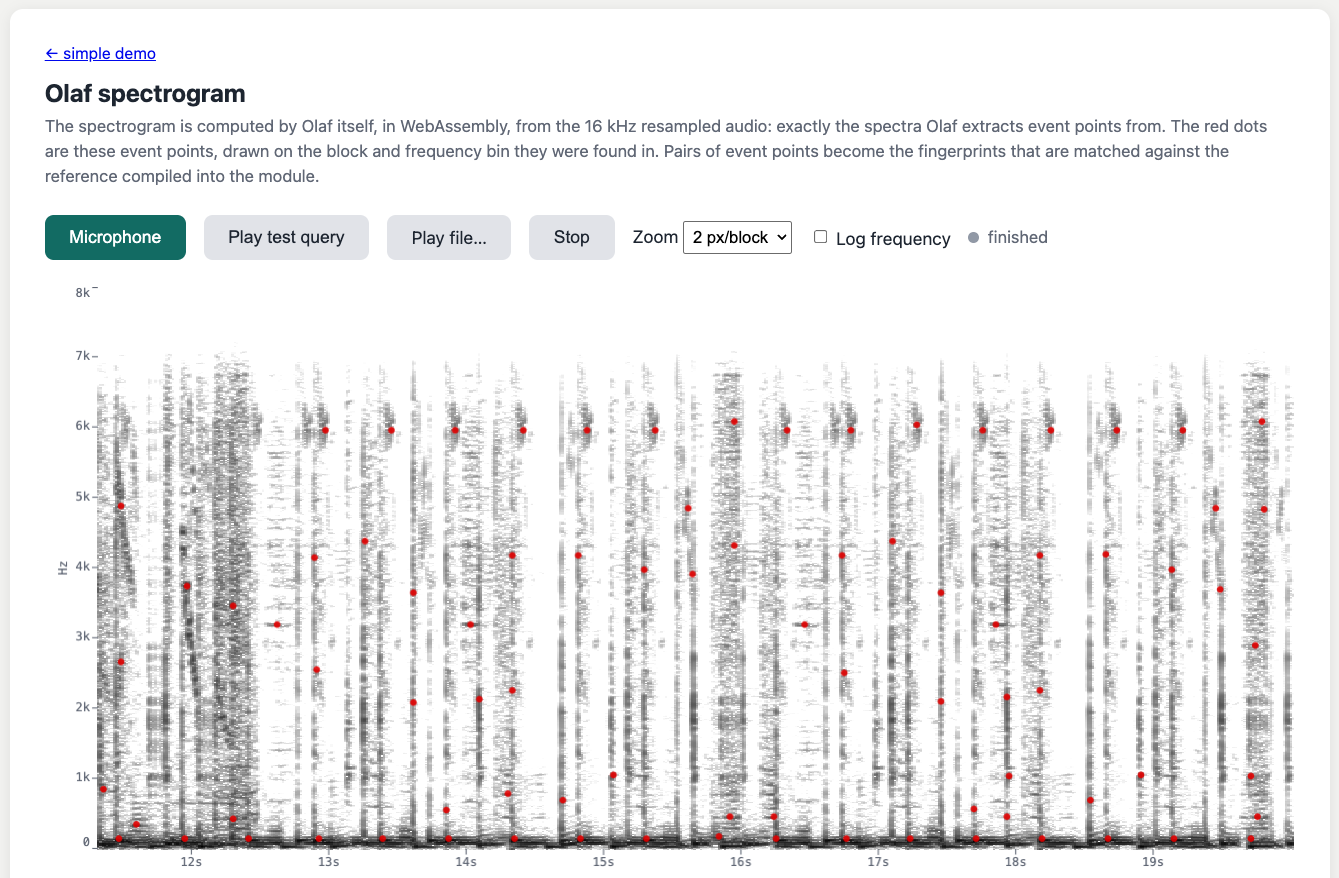
Check out the OLAF repository on GitHub to explore the code, try the new CLI, REST API, and Python bindings, or run the WASM demo here. Feedback, bug reports, and pull requests are very welcome.
UGent and Code
The SEMANTiCS conference took place in Ghent from 15 to 17 September 2026. Our contribution was a collaboration between GhentCDH and the Semantic Computing Research Group at Aalto University on publishing humanities data with Sampo-UI and Ontop.
Sampo-UI Meets Ontop: Publishing Relational Digital Humanities Data on the Semantic Web, Joren Six¹, Jahid Chetti¹, Annastiina Ahola², Frederic Lamsens¹, Heikki Rantala², Eero Hyvönen²
¹ Ghent University, Ghent Centre for Digital Humanities (GhentCDH)
² Aalto University, Department of Computer Science, Semantic Computing Research Group (SeCo)
At GhentCDH, we often publish research datasets in the digital humanities. Several projects need similar search filters, map visualizations and data exports. Sampo-UI makes it possible to reuse these components when the data is available as Linked Data. In collaboration with the original Sampo-UI team, we worked on modernizing the framework. Our first contribution separates the shared core from project-specific configuration, making updates and reuse more manageable. The second uses Ontop to expose existing relational databases through a SPARQL endpoint. This lets us use Sampo-UI while keeping the database infrastructure and tooling we already have. Having one fewer database system to maintain is welcome.
Abstract: The Sampo model and its Sampo-UI framework have become an established approach for publishing Cultural Heritage and Digital Humanities data on the Semantic Web. Sampo-UI enables exploration of data originating from SPARQL endpoints through faceted search across multiple views with seamlessly integrated visualization and data analytic tools. Here, we present two contributions to the Sampo-UI ecosystem: (i) a separation of Sampo-UI core from application-specific configuration; decoupling core and application simplifies updates and facilitates reuse of efforts, and (ii) the use of Ontop — a virtual knowledge graph system — to expose relational databases through a SPARQL endpoint and Sampo-UI. The use of relational databases and reuse of tooling and expertise around relational databases lower the operational burden of publishing small-to-medium-sized datasets typical of digital humanities projects. These contributions originated outside the original Sampo-UI team but were developed in collaboration with it, and are being prepared for upstream integration. We illustrate the approach with two projects at Ghent University: one on Roman coin finds in Belgium (NuMAD) and one on historic Belgian company data (BelHisFirm). Both portals run the same Sampo-UI core with a different configuration, and operate on existing institutional relational database infrastructure without a dedicated graph database.
The demo below shows the NuMAD portal for exploring Roman coin finds in Belgium through the modernized Sampo-UI. Another demo presents historical records of Belgian companies through the BelHisFirm portal. Both portals run the same Sampo-UI core with different configurations, demonstrating the flexibility of the system.
Alongside the Sampo-UI Meets Ontop paper, a conference poster on Sampo-UI that I prepared is also available.
Video: NuMAD — exploring Roman coin finds in Belgium.
UGent, Code, Presentation, and GhentCDH
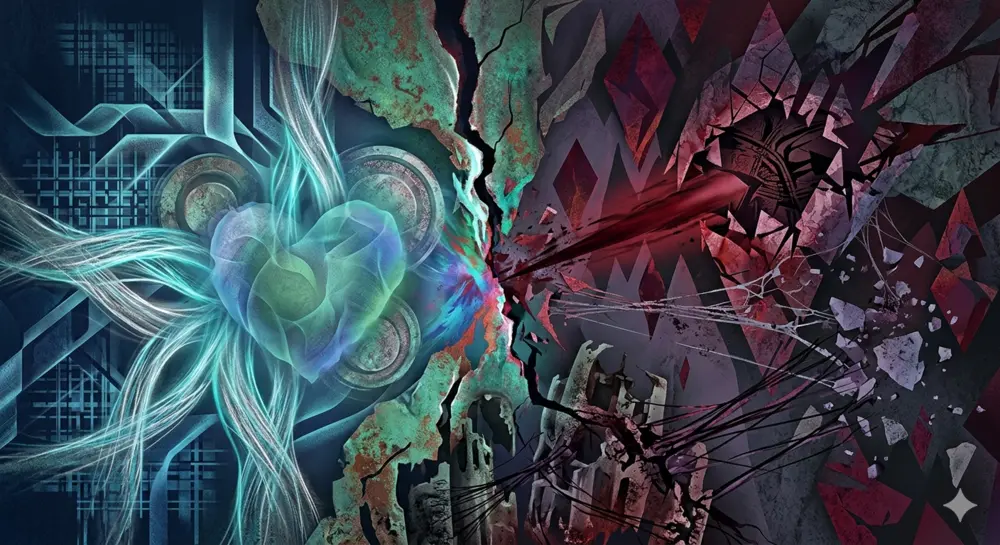 Fig: Gemini imagining the age of AI exploits.
The following text puts into words a change that I have seen happening the last month. At the Ghent Centre for Digital Humanities we manage a fleet of virtual servers on the Ghent University network and have first-hand experience with security incidents appearing regularly now. It has a different tone than other posts here: it was sent in as a letter for a newspaper but was not published. Let’s see in a few years if the tone was too alarmist or if it holds up:
The newest generation of AI coding tools is a great asset for software developers. They help with understanding complex codebases, and assist in writing code. Used properly, AI coding tools increase software quality and developer productivity. Unfortunately, these powerful tools can also be used with bad intentions. AI coding tools are now sufficiently advanced to find and exploit bugs in software. They pose a threat to essentially all computing systems that form the underpinning of modern infrastructure: banking, aviation, industry, and education.
While earlier reports still used conditional terms to describe these threats, now — only a couple of weeks later — the first effects are already here. With the help of AI coding tools, three bugs were found in Linux, an open-source operating system: Copy.fail, Dirty Frag, and Fragnesia. These first AI-discovered exploits in a broadly deployed system form a watershed moment. The bugs led to service outages, but diligent IT teams quickly patched systems, limiting the impact. The effects of Mythos — widely considered the most capable system for finding bugs in software — are now also clear. Mozilla reported finding and fixing around four hundred bugs last month, where in a typical month around twenty similar bugs are discovered and patched. Not every bug is exploitable, but every exploit starts with a bug. The age of AI exploits is here.
The transition to this new age will be painful. Many unmaintained systems are connected to the internet and will not receive security updates: IoT devices, orphaned servers, smartphones and proprietary systems locked in time. It will become easier to gain illegitimate access to these machines. The skills needed to break into such systems are diminishing. What previously required highly specialized experts or state actors is now within reach of a much broader pool of bad actors, due to the very tools that are meant to help developers.
What can be done? Companies need more stringent cybersecurity policies today. The broader public needs awareness of this evolution and basic cybersecurity hygiene to keep devices up to date. And we need a regulatory framework that holds producers of computing systems responsible for updates over a longer lifespan. Unfortunately, we can not afford to collectively ignore this emerging reality.
UGent and Code
Since a couple of months FFmpeg supports audio transcription via OpenAI Whisper and Wisper-cpp. This allows to automatically transcribe interviews and podcasts or generate subtitles for videos. Most packaged versions of the command line tool ffmpeg do not ship with this option enabled. Here we show how to do this on macOS with the Homebrew package manager. On other platforms similar configuration will apply.
On macOS there is a prepared Homebrew keg which allows to enable or disable the many ffmpeg options. If you already have ffmpeg without options installed you may need to uninstall the current version and install a version with chosen options. See below on how to do this:
  1
2
3
4
5
6
7
8
9
10
11
12
13
14
15
16
17
18
19
20
21
22
23
24
25
26
27
28
29
30
31
32
33

  # check if you already have ffmpeg with whisper enabled
ffmpeg --help filter=whisper

# uninstall current ffmpeg, it will be replaced with a version with whisper
brew uninstall ffmpeg

# add a brew tap which provides options to install ffmpeg from source
brew tap homebrew-ffmpeg/ffmpeg

# this commands adds most common functionality and other default functions
brew install homebrew-ffmpeg/ffmpeg/ffmpeg \
--with-fdk-aac \
--with-jpeg-xl \
--with-libgsm \
--with-libplacebo \
--with-librist \
--with-librsvg \
--with-libsoxr \
--with-libssh \
--with-libvidstab \
--with-libxml2 \
--with-openal-soft \
--with-openapv \
--with-openh264 \
--with-openjpeg \
--with-openssl \
--with-rav1e \
--with-rtmpdump \
--with-rubberband \
--with-speex \
--with-srt \
--with-webp \
--with-whisper-cpp
Installation will take a while since many dependencies are required for the many options. Once the build is finished the whisper filter should be available in FFmpeg. See below on how this should look, once correctly installed:
  1
2
3
4
5
6
7
8
9
10
11
12
13
14
15
16
17
18
19
20
21

  ffmpeg version 8.0 Copyright (c) 2000-2025 the FFmpeg developers
  built with Apple clang version
        ...
Filter whisper
  Transcribe audio using whisper.cpp.
    Inputs:
       #0: default (audio)
    Outputs:
       #0: default (audio)
whisper AVOptions:
   model             <string>     ..F.A...... Path to the whisper.cpp model file
   language          <string>     ..F.A...... Language for transcription ('auto' for auto-detect) (default "auto")
   queue             <duration>   ..F.A...... Audio queue size (default 3)
   use_gpu           <boolean>    ..F.A...... Use GPU for processing (default true)
   gpu_device        <int>        ..F.A...... GPU device to use (from 0 to INT_MAX) (default 0)
   destination       <string>     ..F.A...... Output destination (default "")
   format            <string>     ..F.A...... Output format (text|srt|json) (default "text")
   vad_model         <string>     ..F.A...... Path to the VAD model file
   vad_threshold     <float>      ..F.A...... VAD threshold (from 0 to 1) (default 0.5)
   vad_min_speech_duration <duration>   ..F.A...... Minimum speech duration for VAD (default 0.1)
   vad_min_silence_duration <duration>   ..F.A...... Minimum silence duration for VAD (default 0.5)
I’ve just pushed some updates to mot — a command-line application for working with OSC and MIDI messages. My LLM tells me that these are exciting updates but I am not entirely sure that this is the case. Let me know if this ticks your box and seek professional help.
I have implemented a MIDI processor that lets you transform, filter, and generate MIDI messages using Lua scripts.
Why is this useful? MIDI processors act as middlemen between your input devices and output destinations.You can do the following on incoming MIDI messages:
The processor reads incoming MIDI from a physical device, processes it through your Lua script, and outputs the modified messages to a virtual MIDI port that your DAW or synth can receive. Some examples:
  1
2
3
4
5

  # Generate chords from single notes
mot midi_processor --script scripts/chord_generator.lua 0 6666

# Transpose notes up by one octave
mot midi_processor --script scripts/example_processor.lua 0 6666
OSC receivers now advertise themselves on the network using mDNS/Bonjour with the _osc._udp service type.
This makes mot compatible with the EMI-kit — the Embodied Music Interface Kit developed at IPEM, Ghent University. OSC-enabled devices can automatically discover mot receivers on your network, eliminating manual configuration if the OSC sources add this functionality.
Installation via Rust’s cargo:
  1
2
3
4

  git clone https://github.com/JorenSix/mot.git
cd mot
cargo install --path .
mot midi_processor -h
Check out the mot repository for full documentation and example Lua scripts!
UGent, Code, and Music Information Retrieval
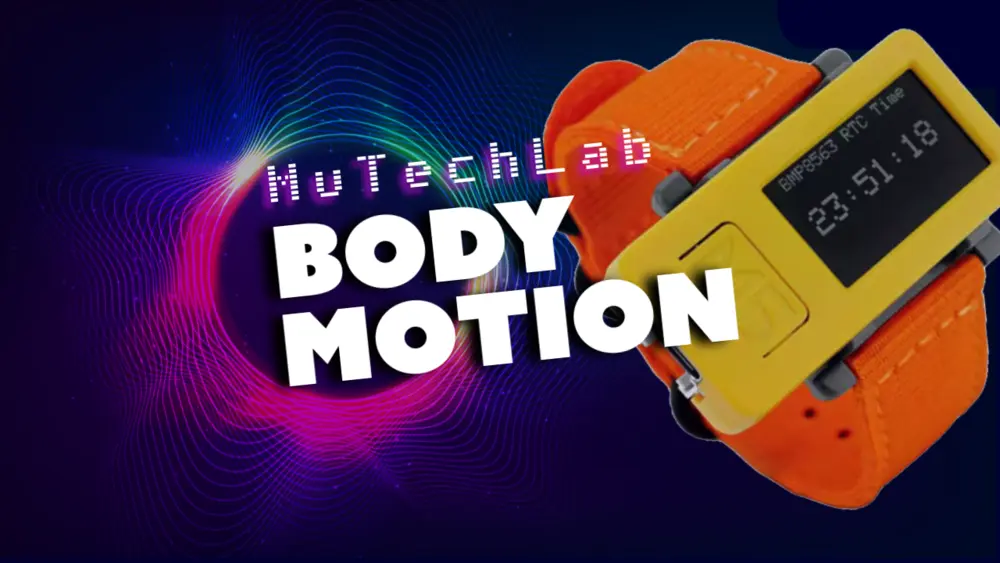 Last Friday, I had the pleasure of facilitating a hands-on workshop in Luxembourg as part of MuTechLab workshop series, organized by Luc Nijs at the University of Luxembourg. Together with Bart Moens from XRHIL and IPEM, we presented a system to control musical parameters with body movement.
MuTechLab is a series of workshops for music teachers who wish to dive into the world of music technology. Funded by the Luxembourgish National Research Fund (FNR, PSP-Classic), the initiative brings together educators eager to explore how technology can enhance music education and creative practice.
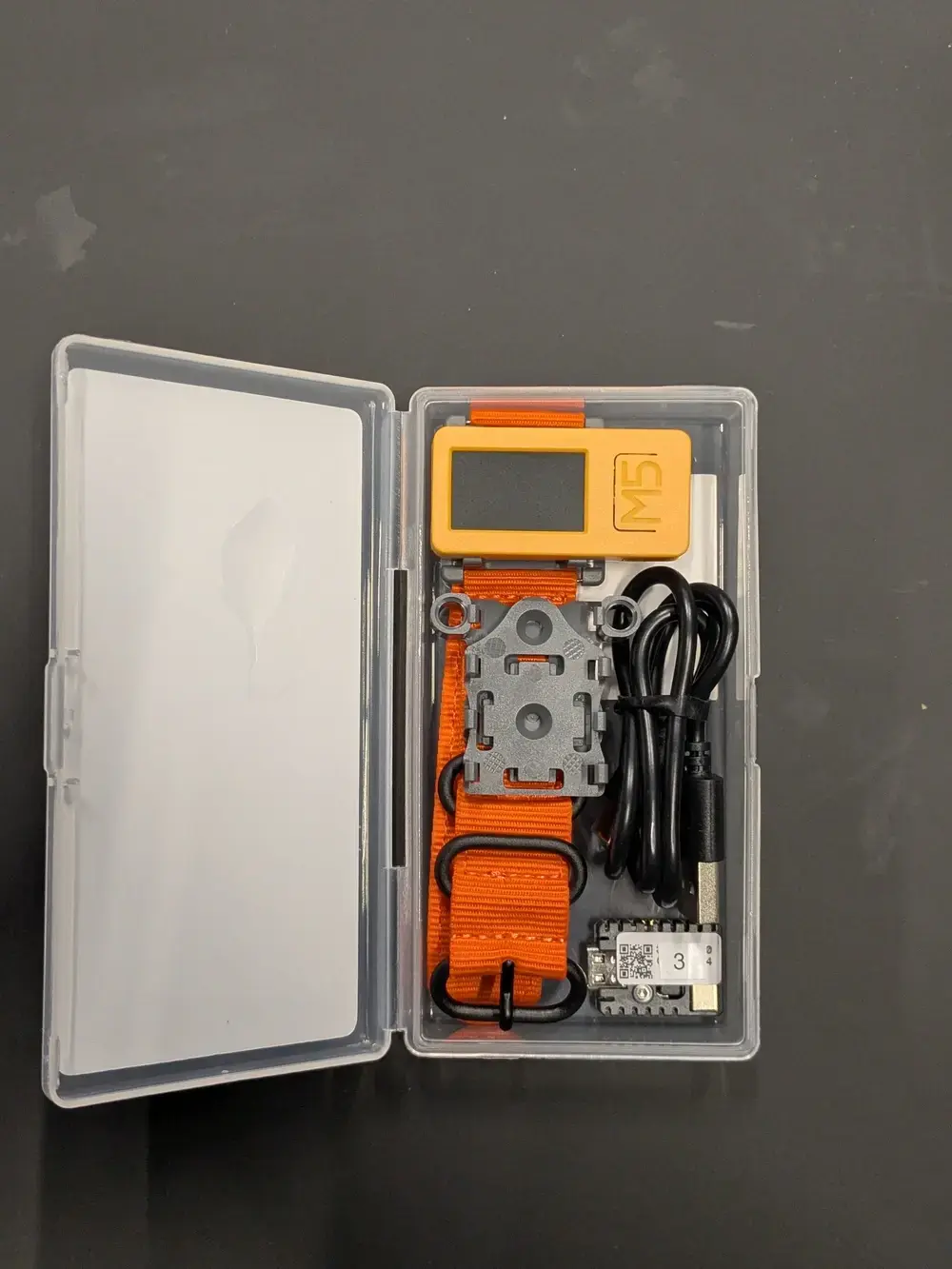
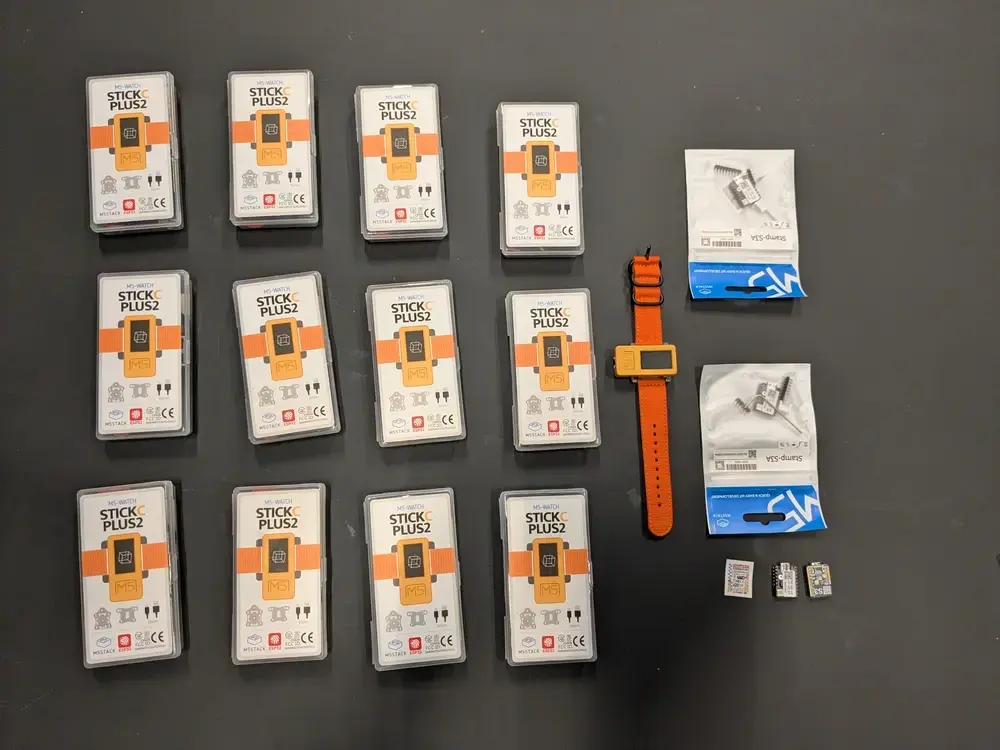
During the workshop, participants got hands-on experience with the EMI-Kit (Embodied Music Interface Kit) – an open-source, low-cost system that allows musicians to control Digital Audio Workstation (DAW) parameters through body movement.
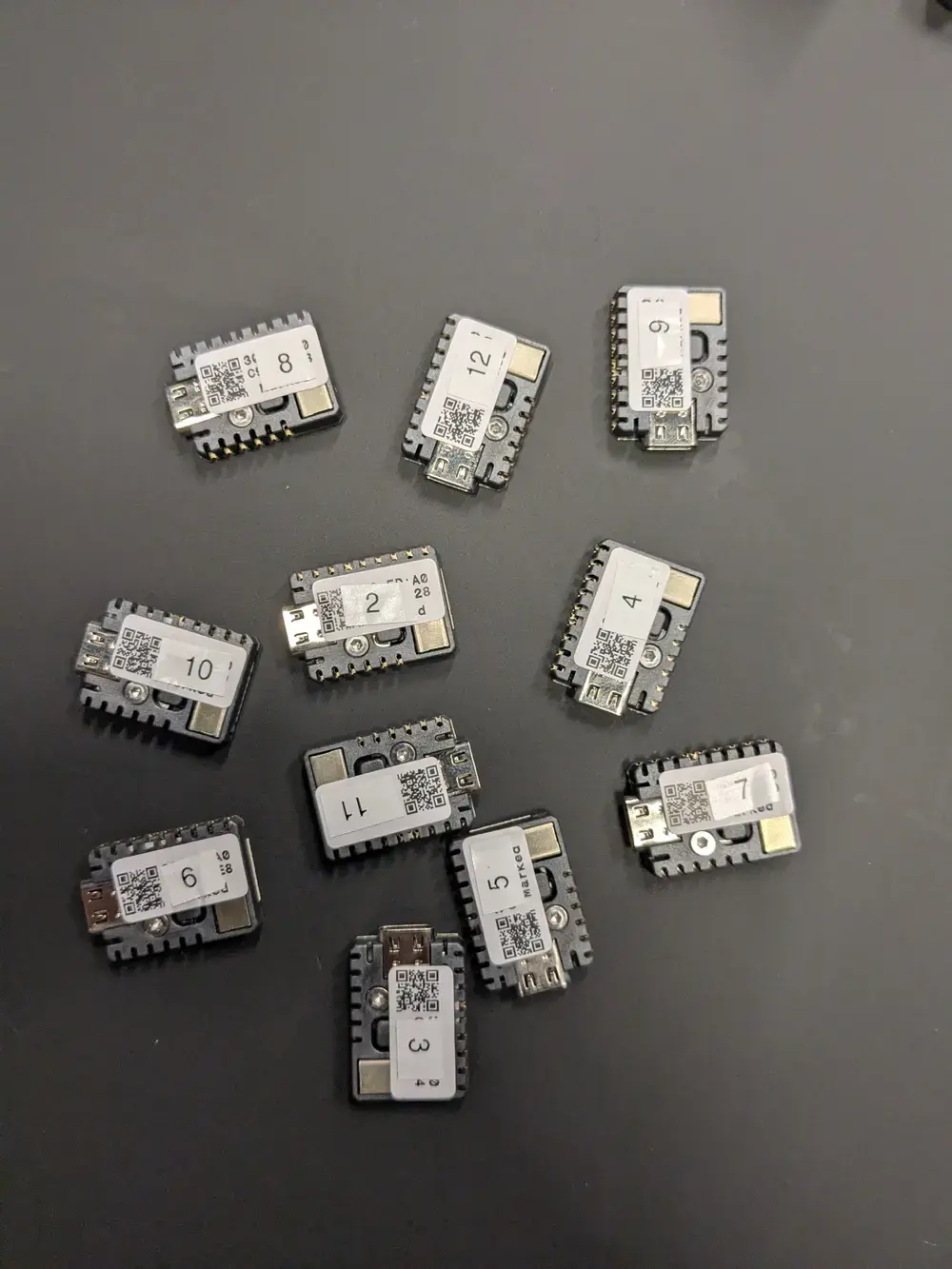
The EMI-Kit consists of: - A wearable sensor device (M5StickC Plus2) that captures body orientation and gestures - A receiver unit (M5Stack STAMP S3A) that converts sensor data to MIDI messages
Unlike expensive commercial alternatives, EMI-Kit is fully open source, customizable, and designed specifically for creative music practice and embodied music interaction practice and research.
Teachers experimented with mapping natural body movements – pitch, yaw, roll, and tap gestures – to various musical parameters in their DAWs. The low-latency wireless system made it possible to move and control sound, opening up new possibilities for expressive musical performance and pedagogy.
Interested in exploring embodied music interaction yourself? Check out:
The EMI-Kit project as-is is a demonstrator to inspire educators to embrace these tools and imagine new ways of teaching and creating music. The EMI-Kit as a platform can - with some additional programming - be a good basis to control musical parameters using various sensors. Have fun with checking out the EMI-Kit.
 UGent, Code, and Projecten